





NIGERIA’S quest for sustainable development will remain elusive unless scientific research is deliberately integrated into public policy and national planning, a Professor of Orthopaedic and Trauma Surgery, Timothy Nottidge, has said.
Nottidge made the call while delivering a keynote lecture titled “The Man, His Methods and His Mandate” in honour of renowned orthopaedic surgeon and former teacher, Professor Segun Ogunlade, at 70. He described the surgeon as a model of selfless service, professional excellence and transformational leadership.
He said although Nigerian universities and research institutions have generated solutions to many of the country’s developmental challenges, the failure to translate research findings into policies and practical interventions has deprived society of the benefits of scientific inquiry.
The consultant at the University of Uyo Teaching Hospital advocated greater emphasis on translational research to ensure scientific findings move beyond academic publications to influence government decisions and improve citizens’ lives.
According to him, society remains the principal stakeholder in research because public institutions, infrastructure and resources provide the foundation for scientific investigations.
While ethical standards and scientific rigour remain essential, he said researchers must ensure their work addresses real societal needs and justifies public investment.
“Nigeria has a significant gap between research and societal benefit. Many problems confronting the country have already been researched, but the findings are gathering dust in repositories instead of being translated into policies that improve people’s lives,” Nottidge said.
He noted that the challenge is no longer producing more academic work but creating institutional frameworks that refine research findings, adapt them into practical solutions and facilitate implementation by governments and relevant agencies.
“The challenge is to dust up that research, fine-tune it to make it practical and provide a means of transmitting it to societal needs through policy implementation and follow-up so that actual change occurs in society based on research,” he added.
Nottidge argued that evidence-based policymaking offers Nigeria a faster and more reliable path to development than decisions driven primarily by political expediency. He also urged researchers to focus on solving clearly identified societal problems rather than pursuing publications alone.
To illustrate the practical value of research, he cited a collaborative study with Professor Ogunlade on motorcycle-related injuries, which provided an evidence-based alternative to outright bans on commercial motorcycles introduced by some state governments.
READ ALSO: Why war against malaria has become intractable
He explained that larger motorcycles, because of their weight, speed and tendency to carry multiple passengers or heavy loads, are associated with more severe crashes and orthopaedic injuries. Rather than banning motorcycles, the study recommended replacing larger commercial motorcycles with smaller ones that naturally limit passenger capacity while reducing injury severity.
“Our research suggested changing from the bigger motorcycles to smaller motorcycles so that transportation needs are met without providing a vehicle that is itself heavy and capable of carrying many passengers,” he said.
Nottidge acknowledged that motorcycles remain indispensable in many communities because Nigeria’s public transport network has yet to adequately serve rural and inner-city areas.
He urged policymakers, universities and research institutions to strengthen collaboration so that scientific evidence becomes central to national development planning, maintaining that Nigeria has the intellectual capacity to address many of its healthcare, transportation and socio-economic challenges if governments consistently adopt evidence generated by local researchers.
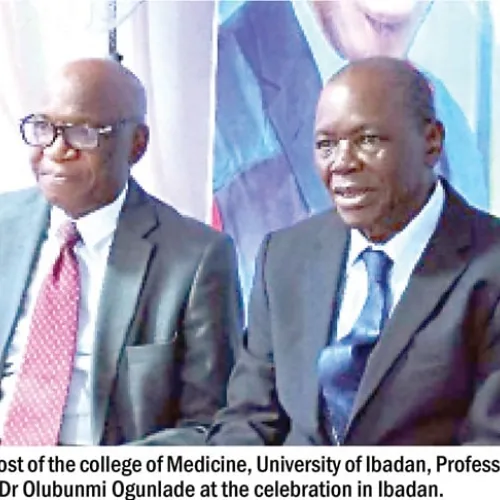
Speakers at the event, including the Vice Chancellor of the University of Ibadan, Professor Kayode Adebowale, and the Chief Medical Director of the University College Hospital (UCH), Ibadan, Professor Jesse Otegbayo, described Professor Samuel Ogunlade as an accomplished scholar, surgeon, teacher and mentor whose career has left an enduring legacy in medical education and orthopaedic practice.
Representing the Vice Chancellor, the Provost of the College of Medicine, Professor Temidayo Ogundiran, said the occasion celebrated not only Ogunlade’s retirement and milestone birthday but also a lifetime of excellence, integrity and dedicated service to humanity. He praised his contributions to orthopaedic surgery, trauma care, fracture management, osteomyelitis and musculoskeletal research.
Representing the Chief Medical Director of UCH, the Chairman of the Medical Advisory Committee, Professor Bukola Adesina, described Ogunlade as one of the institution’s finest orthopaedic surgeons and mentors, noting that he inspired generations of doctors through discipline, humility, professionalism and integrity.
Dr. Ajibola Oladiran, Head of the Department of Orthopaedics at UCH, said Ogunlade remains a father figure affectionately known as “Baba.”
He recalled being mentored by him from medical school through residency and producing his first academic paper under the professor’s guidance.
Comments
Start the conversation about this story.