





- Advertisement -
Prolonged drought, coupled with repeated temperature extremes, is significantly increasing the risk of wildfires across the European countryside. Over the past few weeks, fires have engulfed thousands of hectares in Spain, France, Greece or Germany.
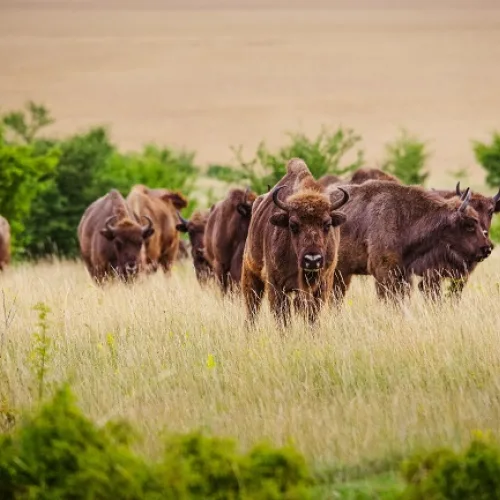
According to experts, it is necessary to introduce preventive measures that will significantly reduce the risk of fires. One of the most effective and cheapest methods is to remove the most flammable material of all, which in the countryside is dry grass. The most effective way to remove it is through natural grazing by large ungulates, such as wild horses and European bison.
“When it comes to wildfires, the public usually pictures a burning forest. Yet dry grass is one of the most flammable materials found in nature. It is precisely the fact that highly flammable dry grass biomass ignites so easily that is the cause of most fires. Not only does it catch fire easily in dry, hot weather, but the flames spread through it at an incredible speed,” notes Miloslav Jirku from the Biology Centre of the Czech Academy of Sciences.
At the same time, the area covered by dry grassland has been increasing significantly in Europe over recent decades. This is linked to an overall change in the way people manage the landscape. Its use is either too intensive or, conversely, completely lacking.
“All manner of marginal and abandoned areas are becoming overgrown with invasive grass species, which turn into standing hay in the summer and provide an ideal environment for fires to start and spread. Large ungulates, such as wild horses, European bison or back-bred aurochs, are unique, amongst other things, for their ability and willingness to graze even on very poor-quality grasslands, including so-called thatch,” added Jirku.
Common farm animals do not usually eat dry grass; sheep, for example, are completely unable to graze on it, nor can forest animals such as deer. The fact is, they are not biologically equipped to do so. Without large ungulates, dry grass accumulates in the countryside, and as its volume increases, so does the risk of fire.
A number of European countries are making intensive preparations for the new normal of extreme heat, drought and wildfires.
“An undeniable advantage of large ungulates is that using them for fire prevention is very inexpensive,” added Dalibor Dostal, director of the conservation organisation European Wildlife.
In 2015, in collaboration with scientists, it established a reserve for large ungulates and, in recent years, has been relocating European bison and other herbivores across Europe. This is partly to reduce the risk of wildfires in the area.
Large ungulates help prevent the spread of fire across the countryside in two ways. Above all, grazing dramatically reduces the volume of dry biomass in the wild. Furthermore, they create a regular network of paths across the landscape, which act as natural firebreaks and can stop fires in their tracks before they spread on a large scale.
Scientists point out that the existence of vast expanses of old dry uncut grass (thatch) in the countryside is not a natural state of affairs.
“Large herbivores have been a natural part of the ecosystem for millions of years. It was only after humans had wiped them out that the number of wildfires began to rise significantly. If we want to introduce quick, inexpensive and, above all, long-term fire prevention, we need to reintroduce large ungulates into the countryside.
“Experience from various European countries shows that this is possible not only in unspoilt natural areas, but practically anywhere, from the outskirts of major cities to the cultural landscape and even intensively used military sites. The sooner we start, the cheaper the preventive measures will be,” concludes Jirku.
Comments
Start the conversation about this story.