





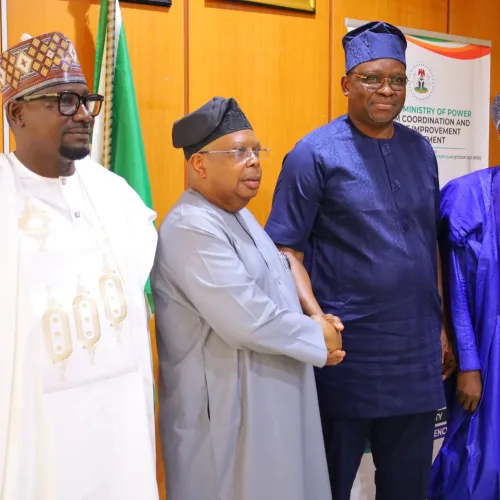
The Minister of Power, Mr Joseph Tegbe, on Friday inaugurated former Ekiti State Governor, Ayo Fayose, as Chairman of the Governing Board of the Rural Electrification Agency (REA).
Also inaugurated were Alhaji Ahmadu Abubakar, Mr Ilyasu Makinta, and three others as board members and non-executive directors, while Mr Abba Aliyu was inaugurated as the Managing Director.
Fayose, who thanked President Bola Tinubu for finding them worthy of the appointments, said his mission at the REA was to take the agency to greater heights by providing the necessary political will.
He promised to do everything possible to ensure that the agency secured adequate funding to implement its short- and long-term programmes aimed at expanding electricity access for Nigerians.
“Work has started in earnest. We are reaching out very fast and appealing to people to ensure the work is done. I want to use this opportunity to assure Nigerians that your expectations of my appointment and that of my colleagues will not be dashed.
“We will give our best to achieve the Renewed Hope agenda of President Tinubu and make the country better for us all,” he said.
He noted that many of the challenges facing the power sector were concentrated at the grassroots.
ALSO READ: Alausa demands accountability, proactive measures on education reforms
According to him, the assignment before the board goes beyond providing electricity to ensuring that more Nigerians feel the impact of improved energy access.
“When this happens, the people will forever be indebted to the agency,” he said.
On his part, the REA Managing Director thanked President Tinubu for the opportunity to serve.
Aliyu promised that the agency would continue to do its best to ensure electricity reached both served and underserved communities.
Earlier, Tegbe said Nigeria’s electricity sector was shifting its focus from simply counting kilowatts and megawatts to measuring the number of communities and people gaining access to electricity.
The minister made the remarks while inaugurating the Governing Board of the Rural Electrification Agency (REA) in Abuja on Friday.
He explained that the REA occupies a unique and strategic position within Nigeria’s power sector, adding that its mandate extends far beyond connecting communities to electricity.
“We are moving from just counting kilowatts and megawatts to asking how many communities and people are being powered across the country.
“REA is fundamentally an institution for expanding opportunity.
“Every mini-grid inaugurated, every solar home system deployed, every market, school, primary healthcare centre, farm, or productive enterprise electrified represents an investment in human capital, economic inclusion, and national prosperity.
“As we continue the implementation of the Electricity Act and deepen reforms across the Nigerian Electricity Supply Industry, the role of REA has become even more significant,” he said.
The minister said the agency serves as the bridge between national policy and grassroots impact by ensuring that “the benefits of power reforms are being felt across the country.
“Not only in our major cities but also in the remotest communities across the federation,” he said.
Tegbe said the inauguration of the board was another demonstration of President Tinubu’s unwavering commitment to strengthening governance in public institutions.
According to him, the move is aimed at entrenching a culture of accountability, strategic oversight, and excellence across the public sector.
The minister said the board assumed office at a defining moment and that its stewardship must be guided by strategic thinking, transparency, innovation, and a steadfast commitment to delivering value for money.
He said members were expected to provide clear policy direction, strengthen institutional governance, and safeguard public resources.
He urged them to encourage productive partnerships with development partners and the private sector while ensuring that the REA remained a model public institution that delivered measurable impact.
“Most importantly, I encourage you to continually ask one fundamental question whenever decisions come before the board: ‘How does this improve the lives and livelihoods of ordinary Nigerians?’
“If that question remains our compass, I have no doubt that the agency will continue to exceed expectations.”
Comments
Start the conversation about this story.