






The establishment of airlines by state governments after building many unviable airports is greeted with mixed reactions among aviation stakeholders. BENJAMIN SAMSON, in this report, speaks with experts who raised concerns over the increasing number of state carriers amid rising operational costs and sustainability issues.
The Kano state government this week unveiled plans to establish a commercial airline in a move expected to create employment opportunities for professionally trained indigenous pilots and strengthen the state’s participation in nation ’s aviation industry.
The proposed airline, expected to begin operations within the next oneyear according to the statement government, is also aimed at preventing the loss of skilled aviation professionals who have completed expensive pilot training, but remain without employment due to limited opportunities in the country’s aviation sector.
Likewise, a few weeks ago, the Nigeria Civil Aviation Authority (NCAA) granted an Air Operator Certificate (AOC) to the Bayelsa state-owned Pioneer Airlines Limited to begin non-scheduled flight operations.
Blueprint Weekend also gathered that Sokoto state is working toward launching an air carrier called Caliphate Air. Ogun, Anambra, and Lagos are also at different stages of establishing their own carriers, with a promise to provide jobs for hundreds of their indigenes and the nation’s aviation professionals.
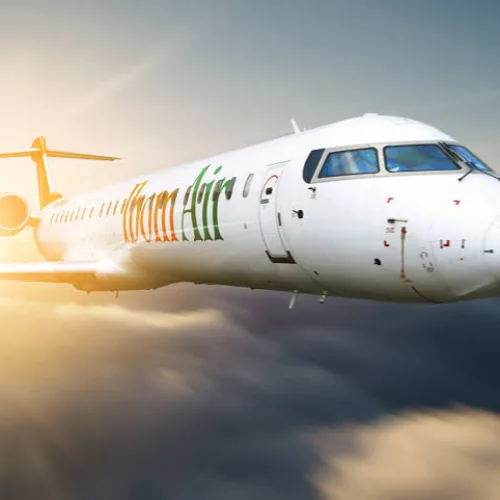
This is in addition to the numerous airlines owned by state across the country. For instance, Akwa Ibom state had, in 2019, established Ibom Air as the state carrier. While Cross River state launched Cally Air in 2021, and Enugu state officially launched its airline last year.
Viability issues
On the viability of the states’ airlines, an aviation expert and former commandant of the Nnamdi Azikiwe International Airport, Abuja, Capt. John Adetunji, berated state governments for establishing airlines while neglecting their basic responsibilities of providing basic amenities for the people.
He said, “The emerging trend has raised questions among aviation experts on the logic and viability of state governments investing billions in airline operations at a time of pressing basic infrastructure deficits, healthcare challenges, educational funding gaps, and rising expenditure.
“Moreover, only a handful of Nigerian states can survive on internally generated revenue (IGR), while the majority depends on monthly disbursements from the Federal Allocation Account Committee (FAAC) to pay salaries and cover other essential spending.
“Recall that the first state-owned airline was Imo Air, launched in January 2017 by a former Imo State governor, Rochas Okorocha, in partnership with the former Dana Air.”
Continuing, he said, Despite the fanfare that accompanied the launch, the 10-year partnership deal between Dana Air and the Imo state government did not stay in the air long before it was eclipsed. And none of the plans itemised for the airline’s growth materialised.
“Okorocha had promised to acquire five airplanes under the Imo Air project within a year, while hundreds of the state’s indigenes were also promised employment.”
Gimmicks
In his reaction, the Secretary of Coalition of Human Rights Activists, a civil society organisation, Comrade Sodiq Olaifa, noted out that most of the state-owned airlines and even the airports are politically motivated to hoodwink the citizens.
He said, “Looking closely, one can easily find out that states that are venturing into such huge projects have not been able to provide its citizens with good roads, schools, housing.
“Most of the states establishing the airlines and airports are not professionals. They are opening it to deceive their people and for political gains. Above all, their citizens don’t have dividends of democracy.
“Such establishments, especially airports, put a burden on the federal government as no sooner that they are established, they are handed over to the Federal Airports Authority of Nigeria (FAAN) to manage due to their incapability; a typical example is Akure Airport and Owerri Airport.
“Such state ventures are not in the interest of the federal government because in the long-run it will put financial strains on the government, as it would require funding in terms of operational costs in the areas of staffing, equipment, safety, security, conducive environment to commence operations.”
In the same vein, a political economist, and lecturer in the Department of Political Science, University of Abuja, Dr. Lancelot Igiebor, said most of the state-owned airlines are drains on scarce resources.
“Since President Bola Ahmed Tinubu removed fuel subsidies, each of the 36 states and 774 local government areas has been receiving humongous funds from the Federation Account Allocation Committee (FAAC). Rather than invest the money on things that will advance public good, some of the states have embarked on vanity projects.
“After establishing airports that are not viable and dumping them on the federal government, there seems to be a new competition among governors in the high-risk airline business. Yet, many of these highly indebted-states are yet to meet the primary requirements of their citizens, such as the provision of potable water, good hospitals, schools, and road infrastructure,” he said.
He continued: “There are indications that after some of these states had built their own airports, it dawned on them that the facility would become grossly underutilised, knowing they cannot attract commercial airlines. They thereafter decided to establish their own airlines.
“For all practical purposes, these airlines are being established for the comfort of the political elite and other VIPs whose regular trips to those states cannot generate enough revenue to sustain their operations. Hence, they are monuments to waste.
“Airline operation is capital intensive. For the states to sustain the airlines, they must regularly allocate funds for their operations, and this will be a huge drain on scarce resources.”
Also, an aviation expert, Group Capt. Abdalla Isiaka (retd.), said establishing airlines without a corresponding increase in numbers of air passengers could be a waste of resources.
He said, “The implication of the multiplication of airlines and airports without increase in the national passenger traffic or from the geographical zone of the new airports, is nothing but a waste of financial resources that would have served the people better.
“Since 2020, when the projected passenger traffic figure was 20 million, we have not got that figure even now in 2026, six years after the projected date. Apart from Lagos with over six million passenger traffic figures in the South-west, no airport has passenger traffic up to 200, 000 annually in that zone.
“So also, beside Abuja which has 6 million passengers and Kano, 1 million, no airport in the three northern zones has passenger traffic of 200,000.”
Speaking further, he said, “The total number of passengers in the South-east asides Lagos, is less than two million at the four airports; so too is the passenger traffic in South-south at the four airports. The implication is on the Government spending money on the periodic maintenance of these airports, but how many of them generate sufficient revenues to sustain their operations and the periodic maintenance programme to meet the national/international safety and security standards and regulations? This is a major problem for the Nigeria Civil Aviation Authority (NCAA) to solve?”
Positives
However, a transportation expert and Senior Lecturer in the Department of Geography, Faculty of Social Sciences, Nasarawa State University, Keffi, Dr. Chris Zamani, said state establishment of airports and airlines has positive impact on the sector and economy as a whole.
According to Zamani, such ventures will boost connectivity nationwide and open up access to every nook and cranny of the country.
On job-creation, he gave the assurance that with such investments, pilots, travel agencies, caterers, ground handling companies and those involved in airport and aviation allied services will be gainfully employed.
“With the new development, there would be cargo and logistics development across the regions. There would be airport utilisation and infrastructure developments. Access roads to the airport would be developed and more businesses would spring up. Of course, tourism would be developed and it also offers avenue for state branding,” he said.
State govt’s reaction
An official of one of the states planning to start an airline, who asked not to be named in print for obvious reasons, said there was nothing wrong in state governments setting up an airline, adding that the development was usually borne out of the desire to improve air connectivity in their domains and stimulate local economies.
The official said, “Nigeria’s state-owned airlines are a recent phenomenon borne out of the desire of state governments to improve air connectivity and stimulate local economies.
“It is also aimed at preventing the loss of skilled aviation professionals who have completed expensive pilot training but remain without employment due to limited opportunities in the country’s aviation sector.
“It would provide direct employment for trained pilots while contributing to the state’s economic growth. The initiative would also to ensure that the state’s investment in aviation training yields tangible economic returns.”
Sustainability, other challenges
To drive sustainability, Zamani urged state governments to invest in infrastructure and enter into partnerships with relevant stakeholders.
“The aviation industry is notorious for its thin profit margins. To achieve sustainability, airlines must at least break even on operational costs. However, state-owned airlines in Nigeria face significant challenges. This includes low seat occupancy.
“Without deliberate interventions by either the state or the communities to increase demand, these airlines may struggle to fill seats, making it difficult to cover operational costs,” he said.
He added, “There are other challenges, including high operational costs. State-owned airlines may inherit inefficiencies, outdated infrastructure, and high overhead costs, making it harder to achieve break-even.
“State-owned airlines may not benefit from economies of scale, making it challenging to compete with larger, more established carriers; they could, however, collaborate with other airlines to avoid flying with empty seats.
“To make state-owned airlines sustainable, the states must be willing to invest in operational efficiency. Modernise infrastructure, adopt cost-saving technologies, and streamline operations to reduce waste and improve productivity.
“They can also explore partnerships with other airlines, airports, or tourism boards to share resources, expertise, and risk. Ultimately, without a well-thought-out strategy and commitment to sustainability, the proliferation of state-owned airlines in Nigeria may not be viable in the long-term.”
What to do
On what should be done to ensure sustainability, Capt. Adetunji suggested partnership with investors, saying, “With a good management, in structure and personnel, five states or more can come together to float an airline and spread the cost, while each of the states’ capital becomes a hub for the airline.”
“This is because, indeed, it will be a waste, ultimately, if every state owns an airline with only one or two aircraft and all of them collapse due to poor business decisions that are not sustainable.
“So, it’s good to have a good foundation for money-gulping investments like aviation and by my reckoning, if 10 states have objective grounds to establish an airline, it will be a bold statement starting with 10 or more aircraft in the fleet.
“And having enough capital for overheads, recurrent expenditures and so on will eliminate the growing concerns over sustainability.”
Comments
Start the conversation about this story.