





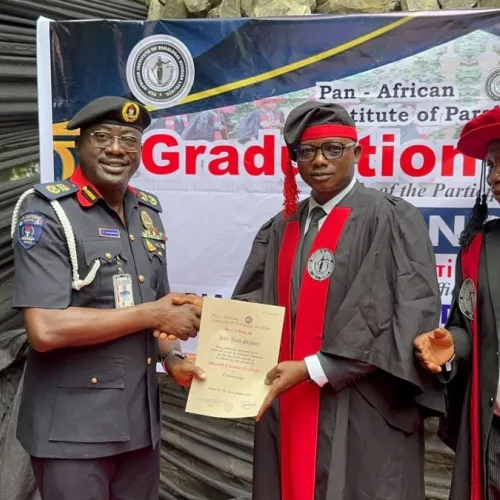
No fewer than 14 officers of the Nigeria Security and Civil Defence Corps (NSCDC), Federal Capital Territory (FCT) Command, on Friday graduated from the Advanced Executive Certificate Programme in Criminology at the Pan-African Institute of Paralegal Studies, Abuja.
The Command’s Public Relations Officer, Monica Ojobi, said in a statement in Abuja that the intensive programme, which was fully sponsored by the FCT Commandant as part of his efforts to build a more professional, intelligence-driven and knowledge-based FCT Command, was made possible through his well-established partnership with the institute.
The Commandant of the NSCDC FCT Command, Dr Olusola Odumosu, said at the graduation ceremony, which was attended by senior officers of the NSCDC, the management and faculty of the Pan-African Institute of Paralegal Studies, family members of the graduands and other stakeholders in the security sector, that the training was deliberately designed to equip personnel with modern tools for crime prevention.
Odumosu described the graduation as “a celebration of excellence, intellectual growth, and our collective commitment to building a more responsive security organisation.”
He noted that, as the lead agency for the protection of critical national assets and infrastructure, intelligence gathering and disaster management, the Corps must understand the science of crime to effectively discharge its mandate.
He disclosed that the officers were trained in criminal psychology, forensic investigation, evidence management, cybercrime, juvenile delinquency and the legal frameworks guiding law enforcement in Nigeria.
“In view of the evolving security challenges, security personnel must not rely solely on physical courage or operational experience. Modern security management requires intellectual capacity, analytical thinking, legal knowledge, strategic planning, and an understanding of the social, economic and psychological factors that drive criminal behaviour,” the Commandant stated.
Odumosu commended the Pan-African Institute of Paralegal Studies for its academic excellence and for partnering with the NSCDC to enhance the capacity of its personnel. He called for the partnership to be sustained.
He charged the 14 graduands to cascade the knowledge they had acquired to their colleagues and to apply professionalism, integrity and intelligence in their daily operations.
“You are now agents of change. Your achievement is a reflection of hard work, perseverance and an unwavering desire to improve yourselves professionally despite the demanding responsibilities of the security service.”
The FCT Commandant reaffirmed his commitment to the continuous training and retraining of personnel, stating that a well-trained officer remains the Corps’ greatest asset in securing lives and critical national assets and infrastructure.
He maintained that the initiative aligns with the vision of the Commandant General of the Corps, Prof. Ahmed Abubakar Audi, mni, OFR, to reposition the NSCDC as a 21st-century security agency driven by knowledge and technology.
The NSCDC FCT Commandant assured residents of the FCT of improved service delivery, adding that, with their knowledge of criminology, the officers are now better positioned to prevent crime and protect critical national assets and infrastructure.
In his address, the Founder and Director of the Pan-African Institute of Paralegal Studies, Esq. Olajide Olakanmi, lauded the leadership of Dr Odumosu for prioritising human capital development and staff welfare. He described the initiative as exemplary, noting that the pioneer batch of 14 NSCDC officers distinguished themselves through discipline, active participation and outstanding academic performance throughout the programme.
He commended the FCT Commandant, Dr Olusola Odumosu, for his consistent interest in the professional development of his personnel and expressed optimism that the partnership would continue through subsequent training programmes.
Highlights of the event included the presentation of certificates to the graduands and gifts to stakeholders.
Comments
Start the conversation about this story.