





Nigeria’s listed paint manufacturers are beginning to reap the benefits of years of investing in local sourcing, with lower input costs allowing a larger share of revenue to flow to the bottom line despite persistent inflationary pressures.
An analysis of the half-year financial statements of Berger Paints, CAP Plc and Meyer Plc by BusinessDay shows that while production costs continued to rise in absolute terms, they accounted for a smaller proportion of revenue during the first half of 2026.
The combined cost of sales of the three listed paint makers increased to N18.02 billion in H1 2026, from N16.10 billion a year earlier and N7.80 billion in H1 2022. However, revenue grew at a faster pace, rising to N31.73 billion from N28.28 billion in H1 2025 and N12.45 billion four years earlier.
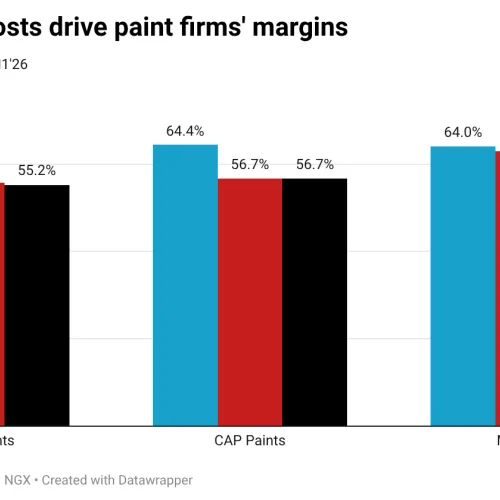
As a result, the industry’s input-cost ratio, measured as cost of sales as a percentage of revenue, fell to 56.8 percent in H1 2026, compared with 65.6 percent in H1 2024, the period when manufacturers faced the combined impact of naira depreciation, soaring import costs, and elevated inflation.
The trend indicates that paint producers now spend about 57 kobo to produce every N1 of revenue, compared with almost 66 kobo two years earlier, leaving a greater proportion of sales available to cover operating expenses, finance costs, and profit.
Company-level data also show improving production efficiency. Berger Paints reduced its input-cost ratio from 69.9 percent in H1 2024 to 55.2 percent in H1 2026. CAP Plc lowered its ratio from 64.4 percent to 56.7 percent, while Meyer Plc improved from 64.0 percent to 62.4 percent over the same period.
The improvement suggests that manufacturers are gradually reducing their dependence on imported raw materials, helping them cushion the impact of exchange-rate volatility that severely squeezed profitability following the naira devaluation in 2023 and 2024.
The decline in production costs relative to revenue has been accompanied by a sharp improvement in profitability.
Combined profit after tax of the three companies rose from N1.05 billion in H1 2022 to N4.02 billion in H1 2026, representing a 283 percent increase over four years. Profit climbed from N3.40 billion in H1 2025 despite continued inflationary and energy cost pressures.
Berger Paints’ profit after tax increased to N789 million in H1 2026 from N624 million a year earlier after recovering from a sharp decline to N87 million in H1 2024. CAP Plc posted a record N2.93 billion profit, up from N2.52 billion, while Meyer Plc grew earnings to N303 million from N257 million.
Local sourcing begins to pay off
Alaba Fagun, group managing director/chief executive officer of Berger Paints Nigeria Plc, in an interview with BusinessDay, said the paint industry is promoting local sourcing by exploring and expanding the use of locally available raw materials and supporting indigenous suppliers where quality and technical requirements can be met.
“This not only helps reduce foreign exchange exposure and supply chain disruptions but also stimulates growth in related industries such as chemicals, minerals, packaging, logistics, and industrial services,” she said.
Over the past few years, paint manufacturers have intensified efforts to procure more inputs domestically, including calcium carbonate, kaolin, limestone, extenders, and packaging materials, while reducing dependence on imported chemicals where viable.
The strategy has become increasingly important since the sharp depreciation of the naira dramatically increased the cost of importing titanium dioxide, specialised resins, pigments, and other industrial chemicals priced in foreign currency.
By sourcing more materials locally, manufacturers require fewer dollars for production, reducing their exposure to exchange-rate volatility and lowering foreign exchange-related losses.
The financial statements already point to improving FX resilience.
Berger Paints recorded foreign exchange losses of N38 million in both H1 2023 and H1 2024 before the loss widened to N768 million in H1 2025 during the height of exchange-rate volatility. Notably, the company reported no material foreign exchange loss in H1 2026, suggesting that improved currency stability, together with lower reliance on imported inputs, eased pressure on earnings.
CAP Plc also demonstrated greater resilience. After reporting a foreign exchange gain of N52 million in H1 2022 and N84 million in H1 2025, the company posted only a modest N132 million foreign exchange loss in H1 2026 despite continuing to expand revenue and profitability.


Chinwe Michael is a financial inclusion advocate and economy journalist who uses compelling storytelling to drive awareness. With a background in Banking and Finance and experience across accounting, media, and education, she applies sharp analysis and attention to detail to every piece. She simplifies complex financial and economy concepts into engaging content for Africa and global audience. Chinwe also doubles as a speaker with global recognition for her expertise.
Comments
Start the conversation about this story.