





In this report, analysts spoke with BENJAMIN UMUTEME, critically examining the country’s two years of tax and fiscal reforms that have lifted non-oil revenue collections and narrowed deficits, in relation to revenue-to-GDP, and debt servicing.
Increased revenue and debt servicing
Nigeria’s public finances present a paradox that has defined economic policy debates through the first half of 2026. Non-oil revenue has grown steadily on the back of tax administration reforms, digital tracking of collections, and the January 2026 commencement of new tax laws.
On the other hand, the federal government’s 2026 budget of N68.32 trillion allocates roughly N15.52 trillion, or about 45.2 per cent of projected revenue, solely to debt servicing, according to fiscal data reviewed by professional services firm PwC — a figure that dwarfs combined federal allocations to education and health.
The tension between rising revenue and rising debt-service obligations sits at the centre of what economists describe as “Nigeria’s structural fiscal imbalance.”
We can double our tax-to-GDP ratio – Minister
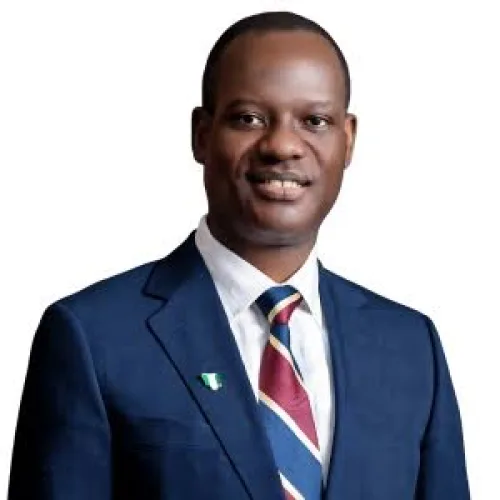
The Minister of Finance and Coordinating Minister of the Economy, Taiwo Oyedele, who took over the finance portfolio on April 21, 2026, in a cabinet reshuffle that elevated him from Minister of State, has been candid about how shallow Nigeria’s revenue base remains relative to the size of its economy.
As chairman of the Presidential Committee on Fiscal Policy and Tax Reforms before his elevation, Oyedele set the tone for the government’s current thinking on the subject, describing the country’s tax yield as “very embarrassing” when measured against economies of comparable size.
“Until last year, we were doing under 10 per cent. South Africa is doing 26 per cent. Some more developed countries are doing 30, 34, 40, like France,” he said, while projecting that Nigeria could more than double its tax-to-GDP ratio, from under 10 per cent to, at least, 18 per cent, within three years on the back of the reforms he designed.
Since assuming the substantive finance minister role, Oyedele has pointed to early results from those reforms.
Briefing the Senate Committee on Finance in July, he disclosed that the federal government generated N21.6 trillion in tax revenue between January and June 2026, a 49 per cent increase over the same period in 2025, while the economy grew 3.8 per cent in the first quarter of the year, driven largely by the non-oil sector.
He pushed back on claims that the administration had piled up between N75 trillion and N80 trillion in fresh borrowing, arguing that much of the increase in Nigeria’s debt profile reflects exchange rate adjustment, the securitisation of inherited Ways and Means advances, and the refinancing of maturing obligations rather than new borrowing.
“Three years ago, our economy was on the brink of severe distress. Today, we have made significant progress. Macro-economic fundamentals are improving, investor confidence has returned, fiscal revenues are increasing and the economy is better positioned for sustained domestic and external growth,” Oyedele told lawmakers.
On the question of how the government intends to close the revenue-to-GDP gap without deepening hardship, Oyedele has consistently rejected the idea of raising rates on existing taxpayers.
“Nigeria’s revenue challenge cannot be solved by imposing higher taxes but by expanding the number of taxpayers and improving compliance within the tax system,” he said.
The minister argued further that many individuals and businesses that should be paying taxes remain outside the net altogether, which both limits government revenue and increases reliance on borrowing to fund public expenditure.
Stability sould translate into productive investment – Cardoso
The Governor of the Central Bank of Nigeria (NBA), Dr. Olayemi Cardoso, has anchored the monetary side of the reform narrative on the argument that macroeconomic stability is a precondition for fiscal space to widen sustainably.
Speaking at the 2026 BusinessDay CEO Forum in Lagos in July, Cardoso said the economy had reached a point where stability could translate into productive investment.
“So, in a nutshell, I do believe that where we are now, we’ve achieved that hard-earned stability, and with stability comes potential for investment, and with investment comes growth, and all our local CEOs should be part and parcel of that train that is moving,” he said.
Cardoso’s tenure has been defined by a deliberate retreat from the central bank financing government deficits directly.
The apex bank ended the N22.7 trillion Ways and Means advances facility that had allowed government to effectively print money to plug revenue gaps, a decision analysts said has been central to restoring monetary credibility but has also, in the short term, sharpened the government’s reliance on market borrowing to fund its obligations.
The CBN’s 2025 audited accounts showed its claims on the federal government through debt securities declined marginally by the end of December, a sign, officials say, of reduced fiscal dominance over monetary policy.
Cardoso disclosed that external reserves stood at $52.73 billion as of July 9, 2026, with diaspora remittances through official channels rising from about $200 million to more than $600 million monthly.
Revenue and capital expenditure
For Dr. Muda Yusuf, Chief Executive Officer of the Centre for the Promotion of Private Enterprise (CPPE), the arithmetic of the 2026 budget illustrates precisely how constrained fiscal space has become.
Yusuf noted that the budget allocates close to N15 trillion to debt servicing against projected revenue of roughly N34 trillion, meaning nearly half of expected government’s income is committed to servicing existing obligations before a single naira is spent on new capital projects.
“Debt servicing is a first-line charge,” Yusuf said, warning against unrealistic revenue and oil production assumptions that have repeatedly failed to deliver the capital expenditure they promised.
In it’s 2026 economic outlook, CPPE noted that debt service, estimated at over N15 trillion in the 2026 appropriation, and about 50 per cent of projected revenue, continues to constrain fiscal space, alongside security challenges, high energy costs and pre-election fiscal pressures.
Yusuf has also linked the debt burden to the discontinuation of Ways and Means financing under the current administration.
“One of the reasons is before he [President Tinubu] came in, there was the option of printing money — ‘Ways and Means’. But the ‘Ways and Means’ was stopped. So, that also created a gap. And the revenue generation was not moving fast enough to fill that gap,” he said.
Yusuf argued that the path out of the trap runs through revenue, not retrenchment.
“We need to moderate the rate of growth of our debts because the debt service position is also of concern. It’s exerting a lot of pressure on the fiscal space. And as the revenue prospects improve, we expect dependence on debt to also reduce,” he said.
He added that a combination of fiscal, tax, monetary, investment and trade policy would be required to ease the pressure sustainably rather than through fiscal policy alone.
Fiscal space constraint on growth
For Bismarck Rewane, Chief Executive Officer of Financial Derivatives Company (FDC), Nigeria’s debt-service burden is the central risk to the country’s growth trajectory.
Presenting FDC’s economic outlook in Lagos, Rewane projected that Nigeria’s public debt would reach about 40.6 per cent of GDP in 2026, rising gradually to around 43.5 per cent by 2030, a pace he described as “not yet uncontrollable but one that leaves little margin for error.”
He listed debt-service challenges among the dozen key trends set to shape the economy in 2026, alongside election-related government spending, inflationary pressure, and oil prices expected to remain below $60 per barrel.
Rewane has previously warned in starker terms that Nigeria risks drifting from a debt-sustainability path toward a debt trap if borrowed funds are not channeled into productive use.
On a more optimistic note, Rewane projected that declining interest rates could reduce Nigeria’s debt-service obligations by about 4 per cent in 2026, freeing up roughly N500 billion in savings that could, if properly directed, expand fiscal space for capital projects, infrastructure development and social programmes.
Inter-dependence
Ugo Obi-Chukwu, an economic analyst with Nairametrics, has framed the challenge as one of interdependence among reform tracks rather than any single lever.
Reforms in one area cannot substitute for reforms in another, he has argued, noting that monetary policy adjustments have already demonstrated how well-executed reform can drive results, but that without complementary fiscal and structural reforms, the broader economy will not feel the impact.
Marrying the trio
Across the range of expert perspectives, a broad consensus has emerged on how the three variables, revenue growth, debt servicing and fiscal space for capital investment, can be reconciled rather than treated as competing priorities.
The first strand is sustained, non-inflationary revenue mobilisation.
Analysts agreed that Nigeria cannot borrow or cut its way out of the current bind; it must widen its tax net, particularly among the non-oil informal, and lightly taxed segments of the economy, while resisting the temptation to repeatedly burden already-compliant taxpayers.
The full implementation of the 2026 tax reform framework, alongside digitised revenue tracking and reduced leakages across revenue-generating agencies, is central to this effort.
The second strand is disciplined, productivity-linked borrowing. Both Oyedele and Rewane have stressed that debt itself is not inherently destabilising; what matters is whether new borrowing is tied to viable, revenue-generating projects rather than recurrent consumption, and whether increases in the debt stock reflect exchange rate adjustment and refinancing rather than fresh deficit spending.
The government’s stated shift from debt-driven financing toward tax-led revenue mobilisation and private capital reflects this logic, though analysts caution that execution, not intent, will determine whether the shift materially eases pressure on the budget.
The third strand is monetary-fiscal coordination. Cardoso’s insistence on ending direct central bank financing of government deficits has removed a source of inflationary pressure but has, in the near term, pushed the government toward more expensive market borrowing.
Experts argue that sustaining the current stability, and the investor confidence it has generated, while allowing fiscal authorities room to expand non-debt revenue, is the coordination that ultimately widens fiscal space for capital investment in transport, security and human capital.
Taken together, the experts’ positions suggest that reconciling Nigeria’s revenue ambitions with its debt obligations will not be resolved by any single policy instrument.
It will depend on whether tax reforms translate into durable, broad-based revenue growth quickly enough to outpace the country’s debt-service bill, and whether the government can sustain the fiscal discipline needed to convert that additional revenue into productive capital spending rather than allowing it to be absorbed by recurrent obligations.
Comments
Start the conversation about this story.