





A total solar eclipse is one of nature’s most breathtaking spectacles. For a few unforgettable minutes, the Moon completely blocks the Sun, turning daytime into twilight as stars and planets briefly become visible. It is an experience that millions travel across countries to witness.
- Why you should never look directly at the Sun
- Wear certified solar eclipse glasses
- Use indirect viewing methods
- Use telescopes and binoculars correctly
- Know when it is safe to remove eclipse glasses
- Join organised eclipse viewing events
- Can you photograph a total solar eclipse?
- Why total solar eclipses fascinate scientists
- Frequently Asked Questions
But as exciting as it is, a total solar eclipse can also be dangerous if viewed incorrectly. Looking directly at the Sun, even for a few seconds can permanently damage your eyesight.
Eye specialists warned that solar radiation can burn the retina without causing immediate pain, meaning many people don’t realise they have injured their eyes until hours later.
Therefore, in this article, Tribune Online looks into how to watch total solar eclipse safely. And learning it is just as important as knowing when and where to see one.
Meanwhile, whether you are planning to watch from the path of totality or observe a partial eclipse from another location, following the right safety precautions can help you enjoy the event without risking your vision.
According to NASA, millions of people will be in positions to observe future total solar eclipses, but safe viewing practices remain essential throughout every phase of the event except during the brief period of totality for those directly within the eclipse’s path.
Why you should never look directly at the Sun
The Sun emits intense visible light, ultraviolet radiation and infrared radiation that can permanently damage the retina. Unlike touching a hot object, staring at the Sun doesn’t trigger immediate pain because the retina has no pain receptors.
This condition, known as solar retinopathy, can cause blurred vision, permanent blind spots, distorted central vision, difficulty recognising faces, and lasting loss of visual sharpness.
Specialists say there is currently no guaranteed treatment that can reverse severe retinal damage caused by direct solar viewing.
ALSO READ: NASA urges US residents to watch August 12’s total solar eclipse
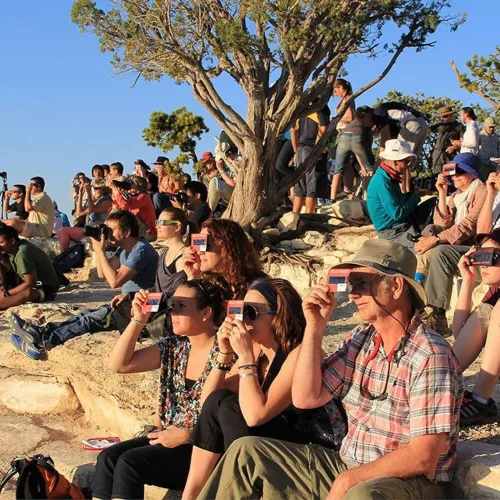
Wear certified solar eclipse glasses
The safest way to observe the eclipse is with eclipse glasses that meet the international ISO 12312-2 safety standard.
These specialised filters reduce sunlight to a safe level while blocking harmful ultraviolet and infrared rays.
Before using eclipse glasses, inspect them for scratches, tears or punctures, replace damaged filters immediately, and buy only from reputable manufacturers or authorised retailers.
Ordinary sunglasses, even very dark ones, are not safe for viewing the Sun. NASA advises the public never to substitute regular sunglasses for certified solar viewers.
Use indirect viewing methods
If you don’t have eclipse glasses, indirect viewing offers an excellent alternative.
One of the easiest techniques is the pinhole projector, which projects an image of the Sun ; by a nearby surface instead of requiring you to look at it directly.
You can also observe the eclipse by watching sunlight filtering through tree leaves, which naturally create crescent-shaped projections, using specially designed solar projection boxes, or viewing organised public demonstrations hosted by science centres or astronomy clubs.
These methods completely eliminate direct eye exposure.
Use telescopes and binoculars correctly
Many people assume eclipse glasses alone make telescopes or binoculars safe. They don’t.
Looking through unfiltered optical equipment concentrates sunlight thousands of times, causing almost instant eye injury.
If you plan to use binoculars, cameras or telescopes, they must have professionally designed solar filters mounted over the front of the optics, not at the eyepiece.
NASA warns that eclipse glasses should never be used while looking through unfiltered optical devices because the concentrated sunlight can destroy both the filters and your eyesight.
Know when it is safe to remove eclipse glasses
This is where many people become confused. If you are outside the path of totality, you must keep your eclipse glasses on throughout the entire eclipse because part of the Sun always remains visible.
And if you are inside the path of totality, you may remove your eclipse glasses only during the brief period when the Moon completely covers the Sun and no bright solar surface is visible.
The moment the first bright ray of sunlight, often called the “diamond ring” effect reappears, put your eclipse glasses back on immediately before looking up again. Missing this timing can expose your eyes to harmful sunlight within seconds.
Join organised eclipse viewing events
Public viewing events provide one of the safest and most enjoyable ways to experience an eclipse.
Museums, observatories, universities and astronomy organisations often provide certified eclipse glasses, solar telescopes with approved filters, live explanations from astronomers, and family-friendly educational activities.
These events reduce the risk of improper viewing while helping participants better understand the science behind eclipses. For first-time viewers, they also remove much of the uncertainty surrounding eclipse safety.
Can you photograph a total solar eclipse?
Yes, but cameras require protection too.
Professional photographers use specially designed solar filters to protect camera sensors and lenses from concentrated sunlight.
Attempting to photograph the eclipse through an unfiltered camera, telescope or smartphone attached to magnifying optics may damage both the equipment and the photographer’s eyes.
If you’re simply taking a quick smartphone photo without optical zoom, always prioritise eye safety over getting the perfect image.
Why total solar eclipses fascinate scientists
Solar eclipses are more than beautiful celestial events. They provide rare opportunities for researchers to study the Sun’s outer atmosphere, known as the corona, which is usually hidden by the Sun’s intense brightness.
Scientists use eclipse observations to better understand solar magnetic fields, space weather, coronal heating, and solar wind.
Research from eclipses has contributed to major discoveries in astronomy, including historical tests of Albert Einstein’s theory of general relativity.
Knowing how to watch a total solar eclipse safely allows you to enjoy one of the world’s most extraordinary natural events without putting your eyesight at risk. Certified eclipse glasses, approved solar filters and indirect viewing methods remain the safest options for most observers.
No photograph or social media post is worth permanent eye damage. By following guidance from trusted organisations such as NASA and eye health experts, you can experience the wonder of a total solar eclipse with confidence—and with your vision protected.
Frequently Asked Questions
Can I wear ordinary sunglasses during a solar eclipse?
No. Ordinary sunglasses do not block enough harmful solar radiation. Only eclipse glasses certified to the ISO 12312-2 standard are considered safe.
Is it ever safe to look directly at a total solar eclipse?
Only if you are within the path of totality and the Moon has completely covered the Sun. The instant any part of the Sun becomes visible again, you must use eclipse glasses before looking up.
Can children watch a solar eclipse?
Yes, but they should always be supervised by adults and use properly certified eclipse glasses or indirect viewing methods.
Comments
Start the conversation about this story.