





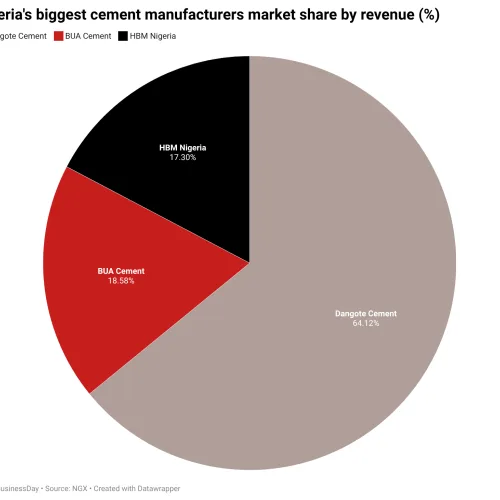
Dangote Cement has reinforced its dominance of Nigeria’s cement industry, accounting for nearly 64 percent of the total market share by revenue in the first half of 2026.
According to the market analysis by BusinessDay, BUA Cement continues to narrow the competitive gap with 18.58 percent, and HBM Nigeria begins a new chapter under Chinese ownership with 17.3 percent market share.
An analysis of the latest half-year financial statements of Dangote Cement, BUA Cement, and HBM Nigeria (formerly Lafarge Africa) shows the three companies generated a combined revenue of about N3.92 trillion in the six months ended June 2026, underscoring the resilience of construction demand despite elevated borrowing costs and persistent pressure on developers.
Dangote Cement remained the undisputed market leader, posting N2.51 trillion in revenue during the period, equivalent to about 64 percent of the combined revenue of the listed cement producers. The company also delivered a profit after tax of N638.5 billion, reflecting the benefits of its scale, pricing power, extensive distribution network, and export operations across Africa.
BUA Cement maintained its position as the industry’s closest challenger after reporting approximately N728 billion in revenue, representing about 18 percent of the combined market revenue.
HBM Nigeria, the company formerly known as Lafarge Africa before its acquisition by Chinese cement giant Huaxin Cement, generated roughly N678 billion, representing a 31.2 percent increase year-on-year.
Also, an analysis of the companies’ share price performance showed that the strong earnings growth has been reflected in their market valuation on the Nigerian Exchange (NGX), with the three cement manufacturers ranking among the exchange’s most valuable listed firms.
Read also: Bank of America sharpens focus on Africa after key role in Dangote refinery placement
Dangote Cement Plc remains the third most capitalised company on the NGX with a market value of about N17.4 trillion. The company’s share price has gained about 70 per cent year-to-date, rising from N609 at the beginning of the year to N1,034 per share as of August 7th.
BUA Cement Plc is the fifth most valuable listed company on the Exchange with a market capitalisation of about N10.7 trillion. The stock recorded a strong year-to-date gain of 77 percent, soaring from an opening price of about N178.50 in January to N316.
HBM Nigeria is currently the ninth most capitalised stock on the NGX with a market value of approximately N5.9 trillion. The company’s share price has delivered one of the strongest performances on the Exchange this year, advancing about 173.2 percent from around N135 at the beginning of the year to N367.4 at the close of trading on Friday.
The strong performance by the cement manufacturers reflects continued growth in construction activities across the country, improved pricing strategies, increased infrastructure spending by governments, sustained demand from the real estate sector, and operational improvements that helped cushion the impact of higher energy, logistics, and financing costs.
According to the country’s gross domestic report for Q1 released by the National Bureau of Statistics (NBS), construction activities is gaining momentum in the economy with its contribution real GDP rising by 4.85 percent in the first quarter of 2026; higher than its contribution of 4.74 percent in the same quarter of the previous year, and higher than in the immediate past quarter, where it contributed 3.91 percent.
Battle shifts beyond capacity
Industry analysts say the latest results indicate that the next phase of competition will no longer be determined solely by installed production capacity but by pricing strategy, operational efficiency, and market penetration.
Dangote Cement has spent the past few years expanding production across Nigeria and key African markets while strengthening export volumes by 62.3 percent, supported by 20 clinker shipments to regional markets. The strategy has enabled the company to maintain market leadership even as rivals continue to add new capacity.
BUA Cement, however, has steadily closed the performance gap through aggressive investments in new production lines and improved operational efficiency. Analysts believe the company’s stronger earnings growth could translate into greater market share over the medium term, particularly in northern Nigeria, where it has continued to deepen its presence.
The biggest wildcard for the industry is HBM Nigeria. Following regulatory approval of Huaxin Cement’s acquisition of the former Lafarge Africa.
The Chinese cement giant operates in 14 countries and has established Nigeria as its strategic hub for West Africa. The HBM transaction also fits into a broader pattern of Chinese industrial investment.
Read also: Dangote Cement exports rise 62.3% as H1 profit hits N638.5bn
Across Africa and Asia, Chinese manufacturers have increasingly targeted established businesses with strong brands but underutilised operational potential.
Chinese investment in Nigeria is not new. Chinese firms have financed railways, airports, seaports, and power infrastructure across the country for years. However, outright acquisitions of major Nigerian manufacturing companies have been relatively rare.
One of the earliest examples was Enitex Limited, the Kaduna-based textile manufacturer, which was acquired by China’s Shanghai Huayuan Group in the late 1990s. The Chinese investors injected fresh capital, upgraded machinery, restored production, and returned the once-struggling textile company to profitability, making it one of the country’s largest taxpayers at the time.
Chinese investors have expanded their footprint into Nigeria’s mining sector. In 2024, Chinese lithium companies, including Canmax Technologies and Jiangxi Jiuling Lithium, acquired a 79 percent controlling interest in the developer of the Ganfeng Lithium refinery project in Nasarawa State, accelerating investment in Nigeria’s emerging battery minerals industry and reinforcing China’s dominance across the global electric vehicle supply chain.
Rather than building new factories from scratch, they acquire existing market leaders, introduce operational discipline, modernise manufacturing systems, improve supply chains and expand capacity.
Huaxin itself recently agreed to acquire a controlling stake in Holcim’s Philippine cement business for $527 million, reinforcing its strategy of becoming one of the world’s largest emerging-market cement producers. Nigeria now represents one of its biggest bets. The speed with which HBM Nigeria has strengthened its balance sheet is already attracting attention.
The company has substantially reduced debt, accumulated significant cash reserves, and declared over N400 billion in dividends within less than two years under Chinese ownership.
Dangote, BUA Cement ramp-up expansion
Dangote Cement appears to recognise the changing competitive landscape.
The company recently signed an $800 million engineering agreement with China’s Sinoma International Engineering Company to double production capacity at its Itori cement plant in Ogun State from six million to 12 million metric tonnes annually.
“This $800 million investment represents another bold step in our commitment to strengthening Nigeria’s industrial base and reinforcing our leadership in Africa’s cement industry,” Aliko Dangote, the company’s group president, said.
He attributed the decision to expand the Itori facility to the Federal Government’s renewed emphasis on the use of concrete in road construction and the company’s strategy to serve cement-deficient African countries through exports.
According to him, the project aligns with Dangote Group’s Vision 2030 target of raising cement production capacity to between 90 million and 100 million metric tonnes yearly across its operations.
Similarly, early this year, Nigeria’s BUA Cement, in a statement, disclosed that the company signed a $240 million agreement with China’s CBMI to construct a new 3-million metric tons/year cement production line in Sokoto, expanding the company’s total annual capacity to 20 million mt and positioning it to serve both domestic infrastructure demand and regional export markets across West Africa’s landlocked countries.
Will cement prices moderate?
Nigeria yearly produces 60 million tonnes of cement. It consumes between 25 and 30 million each year, leaving at least 30 million tonnes on the shelf.
A 50kg bag of cement across Nigeria sells for between N11,000 and N15,000. Prices vary by brand, delivery distance, and city, with commercial centers like Lagos, Abuja, and Port Harcourt recording rates from N12,000 to N15,000.
The Federal Government has intensified pressure on cement manufacturers to reduce the cost of cement, warning that the current pricing regime is placing a heavy burden on ongoing infrastructure projects and triggering growing demands from contractors for contract variations.
In a statement, David Umahi, minister of works, stressed that manufacturers must take responsibility for reducing costs rather than expecting the government to continually adjust project contracts to reflect rising material prices.
Get Newsletter Updates
Enjoying our column?
Subscribe to our specialised **Tax 360** feed to receive fresh reports and analyses directly in your inbox.


Chinwe Michael is a financial inclusion advocate and economy journalist who uses compelling storytelling to drive awareness. With a background in Banking and Finance and experience across accounting, media, and education, she applies sharp analysis and attention to detail to every piece. She simplifies complex financial and economy concepts into engaging content for Africa and global audience. Chinwe also doubles as a speaker with global recognition for her expertise.
Comments
Start the conversation about this story.