





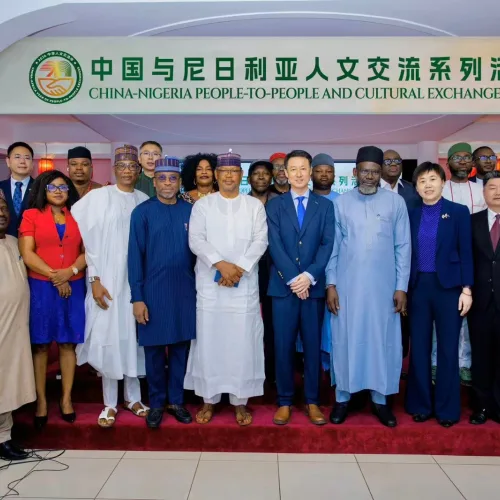
Nigeria and China have moved to deepen cooperation in film, television, and literature following the signing of a strategic agreement between the Nigerian Television Authority (NTA) and China Movie Channel (CMC). Both sides are seeking to expand content exchange, co-production, professional training, and technology transfer. The agreement was signed on Friday at the China Cultural Centre in Nigeria during the China–Nigeria Film and Literature Symposium.
Chinese Ambassador to Nigeria Yu Dunhai said literature and film could play a significant role in strengthening understanding and friendship between the peoples of both countries. He noted that China and Nigeria were both nations with rich civilisational heritages and vibrant creative industries whose writers and filmmakers contribute significantly to global cultural expression.
Yu cited Nigerian writers including Wole Soyinka, Chinua Achebe, and Chimamanda Ngozi Adichie, whose works had portrayed aspects of the Nigerian experience and the people’s pursuit of what he described as the “African Dream”. He also referenced Chinese writers such as Mo Yan, Yu Hua, and Mai Jia, saying their works had explored traditional culture, offered observations on society, and reflected on life philosophy.
Expanding literary and cinematic exchanges
Literary exchanges between the two countries have continued to grow, according to the ambassador. Works on Nigerian literature and Chinese translations of Soyinka and Achebe enjoy readership in China, while English translations of Chinese online literature have gained popularity among young Nigerian readers.
The film industries of both countries also provide a strong foundation for expanded cultural cooperation, Yu said. China has 93,187 cinema screens and produces more than 700 films annually, while Nollywood produces more than 2,000 films each year. The ambassador described Nollywood as the world’s second-largest film industry and noted that its international influence is expanding into mainstream markets in Europe and North America.
Chinese films, including My People, My Country, Blue Star Beyond the Window, and The Dumpling Queen, have been screened in Nigeria and received warmly by audiences. Similarly, Nigerian films such as Lionheart, Battle for the Throne, and October 1 have provided Chinese audiences with opportunities to better understand Nigerian culture and national identity.
Elevating ties to strategic partnership
Yu attributed the growing interest in each other’s cultural productions to shared cultural affinity, as well as historical similarities in values and artistic expression. He said both countries could use literature and film to strengthen people-to-people relations and give greater expression to the voice of the Global South on the international stage.
The ambassador linked cultural cooperation to the broader development of bilateral relations, noting that the two countries elevated ties to a Comprehensive Strategic Partnership during the 2024 Beijing Summit of the Forum on China-Africa Cooperation (FOCAC). Leaders agreed to deepen mutual learning between their civilisations and strengthen people-to-people ties, creating a foundation for expanded exchanges.
The year 2026 marks the 55th anniversary of diplomatic relations between Nigeria and China, as well as the China-Africa Year of People-to-People Exchanges. Yu described the symposium and the CMC–NTA agreement as important steps towards implementing the Global Civilization Initiative and advancing closer ties. Writers, filmmakers, and cultural professionals at the symposium examined the role of literature and film in national development. Participants also watched a screening of The Valiant One, which Yu described as an example of recent developments in China’s film industry and the appeal of Chinese martial arts cinema.
Building institutional bridges for growth
NTA Director-General Salihu Dembos said the agreement represented more than the signing of an institutional document, describing it as the beginning of a new phase in cultural relations. The partnership will provide a platform for content co-production, programme exchange, professional training, technology transfer, and wider distribution of creative works.
The agreement will also create opportunities for filmmakers, writers, broadcasters, and young creative talents from both countries to collaborate, acquire new skills, and reach wider audiences, Dembos said. Film, television, and literature serve as powerful instruments for telling the story of a people by preserving history, promoting identity, transmitting values, and enabling societies to understand one another beyond geographical and linguistic boundaries.
Nigeria’s vibrant creative industry, driven by cultural diversity, talent, and compelling stories, stands to benefit significantly from deeper engagement with China’s creative and technological ecosystem, according to the director-general. Combining these strengths creates enormous opportunities for both countries.
Dembos noted that the agreement is particularly important as the NTA continues its transformation into a modern, competitive, and digitally driven public broadcasting organisation. The authority will use the partnership to strengthen its capacity to tell authentic African stories while building cultural bridges globally. Stressing the need for tangible results, Dembos called for quality joint productions, enhanced professional capacity, greater technological innovation, and programmes capable of deepening mutual understanding.


Comments
Start the conversation about this story.