





The Federal Government has said Nigeria-China strategic partnership is moving beyond trade to deeper cooperation in science, technology, sustainable agriculture and innovation as the 2026 Seasonal Life & Harmonious China Cultural Exhibition opened in Abuja.
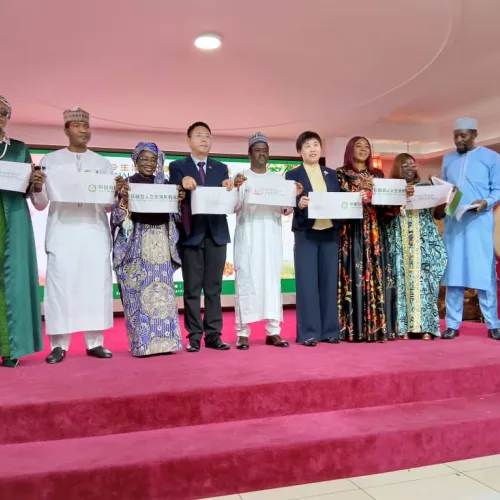
The exhibition, held at the China Cultural Centre as part of the China-Nigeria people-to-people and cultural exchange series, brought together officials, diplomats and cultural stakeholders to showcase Chinese traditions while highlighting opportunities for stronger bilateral cooperation in technology, agriculture and economic development.
Speaking at the event, the Permanent Secretary, Federal Ministry of Innovation, Science and Technology, Dr Mukhtar Yawale Muhammad, said the theme of the exhibition reflected not only Chinese philosophy but also the evolving relationship between Nigeria and China.
ALSO READ: Jigawa receives N11.58bn under FG’s Renewed Hope social grant
He said the bilateral partnership was increasingly producing opportunities beyond conventional trade relations, particularly in agricultural transformation, scientific innovation and technology transfer.
“Just as the seasons of the year bring renewal and harvest, the partnership between Nigeria and China is entering a season of unprecedented opportunity. As we speak, we are witnessing the fruits of a strategic relationship that is moving beyond trade into deep agricultural, technological and scientific transformation,” Muhammad said.
The Permanent Secretary, who congratulated the Communist Party of China on its 105th anniversary, said China’s achievements in socio-economic development, scientific and technological innovation, poverty reduction and infrastructure development offered useful lessons for developing countries.
He said a recent technical visit to China’s Yangling High-tech Agricultural Demonstration Zone and Shaanxi Province had strengthened Nigeria’s interest in applying Chinese agricultural technologies to address challenges at home.
According to him, the delegation witnessed advanced water-saving irrigation and soil-monitoring technologies that enable farmers to cultivate crops in arid conditions while minimising water wastage.
“In Yangling, often referred to as China’s ‘Agricultural Silicon Valley’, we witnessed the seamless integration of modern technology with traditional farming,” he said.
Muhammad said China’s experience in combating land degradation and increasing agricultural productivity in the Loess Plateau could provide valuable lessons for Northern Nigeria and the Lake Chad region.
He also identified China’s zero-tariff policy for products from 53 African countries as a major opportunity for Nigeria to expand agricultural exports to the Chinese market.
He said commodities including sesame, ginger, cashew nuts and cocoa could benefit from improved access to China, potentially increasing farmers’ incomes and strengthening the rural economy.
“With this zero-tariff access, these products can now compete effectively in China, offering a substantial boost to our rural economy and farmers’ incomes,” he said.
However, Muhammad stressed that access to the Chinese market would require Nigeria to improve the quality, packaging and supply chains of its agricultural products.
He said the Federal Ministry of Innovation, Science and Technology would therefore pursue deeper collaboration with Chinese research institutions in post-harvest management, agro-processing and scientific training.
“We intend to partner with Chinese research institutes to develop affordable, solar-powered cold storage facilities for perishable goods,” he said.
He added that Nigeria would also seek technology transfer to process cassava, shea butter and cashew nuts into value-added products for the Chinese and global markets.
Muhammad further disclosed plans to expand scholarships and STEM training opportunities for Nigerian scientists in Chinese universities, with emphasis on sustainable agriculture and water management.
Earlier, Chinese Cultural Centre Councillor, Yang Jianxing, said the exhibition was an important platform for strengthening mutual understanding between Nigeria and China through cultural exchange.
He noted that 2026 marks both the China-Africa Year of People-to-People Exchanges and the 55th anniversary of diplomatic relations between Nigeria and China.
“Cultural exchange is a vital component of China-Africa friendly cooperation and serves as an important bridge for fostering mutual understanding and affinity between our peoples, as well as for promoting dialogue and mutual learning among civilisations,” Yang said.
He explained that the exhibition was centred on the Chinese concept of “seasonal life”, with activities including displays on the Twenty-Four Solar Terms, traditional food tasting, intangible cultural heritage crafts and interactive cultural experiences.
Yang said the Twenty-Four Solar Terms, recognised by UNESCO as Intangible Cultural Heritage, reflected the Chinese philosophy of living in harmony with nature and respecting natural resources.
He said the philosophy also resonated with Nigerian cultural values, particularly the country’s respect for nature, tradition, family and community.
“This philosophy resonates deeply with the Nigerian spirit—which cherishes nature, respects tradition, and values family and community—forming a vital foundation for the exchange, mutual learning, and appreciation between Chinese and Nigerian civilisations,” he said.
Yang said the Chinese Embassy and China Cultural Centre would continue to organise cultural exhibitions, artistic performances, language classes, youth exchanges and tourism promotions to deepen people-to-people relations.
He said such initiatives would also contribute to implementing the outcomes of the Forum on China-Africa Cooperation (FOCAC) Beijing Summit and the consensus reached by the leaders of Nigeria and China.
The exhibition featured displays and interactive activities designed to give Nigerian visitors a first-hand experience of traditional Chinese culture, while the discussions reinforced the growing emphasis on linking cultural diplomacy with practical cooperation in science, technology, agriculture and innovation.
Comments
Start the conversation about this story.