





Nigeria and China are set to deepen cooperation in agriculture, science, technology and cultural exchange, with the Federal Government seeking to leverage China’s zero-tariff policy for 53 African countries to expand Nigerian agricultural exports and strengthen technology transfer.
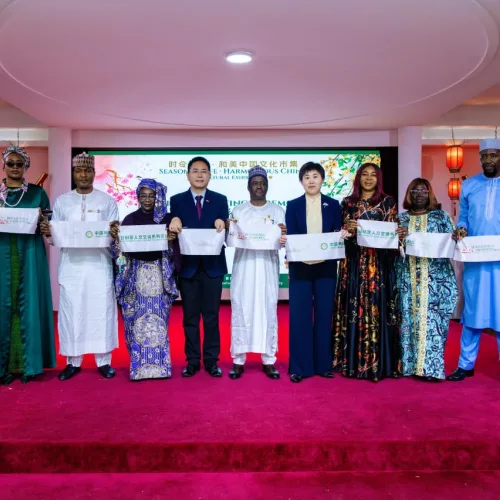
Mukhtar Muhammed, Permanent Secretary of the Federal Ministry of Innovation, Science and Technology, disclosed this on Saturday at the “Seasonal Life, Harmonious China” cultural exhibition held at the China Cultural Centre in Abuja.
Muhammed said the new trade opportunity created by China’s zero-tariff policy should be matched with stronger scientific innovation, agro-processing capacity and technology transfer to enable Nigerian producers to meet the quality and supply-chain requirements of the Chinese market.
He said Nigeria’s agricultural commodities, including sesame, ginger, cashew nuts and cocoa, had significant export potential but had historically faced barriers to accessing international markets.
According to him, the implementation of the zero-tariff policy, which took effect in May, provides an opportunity for Nigerian agricultural products to gain greater access to the Chinese market.
“However, we must see this as a starting point. The policy does not just facilitate exports; it forces us to level up,” he said.
Muhammed said Nigeria must improve the quality, packaging and supply-chain standards of its agricultural products to take full advantage of the Chinese market, adding that the Ministry of Innovation, Science and Technology would play a central role in driving the required scientific and technological transformation.
He said the Federal Government was seeking deeper collaboration between Nigerian and Chinese ministries responsible for science and technology, universities, research institutions and industries.
The permanent secretary said proposed areas of cooperation included the development of affordable solar-powered cold storage facilities to reduce post-harvest losses, technology transfer for agro-processing and expanded scientific exchanges.
He said Nigeria was particularly interested in technology that could support the processing of cassava, shea butter and cashew nuts into value-added products for the Chinese and global markets.
“We want to move from exporting raw commodities to exporting value-added products,” Muhammed said.
He also said the government planned to expand scholarships and Science, Technology, Engineering and Mathematics (STEM) training opportunities for Nigerian scientists in Chinese universities, with particular emphasis on sustainable agriculture and water management.
Muhammed said his recent technical visit to China, particularly the Yangling High-tech Agricultural Demonstration Zone in Shaanxi Province, had reinforced the potential for closer agricultural and scientific cooperation between both countries.
He described Yangling as China’s “Agricultural Silicon Valley”, saying the delegation witnessed the integration of modern technology with traditional farming practices.
Among the technologies observed, he said, were water-saving irrigation systems and soil-monitoring technologies that enable agricultural production in arid environments while reducing water wastage.
He said China’s experience in combating land degradation and improving agricultural productivity in the Loess Plateau could provide useful lessons for addressing agricultural and environmental challenges in Northern Nigeria and the Lake Chad region.
“This is not just theoretical research; it is practical, scalable innovation that transforms lives,” he said.
Muhammed said the Federal Government wanted to translate lessons from such international partnerships into practical solutions that could improve agricultural productivity, reduce losses and increase incomes for Nigerian farmers.
He described the growing Nigeria-China relationship as one that was moving beyond conventional trade to encompass agricultural, scientific and technological transformation.
Earlier, Yang Jianxing, Chinese Cultural Centre Councillor, said the exhibition was part of the broader China-Nigeria people-to-people and cultural exchange programme and was designed to provide Nigerians with an opportunity to experience aspects of Chinese traditional culture.
The Councillor said 2026 marked both the China-Africa Year of People-to-People Exchanges and the 55th anniversary of the establishment of diplomatic relations between China and Nigeria.
He said cultural exchange remained an important component of China-Africa cooperation and a bridge for promoting mutual understanding, friendship and dialogue between civilizations.
According to him, China and Nigeria, despite their geographical distance, are ancient civilisations with long histories, diverse cultural traditions and values of openness and inclusiveness.
He said exchanges between the two countries in culture, education, tourism and youth affairs had expanded in recent years, contributing to deeper understanding between their peoples and strengthening the China-Nigeria comprehensive strategic partnership.
The exhibition, he said, was centred on the concept of “seasonal life”, a principle rooted in traditional Chinese culture and reflected through the Twenty-Four Solar Terms, traditional cuisine, intangible cultural heritage crafts and interactive cultural activities.
The Twenty-Four Solar Terms, he said, represented the accumulated wisdom of ancient Chinese people in observing nature and had also been recognised as intangible cultural heritage by UNESCO.
He said the concept reflected values centred on respect for nature, conservation of resources and the pursuit of a harmonious and beautiful life.
Jianxing noted that these values also resonated with Nigerian traditions that emphasise respect for nature, family, community and cultural heritage.
He said the similarities provided a strong foundation for greater cultural exchange and mutual learning between China and Nigeria.<
The Chinese embassy and the China Cultural Centre in Nigeria, he said, would continue to serve as bridges between the two countries and implement the outcomes of the Forum on China-Africa Cooperation (FOCAC) Beijing Summit as well as agreements reached by the leaders of Nigeria and China.
Read also: Customs intercepts rifle parts, N373.8m cannabis cargo as election security risks rise
He said the China-Africa Year of People-to-People Exchanges would provide an opportunity to organise more cultural exhibitions, artistic performances, language classes, youth exchanges and tourism promotion activities.
The Councillor said the objective was to deepen cultural cooperation and strengthen ties between the peoples of China and Nigeria.
Muhammed also congratulated the Communist Party of China on its 105th anniversary, describing China’s socio-economic development, technological innovation, poverty reduction and infrastructure transformation as examples of the impact of long-term strategic planning.
He said Nigeria could draw lessons from China’s experience, particularly in using science, technology and innovation to accelerate development.
He stressed that the next phase of Nigeria-China relations should focus on translating bilateral opportunities into tangible benefits for Nigerians.
“The Federal Ministry of Innovation, Science and Technology is committed to ensuring that this new season of trade openness is matched by a new season of scientific enlightenment and technological advancement,” he said.
Muhammed said Nigeria would continue to work with China to turn emerging opportunities in trade, agriculture, science and technology into practical outcomes that would benefit Nigerian farmers, researchers, industries and the wider population.


Comments
Start the conversation about this story.