





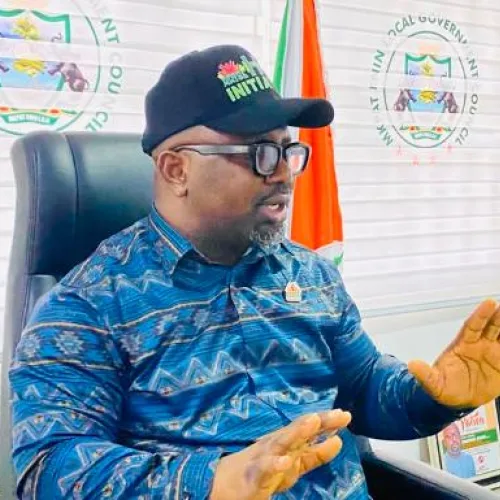
Eighteen months after he was sworn into office as chairman of Mkpat Enin Local Government of Akwa Ibom, Emmanuel Inyang has explained why his administration focused on revolutionalising infrastructure development and healthcare provision in the council.
Recall that after his inauguration, Inyang had assured that his administration would complete all projects begun by his predecessors, noted that since development is cumulative and not competitive, continuity should not be seen as political weakness, but institutional strength.
He described infrastructure as the skeleton of development, stressing that without it, every aspiration becomes structurally fragile. “Roads, in particular, perform functions that transcend transportation. They are economic arteries through which commerce circulates, agricultural produce reaches markets, educational access expands, healthcare becomes attainable and social cohesion is strengthened,” he added.
Giving a rundown of his council’s achievements in the last one and a half year, the chairman disclosed that recognising that indispensable reality, his administration embarked upon the grading of more than seventy-seven kilometres of roads strategically distributed across Mkpat Enin.
“The interventions traversed the Ibekwe–Ikot Mkpenyen–Ikot Unya–Ikot Eda–Ikot Abasi Obio Akan corridor; Ikot Inyang Okop–Ibioette Road; Ikot Edim–Ikot Ayan–Ikot Osunotuk–Ikot Akpabio–Ikot Etefia–Ikot Akan Ukam Road; Mkpat Enin–Ikot Obio Akwa–Ikot Ekpe Road; INEC Road; Asong–Atanuk Road; Ekpuk–Minya Ntak Road; Ikot Abia–Ikot Obio Ekoi Road; and Ikot Ekim Town–Ikot Aba Road.
“To regard these merely as engineering interventions would be to underestimate their developmental significance. Every rehabilitated rural road, shrinks distance between producers and consumers. It lowers transportation costs for traders, reduces post-harvest losses for farmers, accelerates emergency response, enhances school attendance and broadens economic participation,” Inyang stated.
Reflecting on Inyang’s first 18 months in office, a stakeholder, Mr Godwin Edet, said the period “suggests a governing philosophy rooted less in ceremonial politics than in developmental pragmatism. Rather than concentrating governmental energies upon monumental projects designed principally for political symbolism, the administration appears to have embraced the less glamorous—but infinitely more consequential—task of solving everyday problems confronting ordinary citizens.”
Edet maintained that communities are rarely transformed by isolated grand projects but through the cumulative effect of hundreds of practical interventions that incrementally improve daily existence, adding: “The history of development across nations consistently demonstrates that prosperity rarely arrives where accessibility remains absent. Connectivity is itself a form of capital. Great infrastructure does more than occupy physical space; it solves persistent social problems.”
He noted that the construction of three culverts alongside rehabilitation works within Odoro Ikot Community, extending through Ikot Inyang Okop and Ibioette, illustrates infrastructure conceived, not as political ornamentation, but as functional public investment.
“Flood mitigation, improved drainage and enhanced mobility represent interconnected developmental outcomes whose benefits extend far beyond the immediate communities. Markets become more accessible, businesses operate with greater predictability, agricultural productivity improves, while public safety is enhanced.
“Such projects rarely dominate political headlines, yet they quietly reshape the everyday rhythm of community life. They exemplify governance at its most intelligent, illuminating communities and expanding Possibilities
“Electricity occupies a singular position within the hierarchy of developmental infrastructure, because, where power exists, enterprise follows.
And, where enterprise flourishes, employment expands. Where employment grows, prosperity gradually acquires permanence,” he remarked.
For her part, Madam Mary Rose Nseobong, disclosed that the Inyang administration’s provision of a brand-new 300KVA transformer to Ikot Oyoro community after years of prolonged darkness represents more than an engineering accomplishment as according to her, it constitutes the restoration of economic possibility.
“Likewise, the rehabilitation of the transformer at Ikot Akpan Ukam, electrification expansion into Ibiaku Village and ongoing transformer installation at Ikot Ekpaw collectively reflect an appreciation that modern economies cannot flourish beneath the shadow of chronic energy deprivation.
“Electricity lengthens productive hours, it sustains small businesses, improves healthcare delivery and enhances educational outcomes,” she asserted, adding that in many respects, every electrified community becomes a newly connected participant within the broader economy.
While describing institutional renewal as democratic investment, Nseobong, who runs an event centre in the council area, noted that the durability of democracy depends not only upon elections, but upon the strength of institutions that sustain public administration.
“The renovation of the Legion House, rehabilitation of the Divisional Police Headquarters, landscaping and perimeter fencing of the Council Secretariat, alongside the renovation of Ekong Sampson Hall, reflects the chairman’s understanding that institutional environments influence institutional performance.
“Functional public institutions cultivate public confidence. Well-maintained civic infrastructure reinforces governmental legitimacy.
Administrative efficiency often begins with administrative dignity. These investments therefore extend beyond aesthetics; they represent deliberate efforts to strengthen the architecture through which governance itself operates.
“The chairman has also democratized opportunity through economic empowerment. I dare say that economic inclusion remains among the most potent instruments available to contemporary governance.
“The administration’s ₦100 million empowerment initiative—comprising ₦50 million in business grants and ₦50 million worth of gift items—illustrates an effort to decentralise opportunity by placing productive resources directly into the hands of citizens.
“Unlike conventional welfare, empowerment aspires to generate economic self-sufficiency. Its objective is not perpetual dependency but entrepreneurial independence. When artisans acquire equipment, traders expand inventory and small businesses secure working capital, local economies acquire new layers of resilience.
The most sustainable social intervention remains the creation of opportunity,” she reiterated.
It is recalled that in January 2025, when the Akwa Ibom State governor, Pastor Ume Uno, inaugurated the newly elected council chairmen in the state, he charged them to reflect the needs of the rural dwellers in the development agenda, stressing that the Arise agenda of his administration would not condone indolence.


Comments
Start the conversation about this story.