





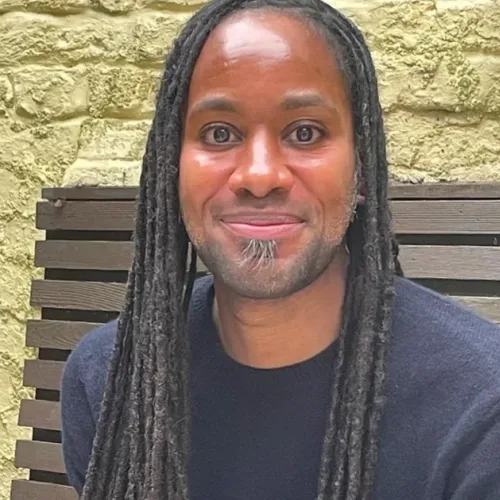
Jason Arday’s resignation from the University of Cambridge has brought renewed attention to the British sociologist, whose career and personal story had made him one of the most prominent Black academics in the United Kingdom.
Arday resigned as professor of sociology of education with immediate effect on Wednesday, after Cambridge announced an investigation into his academic qualifications and honorary appointments.
The university had previously said it was investigating allegations of academic misconduct, while Liverpool John Moores University, which awarded Arday his PhD, said its earlier investigation into plagiarism allegations found no academic misconduct and that his doctorate remained valid.
The controversy has since expanded beyond the plagiarism and Arday’s career to debates about race in academia.
Here are things to know about Arday and the controversy surrounding him.
Who is Jason Arday?
Arday is a sociologist whose work has focused largely on race, education, inequality and diversity.
He was appointed professor of sociology of education at Cambridge in 2022 and took up the position in 2023.
His appointment attracted international attention because, at 37, he became the university’s youngest Black professor.
Before Cambridge, Arday held academic positions at institutions including the universities of Glasgow, Durham and Roehampton.
His rise was particularly notable because of his account of his childhood and educational journey.
Arday has said he was diagnosed with autism and global developmental delay at the age of three. He has said he did not speak until he was 11 and learned to read and write at 18.
His story was widely celebrated as an example of overcoming significant personal and educational challenges.
Plagiarism and errors
Arday became the subject of intense scrutiny after allegations were made about his 2015 PhD from Liverpool John Moores University entitled “An Exploration of Peer-Mentoring Among Student Teachers to Inform Reflective Practice Within the Context of Action Research.”
The issue was raised by US researcher Nathan Cofnas, a researcher who has described himself as a “race realist” and whose Cambridge college role ended after controversy over his views on race and meritocracy.
He alleged that sections of the thesis contained passages that were identical or very similar to material in earlier academic work.
The Telegraph subsequently reported that more than 180 passages in the work were identical or near-identical to a 2009 doctoral dissertation by Paula Zwozdiak-Myers, a student at Brunel University of London.
Cofnas said plagiarism-detection software had identified passages that were “lifted with minimal editing.”
Critics have questioned the research methodology section and argued that similar plagiarised passages appeared in other Arday’s academic papers
There are also claims that the thesis relied on the professor’s subjective commentary regarding his personal experiences instead of foundational qualitative or quantitative data analysis.
Critics also argued that the thesis and subsequent papers show a lack of understanding of statistical inference after an impossible field study with 78% male respondents and 32% female respondents was reportedly stated.
Arday has denied plagiarism but has acknowledged errors in his work.
Liverpool John Moores University, where he completed his PhD in 2015, investigated plagiarism allegations made against his thesis and did not uphold them.
The university has said its position remains unchanged and that Arday’s PhD “still stands”.
Arday’s reaction
Arday has said he accepts responsibility for mistakes in his academic work but rejects the portrayal of him as a liar or fraud.
In an interview with The Times, he said: “I am accountable for the mistakes I’ve made.”
He added: “What I am not is a liar.”
Arday has also said that some errors in his early academic work were linked to his autism and the way he used mimicry to understand information.
He has described the scrutiny as part of a coordinated campaign against him and suggested that it was racially motivated.
“There has been, since I arrived at Cambridge, a very well orchestrated and co-ordinated campaign to unseat me from my position,” he said.
Why did he resign?
Arday announced his resignation after Cambridge said it had launched an investigation “following new information” about his “academic qualifications and honorary appointments”.
In his resignation statement, Arday said he had faced “an unrelenting level of public scrutiny and personal attack”.
He said being appointed to Cambridge had been “without question, the greatest professional privilege of my life”, but added: “There comes a point when the personal cost becomes too great.”
Arday said his decision to resign should not “be interpreted as a loss of faith in scholarship” or “be mistaken for an acceptance of the narratives that have surrounded me”.
“For my own wellbeing, for my family, and for those who have stood by me throughout this difficult period, I have concluded that the only way to bring this chapter to an end is to step away,” he said.
He added: “This is not the end of my work” and said he needed “time to heal”.
What questions have been raised about his CV?
The scrutiny has extended beyond his PhD.
Several universities have reportedly disputed claims about academic positions or honorary appointments attributed to them.
The Telegraph reported that two universities denied Arday’s claims that he was a visiting professor, while another disputed his claim to have been an honorary professor.
A fourth institution reportedly disputed that he had studied there.
Cambridge has said its investigation will examine the circumstances surrounding Arday’s appointment and tenure.
The University of Glasgow, where Arday worked as professor of sociology of education from January 2022 to March 2023, has also commissioned a review of his appointment.
The university said the review was intended to establish the facts and identify lessons for the future.
His publications
Questions have also been raised about Arday’s academic publications.
A retired academic, David Harris, had previously raised concerns about some of Arday’s academic papers.
Two journals subsequently issued corrections relating to papers associated with Arday.
The controversy also led to scrutiny of a book Arday had claimed to have published, titled Being Young, Black and Male: Challenging the Dominant Discourse.
Palgrave Macmillan confirmed that it had accepted a proposal for the book but did not publish it.
Controversy sparks race debate
Race has been central to the debate surrounding Arday.
Some academics and commentators have argued that the scrutiny against him is connected to opposition to diversity, equity and inclusion policies and to the presence of Black academics at elite universities.
Academic Kehinde Andrews said the controversy reflected a broader belief that Black people did not belong in institutions such as Cambridge.
He said: “For three years they’ve been trawling through all of this to prove that there’s some conspiracy to benefit black people.”
Others have argued that Cambridge may have prioritised diversity considerations in appointing Arday.
Kathleen Stock, a philosopher and former professor at the University of Sussex, said elite universities wanted to change perceptions that they were “very white places”.
Cambridge has not said that Arday was appointed because of his race.
What has Cambridge done?
Cambridge initially defended Arday against the allegations, describing them as part of a “vile campaign to undermine his credibility”.
However, after the university announced its investigation into his qualifications and honorary appointments, it said it would continue examining the circumstances surrounding his appointment and tenure even after his resignation.
The university has also announced a review of its process for appointing senior academics.
It said findings from the investigation into Arday would “feed into” the review.
Jesus College, where Arday was a fellow, has also launched its own process parallel to the university’s investigation.
Arday’s memoir
Arday is the author of Great and Unfortunate Things, a memoir scheduled for publication by Simon & Schuster.
The publisher has said it intends to proceed with publication despite the controversy.
Arday previously told the Guardian that the publisher had offered “1.4 million” for the memoir, although he did not specify whether the figure was in pounds or US dollars.
Simon & Schuster has not confirmed the amount.
Publishing insiders questioned whether such a large advance was plausible for a book by an academic who was not already a major commercial author.
The memoir recounts Arday’s life, including his childhood diagnosis, educational difficulties, academic career and rise to Cambridge.
Questions have also been raised about differences between the book proposal and the final memoir, including accounts of events in his life.
Comments
Start the conversation about this story.