





…Okunbo’s life offers lessons in leadership, says Sirleaf
…My father’s legacy is unity, son
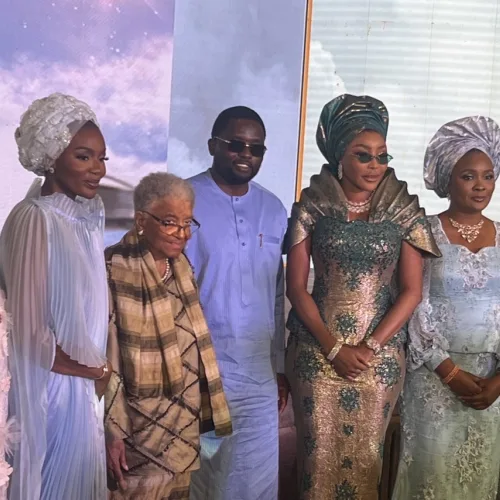
Leadership and legacy took centre stage in Lagos on Saturday as family, political leaders, business associates and friends gathered to mark the fifth anniversary of the death of Captain Idahosa Wells Okunbo, with speakers urging the next generation to measure leadership by its impact on people and society.
The anniversary event, which featured Ellen Johnson Sirleaf, former Liberian president, as keynote speaker, examined how Okunbo’s life, relationships and investments in people could provide lessons for leadership and the responsibility of those left behind to sustain his values.
Sirleaf said Okunbo’s life demonstrated that leadership was not primarily about the power or position held by an individual but the extent to which that power was used to improve the lives of others.
“Leadership is measured not by the power one holds, but by the lives one lives,” she said.
She said Africa had produced many powerful individuals but needed more leaders who would deploy their influence towards the greater good.
“Africa has never lacked powerful men. What Africa needs are leaders who use power for the greater good of humanity,” Sirleaf said.
The former Liberian president said Okunbo’s legacy remained visible five years after his death through the institutions he established and the people he empowered.
She urged young people to see legacy as a responsibility to create impact rather than simply an inheritance.
“As you build your future, do not measure success only by wealth, stature, or recognition. Instead, ask yourself, what problem am I called to solve? What life can I improve? What legacy do I want to leave behind?” she said.
In his opening remarks, Osahon Okunbo, son of the late businessman, said the most important element of his father’s legacy was the mandate he left his family to remain united.
He said Okunbo repeatedly told his children that they needed to stay together, a message he initially understood as a father’s desire for family closeness but later recognised as a broader leadership lesson.
“My father understood that, and everything he built rested ultimately on whether the people he left behind could still sit together,” Osahon said. “He didn’t just simply give us a legacy, he set us up with one. And the commission was for each other.”
He acknowledged that maintaining the family’s unity had been challenging since Okunbo’s death, with difficult conversations and disagreements testing relationships.
Osahon said unity did not mean the absence of disagreements but the ability to remain committed to a shared purpose despite them.
“Unity is deciding that disagreement doesn’t put an end to the mission or the task ahead of us,” he said.
He described the family’s continued togetherness as the central expression of Okunbo’s legacy.
“Unity is not about protecting our father’s legacy, unity is our father’s legacy,” he said.
Dapo Abiodun, Ogun State governor, described Okunbo as a loyal and dependable friend whose influence extended beyond business.
Abiodun recalled their relationship dating back to the 1990s and described Okunbo as “extremely consistent, very dependable, extremely reliable.”
The governor also described Okunbo as a successful entrepreneur with interests across different sectors and recalled his efforts to promote Nigeria’s cultural heritage and the repatriation of Benin artefacts.
Adams Oshiomhole, former Edo governor and senator representing Edo North, said Okunbo’s ability to keep his family together stood out among his achievements.
“It is very rare for a man of the captain’s standing, you know, to depart and for the children, the widows to live together,” Oshiomhole said.
He also recalled Okunbo’s support for his political career, saying the late businessman was prepared to commit his resources to causes he believed would contribute to society.
Aliyu Ahmed Wadada, APC governorship candidate in Nasarawa State, said Okunbo demonstrated that leadership could transcend ethnic and religious differences.
Wadada, who is from northern Nigeria and is a Muslim, said his relationship with Okunbo, a Christian from southern Nigeria, was based on mutual respect and shared humanity.
“He related with me as a human being,” Wadada said.
Wadada said Okunbo’s legacy extended beyond the businesses and assets he left behind to include the people whose lives he influenced.
The anniversary therefore placed leadership not merely in the context of positions held or businesses built, but in the ability to empower others, sustain relationships and leave behind people and institutions capable of carrying a mission forward.


Taofeek Oyedokun is a correspondent at BusinessDay with years of experience reporting on political economy, public policy, migration, environment/climate change, and social justice. A graduate of Political Science from the University of Lagos, he has also earned multiple professional certificates in journalism and media-related training. Known for his clear, data-driven reporting, Oyedokun covers a wide range of national and international socioeconomic issues, bringing depth, balance, and public-interest focus to his work.
Comments
Start the conversation about this story.