





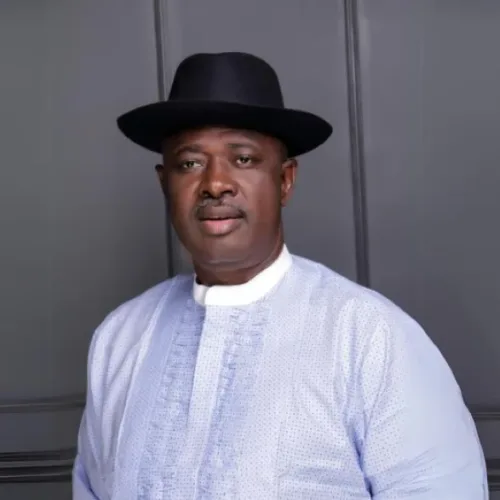
File: Minister of State for Petroleum Resources (Oil), Senator Heineken Lokpobiri
The Federal Government has said the Dangote Refinery alone cannot meet Africa’s growing refined petroleum products needs, urging local and international investors to pour more capital into Nigeria’s refining, midstream and downstream sectors.
The Minister of State for Petroleum Resources (Oil), Heineken Lokpobiri, said Nigeria must build on the success of the Dangote Refinery and attract additional investments if it wants to move beyond supplying the West African market and become a major refined petroleum products hub for the entire continent.
Lokpobiri spoke on Tuesday at the second West Africa Refined Fuel Market Conference in Abuja, where regulators, refiners, traders, financiers and other energy industry stakeholders gathered to advance plans for a transparent regional pricing system for refined petroleum products.
The conference was jointly hosted by the Nigerian Midstream and Downstream Petroleum Regulatory Authority, S&P Global Commodity Insights and the West Africa Regulators Forum.
It was themed, “Funding West Africa Infrastructure & Distribution to Create a Transparent Market for Regional Price Benchmarks.”
The minister described the conference as a turning point in Africa’s pursuit of greater energy sovereignty, saying Nigeria must now build on the progress recorded in its refining and midstream sectors.
He said the Dangote Refinery had demonstrated what could be achieved through private-sector investment but stressed that its growing capacity would still not be sufficient.
“The Dangote Refinery is not enough. Despite the fact that the refinery is increasing its refining capacity to 1.4 million barrels. But it is not enough for the African continent.
“It’s the final capacity to open for middle buyers to be able to sell this entire African continent on top of the entire world,” Lokpobiri said.
The minister called on investors with capital to seize the opportunity presented by Nigeria’s expanding energy market, saying the country was strategically positioned to serve both regional and international markets.
He said Nigeria’s location also offered an advantage because the country was not directly dependent on the Strait of Hormuz for its crude and petroleum product supply routes.
The minister added, “It’s the best time for us to attract as many investors as we can. Not just into the upstream, but into the midstream, and then the downstream.”
He said Nigeria must move beyond the traditional model of exporting raw commodities and importing processed products, arguing that the country’s growing refining capacity provided an opportunity to change the pattern.
Lokpobiri urged stakeholders to replicate the success recorded by the Dangote refinery by attracting more investment into domestic processing.
He said Nigeria should not be content with capturing the West African market but should position itself to supply the wider African market.
Lokpobiri recalled that European demand for Dangote refinery’s jet fuel had affected local market conditions, saying the development demonstrated the need to deepen domestic refining capacity and develop pricing structures that could respond appropriately to market forces.
He assured stakeholders that the Federal Government would continue to support the development of a regional petroleum market and the institutions required to make it work.
He said the objective was not merely to increase Nigeria’s refining output but to develop the infrastructure, regulatory framework and pricing system required to turn the country into a major African energy hub.
Also speaking, the Special Adviser to the President on Energy, Olu Verheijen, said West Africa was not short of energy resources or demand but was constrained by fragmented markets and inadequate infrastructure.
She said Nigeria’s growing refining capacity and declining dependence on imported petrol had created an opportunity for the country to serve as an anchor for a more integrated regional petroleum market.
Comments
Start the conversation about this story.