





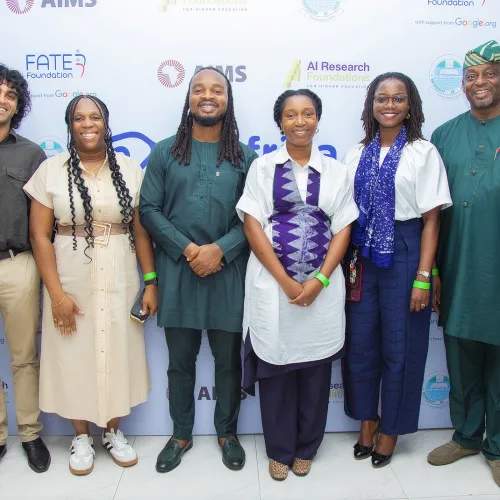
L-R: Michael Alummoottil, project manager, African Institute of Mathematical Sciences; Oluchi Johnson-Achibiri, head, digital Ilinnovation, FATE Foundation; Francis Sani, programme director, 3MTT Nigeria; Matita Arize, Sub-Saharan Africa program manager, Google.org; Ayomide Akindolie-Igwe, executive director, FATE Foundation and Foluso Ebun Afolabi Lesi, deputy vice chancellor of development services, University of Lagos at the launch of the Africa AI Upskilling Programme (AAUP) in Lagos.
Google.org has committed $1.1 million to FATE Foundation to launch an advanced AI training program at 10 Nigerian universities in partnership with the African Institute for Mathematical Sciences.
The intiative – the Africa AI Upskilling Programme (AAUP), launched Monday at the University of Lagos is part of a broader push to build AI capacity across Africa.
The prgramme will use a “Train-the-Trainer” model to equip lecturers to deliver a localized version of the Google DeepMind curriculum to STEM students.
It starts in Nigeria but will ultimately cover 30 higher institutions across Nigeria, Ghana, Kenya and South Africa.
The goal is to train more than 30,000 students and embed advanced AI coursework into mainstream university programs to address gaps in curriculum, faculty expertise and industry linkages that have limited Africa’s AI readiness.
“Technology should be a great equaliser, not a wedge that deepens global inequality,” said Matita Arize, Sub-Saharan Africa program manager at Google.org , at the programme launch in Lagos.
“We believe that the transformative power of AI must be accessible to everyone, everywhere, and most importantly, that those closest to the world’s challenges must be equipped to build the solutions.”
She noted that the initiative will embed advanced AI training and education into universitirs across Nigeria. “We do not just need AI users in Africa, we need AI creators, model architects, researchers and tech founders.”
Arize said the investment targets Nigeria because by 2030 Africa will have the world’s largest workforce with over 230 million digital jobs emerging.
She added that AI could add $30 billion to Sub-Saharan Africa’s economy by 2030, but warned that 263 million young Africans risk lacking opportunities by 2025 without urgent digital skills investment.
“The choices we make right now will determine whether Africa leads in the AI revolution or is left behind,” she said.
“No single institution or funder can solve systemic educational gaps alone,” she added.
“By funding directly into local university ecosystems, we are not creating a temporary intervention; we are institutionalizing capacity so that these universities can continue nurturing generations of AI leaders long into the future.”
The program aims to equip faculty across 10 higher education institutions in Nigeria to scale training to over 10,000 STEM students.
In her opening remark, Ayomide Akindolie-Igwe, executive director of FATE Foundation, said the partnership has set out on an ambitious journey to help build a sustainable, scalable ecosystem for advanced AI education across Africa.
“AI is already shaping work, economies and opportunity, yet several gaps continue to limit Africa’s AI readiness, including curriculum gaps, faculty expertise gaps, weak industry-academia linkages, infrastructure limitations, and fragmented training efforts.”
Akindolie-Igwe said institutions were selected across Nigeria, South Africa, Kenya and Ghana following a competitive process.
“The selected institutions were chosen based on their STEM strength, institutional readiness, the faculty interest and capacity, student population in STEM programmes, leadership commitment, and sustainability plans,” she said.
“Regional representation, that was also key for us, because after all, an African programme should not look like it got stuck in one neighbourhood.”
According to her, the breakdown is 10 universities in Nigeria, 10 in South Africa, 6 in Kenya and 4 in Ghana.
She noted that the initiative’s success will depend on collaboration between universities, AI “Champions” and industry to create a scalable ecosystem that can outlast the initial cohort and prepare graduates for an AI-driven economy.
In his keynote address, Francis Sani, programme director, 3MTT Nigeria, said Africa and Nigeria are positioned to play a central role in the future workforce because of demographics.
“86 percent of the next new additions to the world’s population over the next 25 years is going to be African. And as always, Nigeria is at the centre of that, because one in eight of each of those people are going to come from Nigeria,” he said.
“The people who are going to power the workforce of the future are going to come from this continent,”
He identified gaps in capacity and infrastructure that should be address. “Less than 3 percent of the AI workforce in the world is on the continent. Less than 1 percent of the world’s compute is in Africa,” Sani said.
“But there’s already a lot of work being done. We have Cassava Cloud, we have NTMS launching data centres. And just last month, Nigeria moved up by 42 places in the Global AI Responsibility Index. We are number one in Africa.”
Sani added that government is also rolling out the Nigeria Project Bridge to deliver fast internet across 774 local governments.
Sani urged lecturers and institutions to connect AI research to Nigeria’s economy, where “over 92 percent of our economy is based in the informal sector.”
“To unleash the potential that our young people have, we need to be able to ensure that the people who support them have the capacity that they need. And that’s what this programme has been set up for.”
“Nigeria’s economy is expected to be over $50 trillion by the end of the century. We’re not going to get there without the use of advanced technologies.”
Folasade Ogunsola, vice-chancellor of the University of Lagos, in her remarks, said UNILAG is honoured to be chosen for the launch of the initiative that is Africa-wide.
Represented by Foluso Lesi, deputy vice chancellor of development services, said UNILAG is uniquely positioned to lead the continent’s AI push.
“Unilag is also the host of the first Open AI Academy in Africa, and has the training in AI.”
“You see, that is also one of the UN’s few hubs across Africa, but it’s the only one dedicated to AI. A lot has happened, and Unilag is actually uniquely positioned to deliver and to be part of this initiative.”
She stressed that Africa’s data gap must be addressed for AI to be relevant to the continent. “From my little understanding of AI, AI is drawing from the information. You can only use intelligence or leverage on intelligence that exists. And our information as Africans is missing,” she said.
“Part of building the faculty of champions who are going to influence and impact the next generation is very important in producing that database that we require, that AI needs to use, so it can be more relevant to the solutions.”


Josephine Okojie-Okeiyi is a journalist with over five years’ reporting experience. She writes on industry, agriculture, commodities, climate change, and environmental issues. She is fellow of Thomson Reuters Foundation and Bloomberg Media Initiative for Africa.
Comments
Start the conversation about this story.