






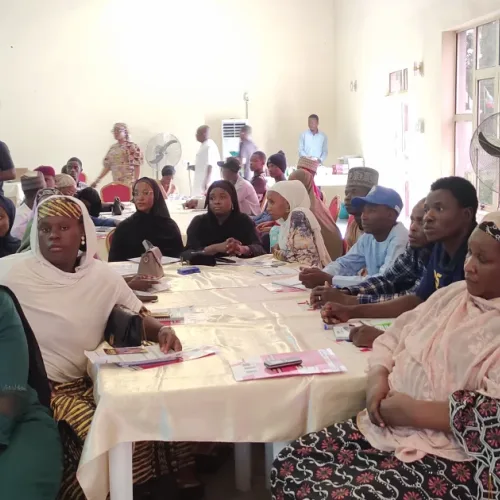
Participants during the training. Credit: Esha Aliku
Women and youths from four local government areas of Katsina State have commenced a four-day training aimed at strengthening their capacity to prevent conflicts, resolve disputes and manage community resources amid growing pressure over land, water and other shared resources.
The training, which began on Monday in Katsina, is being organised under the European Union-funded Conflict Prevention, Crisis Response and Resilience Programme, implemented by the International Organisation for Migration, Mercy Corps and the Centre for Democracy and Development.
The intervention brings together farmers and herders, women and youth representatives, including persons with disabilities, from Safana, Faskari, Sabuwa and Dandume local government areas, as well as representatives of the Katsina State Ministries of Youth and Sports Development and Women Affairs.
Speaking during the training, Senior Programme Manager of Mercy Corps, Philip Ikita, said the approach was designed to move communities away from confrontation and towards identifying common interests that could provide a basis for peaceful settlement of disputes.
He noted that women, who are often directly affected by community conflicts but remain underrepresented in formal peace processes, needed practical negotiation skills to participate more effectively in conflict prevention and resolution.
“The objective is to build the capacity of community women to manage and resolve local conflicts through negotiation approaches that focus on shared interests rather than opposing positions,” he said.
Ikita added that the training was expected to improve participants’ communication and negotiation skills, strengthen trust and collaboration between communities and enhance their ability to address resource-based disputes.
“The second component of the training will focus on Community and Social Development Resource Management, with particular emphasis on the sustainable and conflict-sensitive management of land, water, forests and other resources shared by communities.
“The objective is to equip communities with the knowledge and tools to manage shared community and social development resources in a sustainable and conflict-sensitive way.
“The training was particularly relevant in communities where competition over natural resources could aggravate tensions between farmers, herders and other resource users.
The CSDRM component is expected to strengthen women’s capacity to identify and respond to climate and resource-related conflicts, improve understanding of sustainable resource management and local resource mapping, and promote collaboration around conservation and peacebuilding.
Under the CPCRR Programme, the intervention covers 48 communities across 10 LGAs in Katsina and Zamfara states, with a broader objective of addressing the root causes of conflict, strengthening community resilience and supporting socio-economic recovery.
Mercy Corps, one of the implementing partners, is responsible for activities aimed at strengthening community mechanisms for conflict prevention, supporting inclusive dialogue and enhancing resilience to climate-related shocks.
The organisation is also supporting the construction of community Quick Impact Projects in eight targeted Katsina LGAs: Batsari, Danmusa, Jibia, Kankara, Dandume, Faskari, Sabuwa and Safana.
The CPCRR Programme builds on the experience of the Conflict Mitigation and Community Reconciliation project and seeks to promote long-term peace and stability in Northwest Nigeria through locally led and sustainable interventions.
The Senior Programme Manager further said the approach recognises that lasting peace cannot be achieved solely through security measures, stressing the importance of empowering communities to identify, negotiate and address the issues driving tensions.
Comments
Start the conversation about this story.