






Nigeria’s dependence on monthly federal allocations is undermining productivity and slowing national development, a lecturer at the Nigerian Defence Academy (NDA), Prof. Toba Alabi, has said.
Alabi said the country must move away from a system in which federal, state and local governments rely heavily on allocations from Abuja, stressing the need for states to develop their productive sectors and strengthen internally generated revenue.
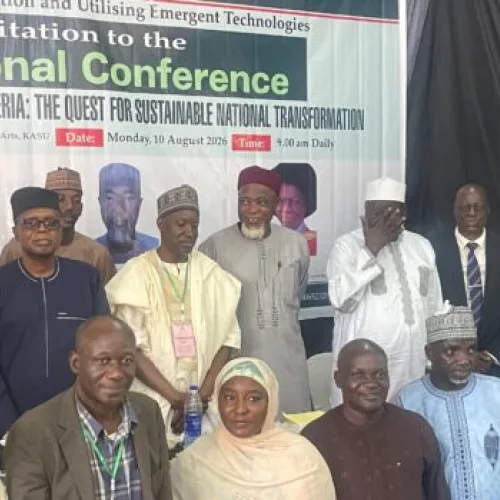
He spoke at a national conference organised by the Department of Religious and Cultural Studies, Faculty of Arts, Kaduna State University (KASU), with the theme, “Development Challenges and Opportunities for Nigeria: The Quest for Sustainable National Transformation.”
The NDA don identified economic dependence, unemployment, insecurity, poor infrastructure, weak human capital development and over-reliance on crude oil as interconnected challenges threatening Nigeria’s transformation.
He said the practice of 774 local governments and 36 states going to Abuja every month for allocations had weakened the incentive for governments to develop their own economies.
“Every 30 days, 774 local governments, 36 state governments, they go to Abuja. They are not contributing, no internally generated revenue. How can a country develop under that condition?” he asked.
Alabi also called for urgent diversification of Nigeria’s revenue base, saying no state should depend on a single source of income.
“There is no state in Nigeria that cannot feed itself,” he said, urging governments to return to agriculture and support local production.
He further criticised the country’s dependence on imported goods, including food and textiles, saying deliberate patronage of locally produced goods could revive domestic industries and create employment.
The lecturer linked unemployment to insecurity, warning that young graduates who remain without jobs for years could become vulnerable to social problems.
He also raised concern over the number of children outside school, saying about 15 million Nigerian children who should be in school are currently out of school, describing the situation as a major threat to human capital development.
Also speaking at the conference, Vice-Chancellor of KASU, Prof. Abdullahi Ibrahim Musa, rejected claims that Nigeria’s university curriculum and educational system were outdated.
Musa said the continued success of Nigerian graduates and academics internationally was evidence that the country’s education system had the capacity to compete globally.
He said Nigerian universities were constantly reviewing their programmes through workshops, conferences and seminars to respond to changing global realities.
The Vice-Chancellor cited his personal experience in the United States, where he said he emerged the best in his class, arguing that such achievements demonstrated the strength of the Nigerian educational foundation.
He urged students to take advantage of the opportunities available to them instead of blaming the system for their challenges.
Musa said KASU was also investing in infrastructure, laboratories, libraries, digital facilities and other learning resources, noting that the university had upgraded several facilities and was continuing to improve its learning environment.
Earlier, the Dean of the Faculty of Arts, Prof. Gaius Jatau, commended the organisers, keynote speaker and participants for contributing to discussions aimed at improving teaching, learning and knowledge production.
Jatau said the conference provided an opportunity for academics and students to engage with contemporary issues and explore ways of applying new knowledge and technology to Nigeria’s development challenges.
He urged participants to translate the ideas generated at the conference into practical actions that could contribute to improving the university and society.
Comments
Start the conversation about this story.