






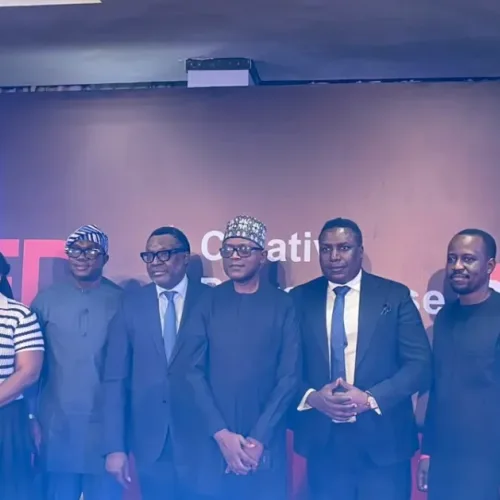
L–R: Director General of the Rivers State Tourism Development Agency, Yibo Koko; Chief Executive Officer of Narrative Landscape Press, Anwuli Ojogwu; alongside other speakers and dignitaries at the QEDNG Creative Powerhouse Summit held in Lagos on Tuesday.
The Chief Executive Officer of Narrative Landscape Press, Anwuli Ojogwu, is seeking the inclusion of trade publishing in Nigeria’s creative-economy funding programmes, saying publishers are being overlooked despite their role in developing intellectual property for film, television and other creative industries.
The executive said at the QEDNG Creative Powerhouse Summit in Lagos on Tuesday that publishing was excluded from Nigeria’s Creative Economy Development Fund and from a government mapping exercise intended to identify activities across the creative economy.
“We are not included in the creative fund. When the creative report mapping was done, publishing was not included,” Ojogwu noted.
Nigeria’s Creative Economy Development Fund is a Federal Government initiative designed to provide financing, capacity building and intellectual-property-backed collateral solutions for businesses and creators across sectors including film, music, fashion, art, gaming, publishing and cultural tourism.
Ojogwu said publishing’s exclusion partly reflects the way the government has traditionally classified the sector, with the industry often viewed through the lens of education, textbooks and curricula rather than as a commercial creative industry.
That classification, she said, overlooks trade publishing, which produces books for the general market and creates intellectual property that can subsequently be adapted into films, television productions and other formats.
“Trade publishing is very fundamental to the creative industry because that is where IP is really, really important,” she stated.
Ojogwu argued that books should be treated as part of the infrastructure of Nigeria’s creative economy, saying the country already has a large body of literature that could provide stories and intellectual property for the film industry.
She urged Nigerian filmmakers to look more closely at locally published literature for source material rather than focusing primarily on whether stories would appeal to Hollywood.
The comments come as policymakers and industry leaders seek to broaden Nigeria’s creative economy beyond its most visible sectors, including music, film and fashion.
Ojogwu declared that publishing often receives less attention because its economic and cultural impact is less immediately visible than that of music, film, fashion and other creative activities. But she argued that its role in developing intellectual property makes it foundational to other parts of the creative economy.
The Director General of the Rivers State Tourism Development Agency, Yibo Koko, similarly criticised the way governments approach culture and the creative economy, saying the sector is still often treated as a “feel-good” activity rather than as a source of sustainable economic value.
Koko said Nigeria needed to view culture as an economic toolkit and build structures that would allow creative businesses and artists to monetise their work.
He pointed to the country’s ethnic diversity, languages and local cultural traditions as potentially significant economic resources, arguing that festivals and cultural activities could attract investment, sponsorship and visitors if developed within a stronger commercial framework.
“The creative economy is a sustainable economic toolkit,” Koko said, arguing that the government still does not fully understand its economic potential.
The QEDNG Creative Powerhouse Summit, themed “Creativity, Culture and Nigeria’s Next Chapter”, brought together participants from the creative, business, government and technology sectors to discuss investment, partnerships, job creation and sustainable development.
Comments
Start the conversation about this story.