





The battle for Osun State Government House took a sharper turn on Tuesday as the three leading governorship candidates clashed over public finances, infrastructure, federal influence and security at a high-stakes town hall ahead of Saturday’s election.
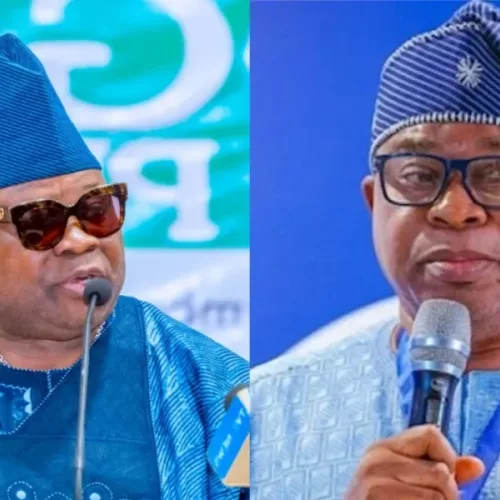
At the ARISE News Governorship Town Hall in Osogbo, Governor Ademola Adeleke of Accord, All Progressives Congress (APC) candidate Bola Oyebamiji and African Democratic Congress (ADC) candidate Najeem Salaam offered competing accounts of the state’s performance and their plans for the next administration.
The N650bn question
The most contentious exchange centred on state finances.
Oyebamiji challenged Adeleke to explain how his administration had utilised what he claimed were about N650 billion in federal allocations received over roughly three and a half years.
The APC candidate contrasted the figure with the approximately N450 billion he said former governors Rauf Aregbesola and Gboyega Oyetola received collectively over 12 years.
“How does N650 billion match what we see in Osun today?” Oyebamiji asked.
He further alleged that about 97 per cent of the administration’s resources had been concentrated in only two local government areas, describing the situation as an “aberration.”
Oyebamiji also disputed claims that Adeleke inherited an empty treasury from Oyetola, insisting that the former administration left about N15 billion for its successor.
The allegations put public spending at the centre of the campaign, raising a broader question for voters: how much revenue has Osun received under Adeleke, where has the money gone, and what measurable assets or services have been delivered in return?
READ ALSO: Osun 2026: Oyinlola group backs Oyebamiji, faults Adeleke over exclusion
Adeleke was not immediately presented with a detailed breakdown of the ₦650 billion figure during the debate, leaving the competing claims over allocations and inherited funds as issues requiring verification against official federal allocation records and audited state accounts.
Adeleke rejects ‘federal might’ threat
Adeleke, meanwhile, adopted a combative posture over allegations that the APC could deploy federal influence to secure victory.
“I am a bulldozer. I am talk and do. I am not afraid of federal might and governors backing the APC candidate. If they like, they should bring all the governors,” he said.
He argued that visiting APC governors could not determine the election because they would not be casting ballots.
“Those governors are my friends. I am a civilised administrator. They won’t vote; they can only come and dance, and after the election, we will meet,” Adeleke said.
The governor also rejected suggestions that his administration had militarised the state ahead of the election, arguing that only President Bola Tinubu, as Commander-in-Chief, could deploy the Armed Forces.
Adeleke’s record under scrutiny
Defending his administration, Adeleke pointed to infrastructure and social-sector projects, claiming that his government had constructed approximately 350 kilometres of roads, with another 160 kilometres under construction.
He also cited the rehabilitation of about 200 primary healthcare centres and investments in agriculture and security.
His public image, including his much-discussed dancing, also came up during the debate.
“I am a very prudent person and a very serious person. Nobody will stop me from dancing. As I am dancing, I am working,” Adeleke said.
Despite the possibility of defeat, the governor declined to entertain the question of congratulating another candidate.
“Forget about it. I’m not going to lose this election because I’m so confident,” he said.
ADC pitches peace
Salaam sought to distinguish himself from the two major contenders by making security and political peace the centrepiece of his campaign.
The former Speaker of the Osun State House of Assembly warned about the alleged proliferation of weapons and political thuggery, arguing that residents were tired of election-related violence.
“Osun people do not want thuggery again because they see us as the most peaceful party,” he said.
Salaam argued that a victory for either of his major rivals could perpetuate political confrontation, positioning himself as a consensus alternative.
He promised to build on useful policies of previous administrations while addressing what he described as failures in governance.
The ADC candidate also highlighted his academic and political credentials, including his doctorate in political science, and presented a 10-point agenda focused on human development and people-centred governance.
What the debate reveals
The town hall exposed three sharply different campaign narratives: Oyebamiji is making accountability and financial scrutiny central to his challenge; Adeleke is campaigning on continuity, infrastructure and resistance to federal influence; while Salaam is selling himself as the peace candidate in a state he says is increasingly threatened by political violence.
But several claims made during the debate remain matters of political contention rather than independently established facts, particularly the figures surrounding federal allocations, inherited funds and resource distribution.
With the election approaching, those financial claims could become critical to how voters assess the competing records of the candidates.
Ultimately, Saturday’s poll will determine whether Osun voters retain Adeleke, return the APC to power under Oyebamiji, or hand the ADC and Salaam the opportunity to offer an alternative political direction.
Comments
Start the conversation about this story.