





By Kazeem Ugbodaga
President Bola Ahmed Tinubu has assured Nigerians that the country’s refineries will be revived and repositioned to deliver sustainable value, stressing that the government is pursuing a comprehensive restructuring of the facilities rather than temporary fixes.
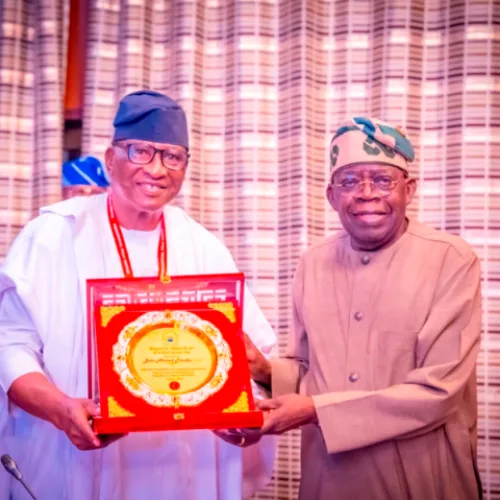
Tinubu gave the assurance on Thursday in Abuja when he received the national executive of the Nigerian Union of Petroleum and Natural Gas Workers (NUPENG), led by its National President, Comrade Salimon Akanni Oladiti, at the State House.
Responding to NUPENG’s call for the revival of the nation’s refineries, the President said the facilities, which represent significant investments made over the years, would not be allowed to deteriorate or become economic liabilities.
He said the government would undertake detailed research, technical assessments and structural reviews to identify the operational, financial and managerial challenges confronting the refineries and develop sustainable solutions.
“The refineries that you mentioned are going to come back to work; we’re just building a very firm, resetting, and structural reworking of the economy of it,” Tinubu said.
The President stressed that merely producing smoke and flames from a refinery would not constitute success unless the facility operates efficiently, generates profit and delivers the value for which it was established.
He said his administration had accepted responsibility for addressing the challenges inherited from previous governments, regardless of how long the problems had persisted.
“No matter what has happened in the years past, it’s now my responsibility as president to fix it and make it work for the greatest common good of our population. I take responsibility for that, and we will do it,” he said.
Tinubu also called for patience and sustained cooperation among stakeholders as his administration implements its economic reforms, expressing optimism that the measures would ultimately create a better Nigeria.
On local government autonomy, the President said constitutional issues surrounding its implementation were being reviewed with a view to possible adjustments, and appealed to stakeholders for understanding.
He also paid tribute to the late former NUPENG President, Frank Kokori, recalling their shared struggle for the restoration of democracy in Nigeria.
“You brought good memories of my relationship with Frank Kokori; may his soul rest in peace. We struggled for this democratic dispensation together, and it was very tough for us to have this democracy,” Tinubu said.
The President further promised greater inclusion of NUPENG in the implementation of the Presidential Initiative on Compressed Natural Gas (CNG), while challenging the union to ensure that the benefits of the programme reach ordinary commuters.
Earlier, NUPENG President Oladiti commended Tinubu for what he described as bold economic decisions, particularly the removal of the fuel subsidy.
He said the policy had helped conserve national resources and created opportunities for government to channel funds into infrastructure and other critical areas.
Oladiti particularly praised the administration’s investment in road infrastructure, citing the ongoing Lagos-Calabar Coastal Highway and Sokoto-Badagry Superhighway as examples of major projects with direct benefits for the petroleum sector and road users.
“For our members, a good road is the difference between arriving home safely and never arriving at all,” he said, noting that improved highways would reduce accidents, petroleum spillages and the risks faced by tanker drivers.
He, however, urged the Federal Government to sustain its efforts to revive the nation’s refineries, arguing that functional domestic refining capacity would strengthen energy security, reduce dependence on imported petroleum products and create more employment opportunities.
The Minister of Information and National Orientation, Mohammed Idris, commended NUPENG for recognising what he described as the positive outcomes of the administration’s reform agenda.
Idris said the union’s acknowledgement of the reforms demonstrated improved understanding between the government and organised labour and had helped reduce friction between both sides.
He recalled previous engagements between the Federal Government and labour unions, including the approval of a new wage regime, describing NUPENG’s latest position as a significant demonstration of confidence in the administration’s direction.
The minister said the union’s recognition of major reforms, including fuel subsidy removal and ongoing infrastructure development, was particularly significant given NUPENG’s strategic role in Nigeria’s petroleum industry.
The NUPENG delegation later decorated President Tinubu as the Grand Patron of the union.
Comments
Start the conversation about this story.