





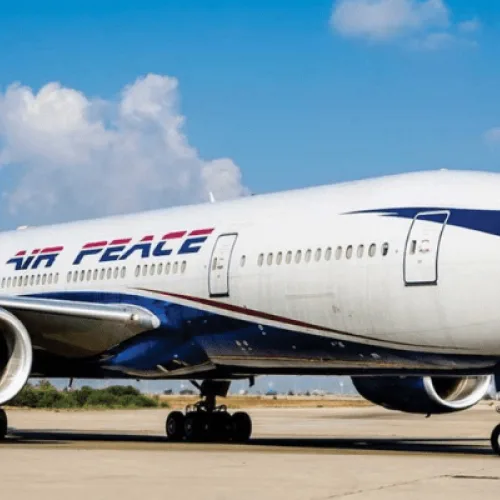
The events of Tuesday morning were chaotic, especially for Air Peace travellers who were stranded due to picketing activities carried out at Lagos and Abuja airports by protesting union leaders. This singular act alone grounded over 70 daily flights and jacked up the airline’s losses to N2 billion.
While the labour unions- the National Union of Air Transport Employees (NUATE) and Air Transport Services Senior Staff Association of Nigeria (ATSSSAN)- justified the act, citing unpaid five percent Ticket Sales Charge (TSC) arrears and restrictions on worker unionisation, legal practitioners and aviation experts have pointed to constitutional boundaries that render the blockades unlawful. This comes as Air Peace management vowed to hold the aviation labour unions financially responsible for passenger compensation and possible lawsuits from the impasse.
Under Nigerian law, trade unions do not possess absolute liberty to disrupt business operations. Enakeno Precious Orogun, a legal practitioner, argued that picketing must remain peaceful and not infringe upon the constitutional rights of third parties
“Under Section 43 of the Trade Unions Act, picketing is recognised as a lawful tool of labour engagement. However, the law explicitly mandates that picketing must remain strictly peaceful and must not infringe upon the constitutional rights of third parties. Legally, picketing cannot be used to obstruct physical entrances, prevent access to business premises, or disrupt ongoing commercial operations,” Orogun said.
Orogun points out that aviation infrastructure enjoys special statutory protection under the Trade Disputes (Essential Services) Act:
“The Act categorically criminalises obstruction or disruption of the smooth running of any essential services. Under the Act, essential services are defined to include transport of persons, goods or livestock by road, rail, sea or air, bringing the aviation industry under the category. Consequently, deliberately obstructing the movement of travellers transitions the action from a labour dispute to a punishable criminal offence under Nigerian law.”
Read also: Beyond the grid: Why Nigeria’s power sector crisis is a crisis of political economy
A foundational point of conflict is whether external trade unions have the right to picket a business solely to force its workers to organise.
“Every person shall be entitled to assemble freely and associate with other persons… The flip side is that the right nit to associate is also protected. Freedom includes freedom from compelled association,” Samuel Caulcrick, former Rector of the Nigerian College of Aviation Technology (NCAT) said.
Caulcrick, who referred to Section 40 of the 1999 Nigerian Constitution, said that attempting to force a non-union establishment to organise through blockades crosses the constitutional threshold from protection into coercion.
“When unions picket an establishment solely because it is ‘not open to unionism’, they’re essentially trying to compel association. That crosses from ‘protecting members’ to ‘forcing non-members to associate.’ That’s where it becomes constitutionally shaky,” Samuel Caulcrick, Former NCAT Rector.
Building on this constitutional principle, Orogun notes that external unions have no legal standing over non-member employees: “Lawful trade union action can only be initiated against an enterprise where a direct employer-employee union relationship exists. If Air Peace employees are not members of these aviation trade unions, the unions lack the legal standing to picket the carrier.”
This is reinforced by a subsisting Federal High Court Judgment (April 26, 2024) obtained by Air Peace, which explicitly barred NLC, TUC, NUATE, and police authorities from coercing workers into union membership or disrupting Air Peace operations.
Over 98 percent of Nigerian airline workers are non-unionised, and Air Peace staff have repeatedly voted against union representation.
Thousands of stranded passengers endured delayed travel plans and economic losses. Who then is legally liable under ticket conditions?
“If Air Peace’s terms of offer explicitly incorporate a force majeure clause—absolving the carrier of liability for operational failures caused by unforeseen, external disruptions such as third-party blockades—then direct claims against the airline will fail in court… Through procedural mechanisms, the court can hold the unions financially liable for tortiously inducing the breach of contract,” Orogun explained.


Ifeoma Okeke-Korieocha is the Aviation Correspondent at BusinessDay Media Limited, publishers of BusinessDay Newspapers. She is also the Deputy Editor, BusinessDay Weekender Magazine, the Saturday Weekend edition of BusinessDay. She holds a BSC in Mass Communication from the prestigious University of Nigeria, Nsukka and a Masters degree in Marketing at the University of Lagos. As the lead writer on the aviation desk, Ifeoma is responsible and in charge of the three weekly aviation and travel pages in BusinessDay and BDSunday. She also overseas and edits all pages of BusinessDay Saturday Weekender. She has written various investigative, features and news stories in aviation and business related issues and has been severally nominated for award in the category of Aviation Writer of the Year by the Nigeria Media Nite-Out awards; one of the Nigeria’s most prestigious media awards ceremonies. Ifeoma is a one-time winner of the prestigious Nigeria Media Merit Award under the 'Aviation Writer of the Year' Category. She is the 2025 Eloy Award winner under the Print Media Journalist category. She has undergone several journalism trainings by various prestigious organisations. Ifeoma is also a fellow of the Female Reporters Leadership Fellowship of the Wole Soyinka Centre for Investigative Journalism.
Comments
Start the conversation about this story.