





In a PwC report titled The World in 2050, Nigeria is projected to become one of the world’s 10 largest economies by mid-century, with a GDP of roughly $6.4 trillion, large enough to push the United Kingdom and France out of the top 10. A separate long-range projection puts Nigeria’s economy at $13.1 trillion by 2075, trailing only China, India, the United States and Indonesia. In May 2026, ECOWAS Commissioner for Economic Affairs, Dr. Kalilou Sylla, went further, telling the bloc’s parliamentary session in Abuja that Nigeria could become the world’s fifth-richest nation within fifty years if regional trade and reforms hold their course.
These projections come from serious institutions engaged in long-horizon economic analysis. PwC’s own authors make it clear that achieving the projection depends on Nigeria building its institutions to global standards, diversifying its economy and sustaining growth-friendly policies. Reaching that scale will require sustained improvements in institutions, human capital and productive capacity.
One growth engine is already in motion: population. Nigeria’s population, currently around 242 million, is growing at roughly 2.1 percent a year, with a fertility rate of 4.8 children per woman. The United Nations projects that the population will approach 400 million by 2050, making Nigeria the world’s third most populous country and overtaking the United States sometime between 2045 and 2050. Sixty-three per cent of Nigerians are already under 25.
A growing population can expand an economy as more people produce and consume. The challenge is ensuring that population growth produces higher productivity and incomes rather than greater pressure on limited resources. Nigeria’s GDP per capita stands at around $1,556 compared with a global average above $10,500. Without productivity growth, a rapidly growing population can leave more people sharing limited opportunities. China addressed this challenge from the late 1970s under Deng Xiaoping by creating an economic environment that lifted hundreds of millions out of extreme poverty and turned China into a global economic powerhouse. It increased the value produced by its citizens.
Nigeria’s recent macroeconomic indicators provide some grounds for optimism. The economy grew close to 4 percent in 2025 and is forecast to grow by around 4–4.5 percent in 2026. Inflation has fallen roughly by half to the mid-teens following tighter monetary policy and greater exchange-rate stability. The Central Bank cut its benchmark rate for the first time in five years in May 2026, while FTSE Russell restored Nigeria to its Frontier Market index. These developments, however, need to be considered alongside structural weaknesses. Poverty remains widespread, food inflation continues to pose a major concern, while Nigeria’s tax-to-GDP ratio ranks among the lowest in the world, limiting the state’s fiscal capacity to invest in infrastructure, education, healthcare and other foundations of long-term growth.
Nigeria has confronted ambitious economic targets before. In 2009, the National Planning Commission launched Vision 20:2020, with the objective of making Nigeria one of the world’s top 20 economies and achieving a $900 billion GDP by 2020. The target was not achieved. More recently, the Tinubu administration set a target of a $1 trillion economy by 2030. Analysts have questioned whether this is achievable at the country’s current 3–4 per cent growth trajectory, which would need to roughly double to reach the target on schedule. Nigeria does not lack ambitious economic targets. What remains in short supply is the institutional capacity required to achieve them.
The government’s recent reforms are important, but they cannot by themselves produce the scale of transformation assumed by the long-term projections. Subsidy reform, foreign-exchange unification, tax reform and monetary-policy adjustments can improve incentives and resource allocation. The economy also needs the human capital and productive capacity to respond to those incentives. Skills, health, education and greater participation in the formal economy will determine whether Nigeria’s large and youthful population becomes an economic advantage.
The informal economy also requires a more deliberate policy response. With a large share of economic activity outside the formal tax system, Nigeria needs simplified registration, low-friction compliance and digital tax tools that make formalisation easier for small businesses. The objective should be to broaden the fiscal base while allowing businesses to grow, rather than relying primarily on enforcement. A wider and more productive formal economy would give the government greater resources to finance the infrastructure and public services required for long-term development.
Institutional quality is equally important. Property rights, contract enforcement, judicial reliability and effective anti-corruption mechanisms are not peripheral concerns. They determine whether investors can commit capital with confidence and whether businesses can plan beyond the short term. These are among the institutional conditions that PwC’s own projection assumes Nigeria will improve if it is to reach the economic scale projected for 2050.
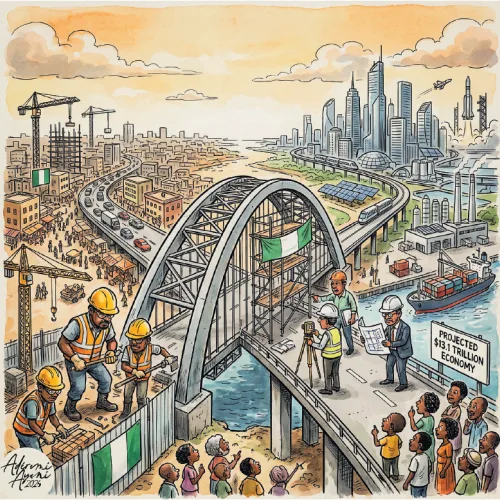
The $6 trillion Nigeria projected for 2050 and the $13.1 trillion economy projected for 2075 are possibilities rather than guarantees. Their realisation will depend on the country’s capacity to build institutions that support sustained productivity growth, expand the productive base, improve human capital and create an environment where private investment can flourish. The experience of Vision 20:2020 remains a warning that projections can identify what Nigeria might become, but institutions, policy and investment must build it.
Nigeria’s economic potential will depend on how effectively it connects its demographic strength to productive capacity. The bridge to a $6 trillion or $13.1 trillion economy will be built through institutions, investment, productivity and human capital. Without those foundations, the projections will remain numbers on paper.
Get Newsletter Updates
Enjoying our column?
Subscribe to our specialised **Who Is Thinking For Nigeria** feed to receive fresh reports and analyses directly in your inbox.


Comments
Start the conversation about this story.