





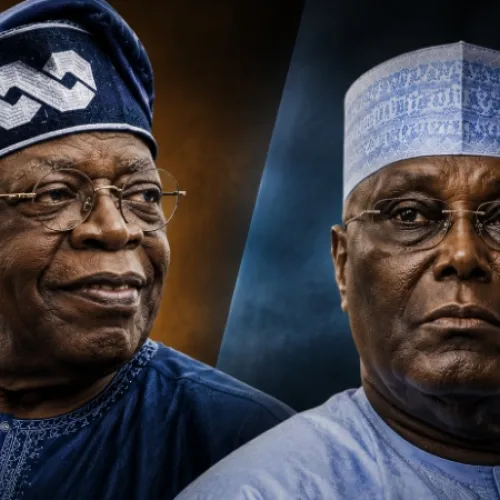
Former Vice President Atiku Abubakar has asked the Federal High Court in Abuja to disqualify President Bola Ahmed Tinubu from contesting the 2027 presidential election, challenging his eligibility over claims surrounding an NYSC certificate and the name attached to it.
Atiku, the presidential candidate of the African Democratic Congress (ADC), personally appeared at the court registry on Friday to depose to an affidavit supporting the suit filed against Tinubu, the All Progressives Congress (APC) and the Independent National Electoral Commission (INEC).
According to a statement by Atiku’s Senior Special Assistant on Public Communication, Phrank Shaibu, the action invokes provisions of the 1999 Constitution, as amended, and the Electoral Act, 2026.
At the centre of the suit is Section 137(1)(j) of the Constitution, which provides that a person is not qualified for election as President if the person has presented a forged certificate to INEC.
Atiku and the ADC are asking the court to determine whether Tinubu and the APC should be disqualified from the 2027 election over their allegation that an NYSC discharge certificate submitted to INEC in connection with the presidential election bears a name different from that of the President.
In his affidavit, Atiku alleged that an NYSC discharge certificate submitted by Tinubu bears the name “Tinubu Bola Adekunle”, rather than “Bola Ahmed Tinubu.”
He further alleged that the certificate was submitted in relation to the 2023 and 2027 presidential elections and questioned whether it was genuinely obtained by the President.
The plaintiffs have also asked INEC to produce Tinubu’s Form CF001 submitted for the 2023 and 2027 elections. Atiku said he had sought certified true copies of the relevant documents from the electoral commission before filing the suit but had not received a response when the court processes were prepared.
Explaining his decision to personally depose to the affidavit, Atiku said the case concerned fundamental constitutional questions and the integrity of the presidency.
“I came here personally because the issues before the court go to the heart of our Constitution and the integrity of the office of President,” he said.
Atiku maintained that the dispute should be resolved through evidence and judicial determination rather than political arguments, urging INEC to make the relevant records available and allowing the court to determine the facts.
The former vice president also challenged provisions of the Electoral Act, 2026, which he and the ADC contend restrict the ability to challenge a presidential candidate’s qualification before an election and limit qualification as a ground for questioning an election.
Their position, according to the statement, is that ordinary legislation cannot override an express constitutional provision and that the Constitution must prevail where there is a conflict between the two.
Atiku argued that the case therefore raises a broader constitutional question over whether legislation can restrict access to a constitutional remedy concerning the qualification of a presidential candidate.
The suit ultimately seeks an order disqualifying Tinubu and the APC from participating in the 2027 presidential election if the plaintiffs establish the allegations contained in their case.
Atiku said the matter was not about personalities or political privilege but about applying the same constitutional standards to every person seeking the presidency.
“Nobody is above the Constitution, not Atiku Abubakar, not Bola Tinubu, and certainly not the President of the Federal Republic of Nigeria,” he said.
He also placed responsibility on INEC to maintain neutrality and produce the relevant electoral records, arguing that Nigerians should know whether candidates seeking the presidency meet the constitutional requirements before they cast their votes.
Counsel to the plaintiffs, Edwin Inegedu, SAN, and Joseph Onu Silas, expressed confidence in the case. Silas Onu said the legal team had reviewed the relevant provisions and presented its arguments before the court, adding that it was prepared to respond to the defence once the defendants were served.
Comments
Start the conversation about this story.