






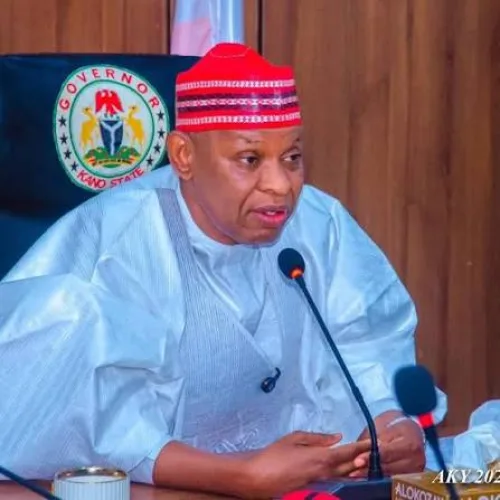
Kano is one of the major sub-national within the Nigerian Nation and hence, leadership in the Nigeria’s most populous State is measured not by the eloquence of campaign promises but by the weight of promises fulfilled or accomplished. History reserves its warmest judgment for those leaders who convert mandates into measurable milestones and its coolest indifference for those who merely master the art of political rhetoric. The administration of Governor Abba Kabir Yusuf offers a compelling case study of governance anchored on delivery and the steady restoration of public confidence, effective governance and result oriented leadership.
A little over years into office, Governor Abba has cultivated an identity that transcends partisan applause. His administration has become synonymous with construction cranes replacing abandoned foundations, classrooms replacing dilapidated structures, hospitals regaining lost vitality and public infrastructure once left to decay now receiving renewed attention and visible and impactful commitment. The list of over one thousand completed and ongoing projects is not merely a statistical exercise, it is the visible dividend of a government determined to honour the social contract between the electorate and the elected and a signal to investors and development partners that Kano is once again a State where public commitments translate into public works.
Nothing illustrates these commitments more vividly than the administration’s unprecedented deliberate investment in education, the sector universally acknowledged as the foundation upon which prosperous societies are built. An educated population is, after all, the surest driver of a diversified economy that is, a knowledge base economy, it feeds the workforce that industry, agriculture and commerce depended on and it is this long horizon that appears to guide the administration’s thinking.
Across the Kano’s 44 Local Government Areas of the State, schools that once stood as monuments to neglect are being transformed into modern centres of learning. New storey classroom blocks equipped with offices have risen in communities across Madobi, Dawakin-Kudu, Bunkure, Gezawa, Ajingi, Gaya, Rogo, Ungogo, Kura, Bichi, Shanono, Karaye, Kiru, Sumaila, Doguwa, Dambatta and numerous other Local Government Areas too lengthy to list out here.
The geographical spread of these projects is perhaps their most compelling attribute. Rather than concentrating development within metropolitan Kano alone, the Abba led administration has deliberately ensured that rural communities enjoy equal access to quality educational infrastructure. This balanced distribution reflects a profound understanding that development acquires greater legitimacy and greater economic reach when every local government area, not just the State capital, feels the benefit of public investment.
Equally remarkable is the Government’s bold intervention in Early Childhood Care Development Education. Prototype classroom blocks are under construction across several local governments, including Gwale, Wudil, Gwarzo, Takai, Kumbotso, Rano, Gabasawa, Dala, Tarauni, Tofa and others. Such investments may appear modest today, but they represent extraordinary foresight, for every classroom built now becomes tomorrow’s incubator of doctors, engineers, professors, entrepreneurs and statesmen. Governor Abba’s educational philosophy recognises that sustainable prosperity begins not with skyscrapers alone but with sound school infrastructure at the earliest stage of a child’s life.
The administration has not limited itself to constructing entirely new facilities. Existing institutions have equally benefited from extensive renovation programmes. School structures damaged by fire incidents have been rebuilt. Government secondary schools have undergone comprehensive rehabilitation. Administrative office complexes have been modernised, while several educational institutions have received structural upgrades capable of supporting effective teaching and learning. This dual approach, building new while preserving what already exists, demonstrates an understanding that genuine educational reform requires both expansion and stewardship of public assets already paid for by the taxpayer.
Additionally, Healthcare has received no less attention under Governor Abba’s stewardship. The construction, reconstruction and upgrading of Primary Healthcare Centres across nearly all of the State’s 484 Wards signals a determination to strengthen care at the point closest to the citizen, where the economic cost of illness, lost farm labour, lost trading days, lost school time is felt most directly by households. Simultaneously, renovation works across secondary hospitals and general hospitals in the local government areas underscore an appreciation that access to healthcare is a fundamental human necessity rather than a privilege reserved for the well-connected. Among the most applauded interventions is the reacquisition of the Hasiya Bayero Paediatric Hospital and its rehabilitation to world-class standard.
Perhaps more symbolic still is the rehabilitation of the School of Health Technology. Beyond bricks and cement, this is an investment in human capital, in the training of the healthcare professionals who will sustain Kano’s medical system for decades to come, long after the current administration has left office. The same philosophy that public institutions deserve dignity irrespective of their function extends even to the State’s correctional facilities, where renovation and construction works at Kurmawa and Goron Dutse reflect a government determined to leave no sector behind, however far from public view.
Governor Abba’s political trajectory offers further insight into the philosophy driving these interventions. Long before occupying the Government House, he had cultivated a reputation as a grassroots politician whose political vocabulary revolved around ordinary citizens rather than elite convenience. His years of public service consistently projected accessibility, humility and an uncommon proximity to the aspirations of the average Kano resident. That political pedigree now finds practical expression in governance, rather than pursuing headline-grabbing spectacle alone, the administration has prioritised projects whose impact penetrates neighbourhoods, villages and underserved communities the places where development is felt in household incomes and daily life, not merely admired from a distance.
Ultimately, the true significance of Governor Abba Kabir Yusuf’s first three years lies not only in the impressive number of projects executed but the philosophy underpinning them. A philosophy that treats government as an instrument of service rather than privilege.
A mandate after all, is NOT redeemed through eloquent speeches, but through visible actions. It is a mandate measured not in media headlines but in improved classrooms, functioning hospitals, restored public infrastructure and the quiet, compounding confidence of a public that has begun once again to witness delivery from their mandate.
It is always Kano first in every dealings of Governor Abba.
…to be continued in Part II, which will examine Governor Abba’s achievements in other areas such as roads, water resources, urban renewal, public works, rural infrastructure and environmental transformation.
Dr. Nuhu Umar writes from Kano. He can be reached via [email protected], [email protected]
Comments
Start the conversation about this story.