






The Pharmaceutical Manufacturers Group of the Manufacturers Association of Nigeria (PMG-MAN) has tasked the federal government to make the sector competitive and investment friendly.
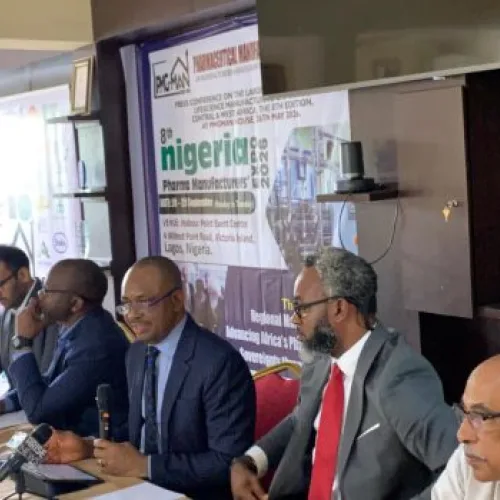
Chairman of PMG-MAN and Managing Director/CEO of Daily-Need Industries Limited, Mr. Oluwatosin Jolayemi, made the call at a media briefing in Lagos ahead of the 8th Nigeria Pharma Manufacturers’ Expo (NPME 2026), scheduled for September 28 and 29 at Harbour Point, Victoria Island, Lagos.
According to Mr. Jolayemi, this can be done by creating an enabling pharma & lifescience manufacturing ecosystem strengthen with policies that are forward looking. This will drive ̌sustained investment that will boost local drug production and help achieve medicine security in Nigeria.
Represented by the Chairman of the Exhibition Planning Committee and Managing Director/CEO of May & Baker Nigeria Plc, Dr. Patrick Ajah, he reaffirmed the industry’s ambition to achieve 70 percent local drug production.
Dr. Ajah said the sector, which has grown from 20 pioneer members in 1983 to more than 200 manufacturing companies, remains committed to reducing Nigeria’s dependence on imported medicines and that the expo, themed “Regional Manufacturing: Advancing Africa’s Pharma and Life Science Sovereignty through Localisation,” would bring together manufacturers, policymakers, investors, technology providers and other stakeholders to discuss the essentials of local pharmaceutical production.
The Executive Secretary and Chief Executive Officer of PMG-MAN, Pharm. Frank Muonemeh noted that Nigeria’s pharmaceutical industry has recorded a significant milestones in the last few years- a paradign shift towards local manufacturing, citing a reduction in imported finished pharmaceuticals from 4.03 billion units to 1.13 billion units as of 2025 according to NAFDAC data.
Muonemeh said high energy costs and delayed clearance of pharma inputs remain a major threat to the competitiveness of local manufacturers, with companies spending more than 40 percent of their revenue on electricity and alternative power generation, compared with less than 10 percent among competitors in countries such as China and India.
While urging the government to introduce targeted interventions, including dedicated industrial energy tariffs and strengthening policies that encourage local production of APIs and other pharmaceutical inputs, he appealed to President Bola Ahmed Tinubu to extend the Presidential Executive Order supporting the pharmaceutical sector from its current two-year cycle to a five-year framework, arguing that longer policy stability would attract investment and consolidate gains in local production.
Comments
Start the conversation about this story.