





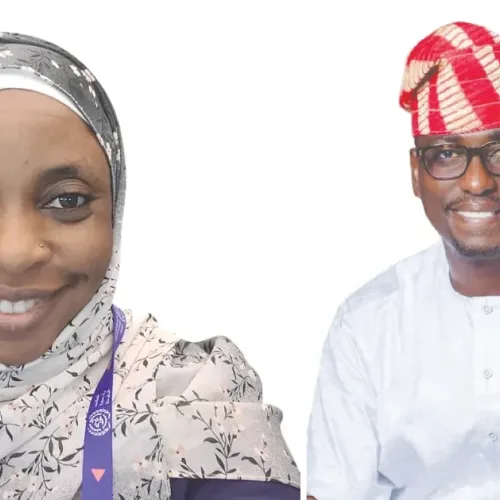
Hauwa Mundi, wife of former personnel of the Department of State Services, Ibrahim Bichi, who was dismissed by the security outfit after 19 years of service, tells AYOOLA OLASUPO about her husband’s detention, the family’s ordeal and her demand for transparency from the agency
Tell us about yourself.
My name is Hauwa Mundi. I’m a broadcast journalist with Radio Nigeria, which is the Federal Radio Corporation of Nigeria. I’m currently in Kaduna. Ibrahim Bichi is my husband, and we’ve been married for nine years.
What does Mr Ibrahim do for a living?
Well, he used to be an official of the State Security Service, also known as the Department of State Services.
Why was he arrested?
He was actually detained after he was asked to report to the headquarters. He went there himself but was detained. I was out of the country at the time. To the best of my knowledge, he said he was asked to come for two-day counter-terrorism training. When I arrived in Geneva and couldn’t reach him, I became worried and started asking questions because he had left Kaduna for Abuja the same day I left for my trip.
After I settled in, about 24 hours later, I still couldn’t reach him, which was quite unusual. So, I started asking questions, and from there, we figured out that he was being detained. I was only able to see him after about two weeks because I spent 13 days in Geneva.
Immediately after I got back, I wrote to the Director-General of DSS requesting to see him. That was when I found out from him that there was a petition written to the Department of State Services by the National Security Adviser concerning his social media activities and posts.
What did the social media posts contain?
He talked about how the Hausa-Fulani terminology is only used for political interests and that there is no such thing as Hausa-Fulani because they are two very distinct tribes and cultures. He also tried to demystify Usman dan Fodio as a revered person. I think this is the most controversial or offensive aspect that most of the people who tried to get to him referred to.
He talked about how a lot of history had been buried concerning what truly happened during the jihad. Apparently, that’s what people did not want to hear because he says Hausa people were killed for no just reason. There is no justification for what Usman dan Fodio did at that time.
He believes it is not different from what is happening now because most of the people suffering from insecurity in northern Nigeria, or north-western Nigeria, are actually Hausa people. So, I think that’s the most controversial aspect of his advocacy that people take issue with.
When exactly was he arrested?
He was detained on June 3, 2026.
Have you had any contact with him since then?
No. As I said, when I got back from my trip, I requested to see him. I wrote the letter, and within two days, I got a response from them. I saw him, and that was when I found out about the circumstances surrounding his detention.
After that day, I also requested to be given access to him for weekly visits, which they granted. So, I’ve been seeing him every week since then, except two weeks ago when I skipped one weekend. But since then, I’ve been seeing him every week.
Has there been any indication that he may be charged or released soon?
As a matter of fact, he wasn’t told anything, and we weren’t either, and the only time we heard anything was when he was queried four days after his detention. He responded to that query, and nothing was said afterwards. Each time I went, I asked him, ‘How far? Have they said anything?’ He would say, ‘No.’ At some point, I had to go to the media because a lot of things happened.
What happened after his detention?
On the first day I tried to see him, the person I was asked to see didn’t even know that my husband was there. They kept asking me, ‘Are you sure your husband is here?’ I said yes. They asked how I knew, and I said we got the information from the personnel. It took almost 30 minutes before they actually brought him out.
For me to experience that, it seemed suspicious. There is no way I would write a letter, you would acknowledge it and ask me to come, and then when I came, you would be asking me if I was sure my husband was there. Because of that, I immediately came out; I made a post on social media.
A lot of people wanted to know what was going on, and I couldn’t say anything because I didn’t have enough information at the time. After I got that information, I went on social media and said this was what was happening. I wasn’t happy with the condition he was in because he had actually lost some weight at the time and had been sick while in detention.
That they were going back and forth about whether he was there or not made me uncomfortable. I don’t know. They might have an excuse or explanation as to why that happened, but they’re not going to deny that it actually happened.
It took over 30 minutes for them to bring him out. So, I didn’t know what that meant, and I had to speak out so that, in case there was any plan to harm him or anything, the world would know that this was where he was.
For those two weeks, we didn’t know where he was. I went on social media and raised the alarm.
Do you have any concerns about how he’s being treated in detention?
When I saw him, I actually raised concerns with them (DSS). I said, ‘I don’t like the way he looks because he has lost weight.’ The person I spoke with earlier assured me that my husband had access to medical treatment and all that. When I saw him two weeks after, he looked better.
He also assured me that they don’t manhandle even the criminals in their custody, let alone their officials. So, for that, there wasn’t an issue about maltreatment. My only concern was the whole secrecy about whether he was there or not. That was my major concern. But as far as physical harm is concerned, there was none at all.
How has the family been coping with the emotional stress so far?
I don’t even know how to answer that question without breaking down. I’ve always told myself that I know I have a lot of crying to do, but it’s not time yet. When he’s out, I can let my hair down and cry. But weakness is not an option for me now. It has been stressful. They took his wallet and his phone.
So, for the past two months, I have had to take care of the kids, the family, and everything, even though well-meaning Nigerians have been supportive without me even asking for their support. But the emotional stress has been enormous. I travel from Kaduna to Abuja every week. At some point, I even had an accident.
So, it’s been emotionally draining. Even more stressful now is the fact that people are making speculations online, accusing him of various offences, including trying to incite violence. All these crimes are being attributed to him, and the DSS has already dismissed him.
How did you get the information that he had been dismissed?
After that query, they gave him four days after he was held; nothing else was done. So, when the matter got media attention, they were forced to come out. All the while I was being interviewed, I didn’t mention that he’s personnel because it wasn’t part of my case. I just came out to cry as a wife and mother whose husband had been in detention without anything being done.
As I said, because of the circumstances and what I witnessed on the day I went there, I wasn’t comfortable, so I had to speak out. But I didn’t mention that he was an official of the DSS. I think that because I started talking, that made them respond, because my interview was used in a report about the Hausa ethnic movement.
So, they had to respond. They came out to say, ‘This person is our officer. It’s not like we arbitrarily arrested him. He’s our officer, and his activities had violated extant laws of the service.’
They said he wasn’t an activist and that he was their officer and had violated the rules of the service. They gave an explanation that they didn’t just arrest a random person. He’s their officer, and they have their own laws.
We said that since they had now come out to say this was what was happening, let’s step back and let them do their thing. Since it was either they punished him as an officer or if they investigated and found out that his so-called crimes were so grievous, they could take him to court.
We kept waiting, but nothing was done. Each time I visited him, I would ask him, ‘How far? Have they said anything?’ He would say no. They hadn’t said anything.
At what point did you involve a lawyer?
At some point, we had to involve a lawyer because we gave them time to see if they would handle it as an in-house matter. He kept saying, ‘Look, the maximum these people will say is that they will dismiss me.’ I think in response to his query, he told them that if his activities on social media would impede his duties or something like that, he was willing to leave the service.
Since we didn’t hear from them, we decided to involve a lawyer because, as an officer, he has the right to counsel and legal representation. He’s a human being first, and these people had kept him in detention for so long, giving people the impression that he must have committed such a grievous crime.
Unless there’s something they know that they are not telling us. I kept asking him, ‘Are you sure there’s nothing else?’ They said no. So, we involved a lawyer. The lawyer wrote them, asking for access to see his client. They did not grant him access. Apart from the acknowledgement copy they received at the reception, nobody called the lawyer.
They didn’t honour that request. In the first letter, he requested access to his client and a legal explanation of his continued detention, and he wrote another one demanding his immediate release and petitioned the Attorney-General as well as the Minister of Justice. They ignored that too, and there has been no response to date.
What happened afterwards?
During the week I didn’t go to see him, apparently, that was when he was dismissed. When I saw him last Saturday, I asked him how far, and he said, ‘Finally, they came and read me my dismissal letter.’ I asked if it was how it was done, and he said yes. From a query, dismissal followed.
Anyway, I said, thank God. Maybe that’s the worst that can happen. I said they (DSS) should either let him go or charge him to court. But none of these has happened because he made me understand that the dismissal took effect on July 28. That was when they informed him, and it had been two weeks since the dismissal.
Have you ever feared that you might not see your husband return home?
Not really, because that was why I spoke out in the first place. I had that fear that if I didn’t do something, I was likely not going to see this man again.
I had that fear, and that was why I had to go on social media. I’m an educated woman and a journalist by training, so I know the implications of coming out to say that my husband, who is personnel, has been detained by the DSS.
Even though I didn’t mention that he’s personnel, I knew I was opening a kind of wound because it would have ended only one way: them exposing his identity, which eventually happened. But I had to do that for the world to know that this person was there, so I could sit back and watch what would happen. I had that fear.
However, since I came out and spoke, and people started talking about it, and the media got involved, I became a little bit more relaxed. I’m hoping that they would do the right thing. But we cannot wait forever.
My children will start school in September. I don’t have money to put them in school. They go to a pricey school. How much is my salary? These people are still holding him. Now, the future is uncertain. We don’t even know what the future holds for him. But at least, they should let us have him back home.
Does your husband have any health condition that you fear might get complicated in detention?
No, it is just that he was sick at the time. Other than that, he’s fine. As a matter of fact, he was looking healthier last Saturday.
Beyond calling for his release, what exactly do you want the government and the DSS to do to bring all the issues to an end?
I want the DSS to be transparent. This man gave them (the DSS) 19 years of his life, but he was dismissed without a single warning. He has never received a query in those 19 years. He is an upright person. Bichi would never do anything to break the law.
But as far as I’m concerned, this is his only crime; he’s said, ‘My people need to wake up and become conscious of what they are doing, and they need to lead themselves. If Hausa people lead themselves in north-western Nigeria, they would know where their issues are and how to deal with their problems.’ This is his only crime, as far as I know.
So, I’m calling on the DSS and the Federal Government to make this matter as transparent as possible and clear this guy’s name. People are calling him a terrorist. People have likened him to Nnamdi Kanu and things like that. It’s not fair.
You can’t accuse someone who is advocating for ethnic consciousness and compare that person to someone who called for secession. It’s not fair. They owe it to him because he has served this country for 19 years without any blemish on his record. He has given his blood and his sweat.
He dealt with post-traumatic stress disorder for years because of what his eyes saw in Maiduguri while fighting Boko Haram.
Even if he is eventually released, do you intend to appeal his dismissal?
I believe he’ll do so, but let him come out first. The most important thing for him now is to come out. But I want to believe that if he knows he has been wrongfully dismissed, he will appeal the decision.
Comments
Start the conversation about this story.