





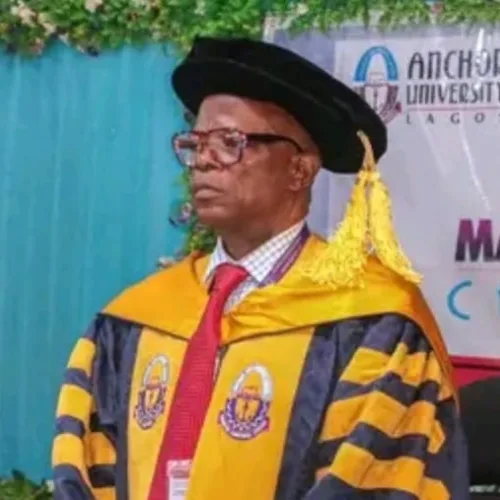
The Vice-Chancellor of Anchor University, Lagos, Professor Samuel Oye Bandele, has commended the German Academic Exchange Service (DAAD) for its role in promoting research collaboration, agricultural innovation, and capacity building across Nigeria and the West African sub-region.
Bandele gave the commendation at the 2026 DAAD Alumni Training Programme on Cocoa Propagation and Production Using Laboratory Techniques, hosted by Anchor University, Lagos.
New Telegraph recalls that the three-day programme brought together 25 DAAD Alumni and Humboldt Fellows from Nigeria and the West African sub-region for specialised training on modern laboratory techniques for cocoa propagation and production.
The eminent scholar posited that the DAAD platform had continued to provide opportunities for scholars from diverse cultural and academic backgrounds to exchange ideas, deepen knowledge, and develop practical solutions to shared developmental challenges.
According to him: “research is more impactful when collaborative is directed toward measurable outcomes in agriculture, food security, economic growth, and environmental sustainability”.
The former Ekiti State University vice-chancellor explained further that the Cocoa-Coconut Research Initiative represents a strategic intervention aimed at improving agricultural productivity through scientific innovation.
He noted that applying modern laboratory techniques to cocoa propagation and production would enhance crop quality, increase yields, and support sustainable agro-industrial development across the region.
He reaffirmed Anchor University’s commitment to research, innovation, knowledge transfer, and international academic partnerships, stressing that the institution will continue to provide an enabling environment for scholarly engagement that addresses societal needs and national development priorities.
The Vice-Chancellor also commended the Anchor University DAAD Ambassador, Dr Mrs C.O. Esuola of the Department of Biological Sciences, for her role in organising the programme and strengthening the DAAD network.
He described her dedication and commitment as instrumental to the success of the training and to advancing research collaboration within and beyond the university community.
He also urged participants to uphold integrity, professionalism, accountability, and ethical conduct in their research activities, noting that credible scholarship depends on honesty, transparency, and responsibility.
He encouraged DAAD alumni and Humboldt Fellows to apply the knowledge gained from the training to agricultural innovation, sustainable development, and stronger academic collaboration across the region.
He expressed confidence that the programme would foster lasting professional relationships and contribute meaningfully to sustainable agricultural development in West Africa.
Meanwhile, the German Academic Exchange Service (DAAD) has reaffirmed its commitment to agricultural research and capacity development in West Africa through its partnership with Anchor University, Lagos, at the 2026 DAAD Alumni Training Programme on Cocoa Propagation and Production Using Laboratory Techniques.
Please follow and like us:
Comments
Start the conversation about this story.