





The Bank of Agriculture has said it is strengthening support for women farmers by expanding access to agricultural finance and inputs to boost production, strengthen livelihoods and improve their participation in the agricultural value chain.
The bank disclosed this in a statement issued to journalists on Monday, highlighting its interventions to address persistent barriers confronting women farmers, including limited access to finance, inputs, technology, mechanisation and markets.
According to the statement, women are widely recognised as a cornerstone of Nigeria’s agricultural economy, with estimates cited by the Food and Agriculture Organisation placing their share of the agricultural workforce at up to 70 per cent.
It noted that the potential to expand women’s contribution to agriculture remained largely untapped, adding that World Bank evidence indicated that closing the gap in access to productive resources between women and men could significantly increase women’s yields and raise agricultural output nationwide.
The bank said such gains would have meaningful implications for food security and poverty reduction, but noted that persistent barriers to finance continued to constrain women farmers.
It cited recent World Bank data which showed that only three per cent of female farmers in Nigeria were formally enrolled in financial systems, compared with 10 per cent of male farmers.
It said, “For the Bank of Agriculture (BOA), this gap represents both a challenge and an opportunity to expand access to agricultural finance in ways that help women farmers increase production, strengthen their livelihoods and participate more fully in the agricultural value chain.”
The Managing Director and Chief Executive Officer of BOA, Ayodeji Sotinrin, said expanding agricultural finance must go hand in hand with understanding what farmers need to remain productive.
“Women are already contributing significantly to agriculture and to Nigeria’s food system. Our responsibility is to ensure that the systems around them give them a better opportunity to produce, grow and participate in the value chain. That means looking beyond credit and addressing the other constraints that affect production”, the bank continued.
Sotinrin added, “Agricultural financing cannot end with disbursement. Farmers need access to inputs, mechanisation, markets and other support required to turn financing into output. That is the ecosystem we are building at the Bank of Agriculture.”
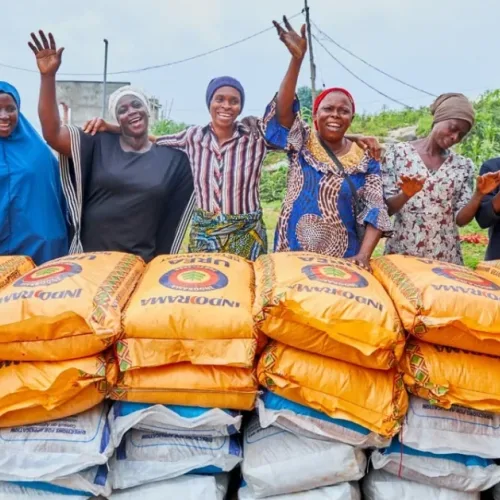
As part of the approach, the bank recently engaged a group of women farmers in Bwari Area Council, Federal Capital Territory, and supported their current farming activities with agricultural inputs.
The statement said the engagement reflected a broader commitment to understand the realities farmers faced and build solutions around the full production cycle.
“For BOA, agricultural finance is not simply about providing credit; it is about ensuring farmers have the resources and opportunities to put that financing to work,” the statement said.
The bank said the approach was reflected in its Renewed Hope Smallholder Support & Value Chain Fund, through which it was working with farmer aggregation companies to bring more than two million smallholder farmers into a structured Federal Government-backed on-lending framework.
The statement added, “The model combines financing with inputs, agronomic support, and offtake arrangements to increase production rather than simply increasing the volume of credit disbursed.”
The bank also said it was widening access to affordable finance, with a N250bn facility being deployed to provide single-digit financing to smallholder farmers.
It added that the bank’s N1.5tn recapitalisation was expected to significantly strengthen its capacity to reach more farmers and deepen agricultural lending.
“For women farmers in particular, expanding access to finance matters because the barriers to production do not exist in isolation,” the statement said.
It added, “Limited access to inputs, technology, mechanisation and markets shapes how much a farmer can produce and how much value they ultimately retain from their work.”
The bank said it was therefore building a more integrated financing ecosystem that connected farmers not only to capital, but also to the wider infrastructure, production and market participation required.
Through its Guaranteed Minimum Price Aggregation Programme, BOA said it was connecting farmers producing selected commodities to structured aggregation, accredited warehouses and guaranteed offtake, providing greater certainty around the market for their produce.
“Across these interventions, the objective remains to make agricultural finance more meaningful to the farmer by connecting capital to the real needs of production,” the statement said.
The bank said as Nigeria worked to increase domestic food production, strengthen food security and build more resilient agricultural value chains, closing the gap between farmers’ productive potential and their access to resources would remain critical.
BOA said it would continue to deepen its partnerships, financing mechanisms and value-chain interventions to bring more farmers, particularly underserved smallholder producers, into the formal agricultural economy.
According to the statement, the interventions would create “stronger pathways from finance to production and from production to market.”
Comments
Start the conversation about this story.