





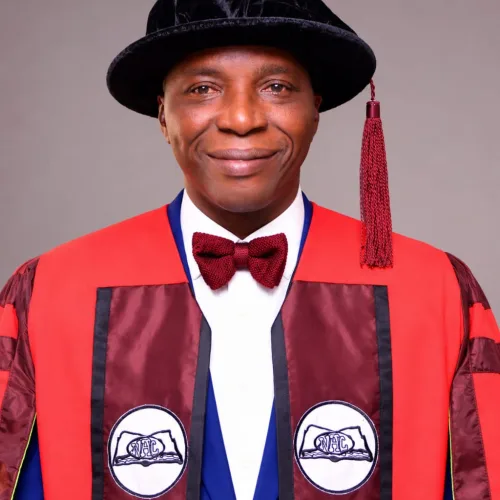
Following several years of impact, particularly in academics and public service, Prof. Oladele Abiodun Balogun has been inducted as a Regular Fellow of the National Academy of Letters (NAL) at its 28th Convocation, Induction and Investiture ceremony held at the J. F. Ade Ajayi Auditorium, University of Lagos (UNILAG), Akoka, Lagos.
Balogun, who expressed delight over his induction as one of the nine inductees of the 2026 Regular Fellows, is part of Nigeria’s foremost contemporary philosophers whose scholarly career spans more than three decades of teaching, research, academic leadership, mentorship, and public service.
The recipient of the Thabo Mbeki Award of Leadership by the University of Texas in 2017 serves as the present Special Assistant to the General Overseer (SATGO) on Administration and Pastor-in-Charge of Region 1 in the Redeemed Christian Church of God (RCCG).
He also played a central role in the establishment and development of Philosophy programmes at Osun State University and Redeemer’s University, Ede.
Having served as the Vice President of the Nigerian Philosophical Association from 2012 to 2016, he also occupied several leadership positions, including Head of Department and Dean of Faculty at Olabisi Onabanjo University (OOU), where he served for a long time.
Balogun, who advocates the recognition of African philosophy as a rigorous intellectual tradition capable of addressing universal human concerns, backs the call for the promotion of mother tongue in order to preserve Nigeria’s ethnic heritage.
He stressed the need to return to mother tongue usage to prevent further loss of values while speaking with journalists in line with the theme of this year’s lecture at the NAL Convocation, Induction and Investiture ceremony, ‘The Mother-Tongue Education Policy: The First Pathway to Nation-Building’, presented by Prof. Imelda Udoh (Professor of Linguistics and Nigerian Languages, University of Uyo).
He said:”What we have been saying is that if we don’t return to our mother tongue, our culture, our values will be lost. In returning to this mother tongue, I want to say everybody is complicit: the parents, the government, even scholars.
“There are some of us who cannot even speak our mother tongues very much, and if we don’t speak our mother tongues, how do we encourage our children? So many of us are sending our children abroad, and many of them don’t even understand our languages.”
Meanwhile, Prof. Udoh in the lecture partly stated, “The question is no longer whether mother tongue education has pedagogical value, but whether Nigeria can build the political commitment, institutional capacity, and public trust needed to sustain it.
“Any future language instruction reform must first build public understanding of why language matters for learning, and how multilingual education can strengthen rather than weaken English proficiency.”
For his part, NAL President, Professor Andrew Haruna, noted that for decades, Nigeria has pursued nation-building using borrowed linguistic tools.
He said:”We have mistranslated fluency in foreign languages as the sole metric of intelligence. Meanwhile, we allow our rich indigenous languages, the vessels of our philosophies and cognitive frameworks, to lie fallow.
“When a child is forced to master a foreign language before understanding the concept being taught, we do not merely delay learning, we fracture their identity. The Nigerian national language policy on education has long paid lip service to Mother Tongue instruction. Yet, as we evaluate the journey so far, we must ask hard questions.”
Please follow and like us:
Comments
Start the conversation about this story.