





…as Nigeria accelerates sugar self-sufficiency drive
The National Sugar Development Council (NSDC) is repositioning Nigeria’s sugar sector as one of the country’s most compelling industrial investment opportunities.
This, the NSDC said is anchored on a $1 billion EPC-plus-finance partnership with SINOMACH of China, a N10 billion Sugar Project Acceleration Fund established with the Bank of Industry (BoI), and a significantly strengthened accountability regime under the Backward Integration Programme (BIP).
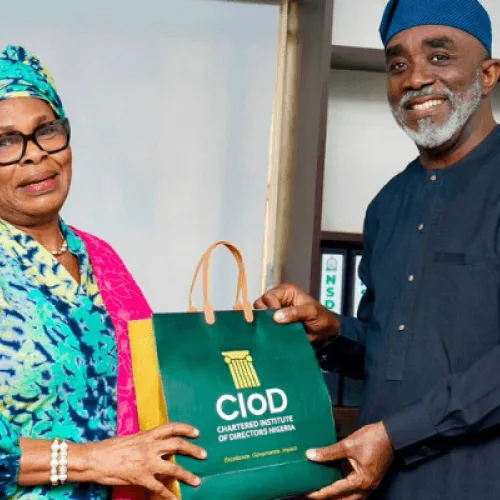
Kamar Bakrin, executive secretary/CEO, National Sugar Development Council outlined the Council’s execution agenda when he received members of the Abuja Chapter of the Chartered Institute of Directors (CIoD) on a courtesy visit to the NSDC headquarters in Abuja on Thursday.
Nigeria consumes about 1.8 million metric tonnes of sugar annually, with an estimated $1billion flowing each year to foreign producers.
Bakrin said the Council views this not as a deficit to be lamented, but as a ready-made domestic market waiting to be recaptured by Nigerian producers — value that the Nigeria Sugar Master Plan (NSMP) 2.0 is designed to retain within the national economy in the form of jobs, rural incomes, foreign exchange savings and industrial capacity.
He noted that the sector’s historical challenge has never been an absence of policy, but the discipline of delivery — a challenge the Council is now confronting directly.
“We don’t lack policy. What we have struggled with is world-class execution,” Bakrin said, stressing that the gap is not a farming problem but a governance problem — and therefore one that serious, well-run institutions can fix.
He described NSMP 2.0 as an “acceleration mandate”: a deliberate compression of Nigeria’s path to self-sufficiency, targeting the delivery of about two million metric tonnes of locally produced sugar.
Bakrin said the Council’s ambition extends well beyond substituting imports. Sugarcane, he noted, is one of the most generous crops in existence — yielding sugar, ethanol, animal feed and electricity — and NSMP 2.0 is structured to capture that full value chain.
“We have been blessed with a crop that is one of the most generous God has ever made. From sugarcane you can get sugar, you can get ethanol, you can get animal feed, you can produce power. Our job is to build a bio-industrial ecosystem around it — this is not just about producing a commodity,” he said.
On enforcement, Bakrin said the Backward Integration Programme has been rebuilt around four principles — qualify, reward, verify and enforce — designed to give both government and investors confidence that quota privileges are matched by real production on the ground.
Read also: Consumers raise alarm over declining product quality, quantity amid rising costs
Companies seeking import quotas must now demonstrate genuine commitment to backward integration, while major refiners are required to provide audited production commitments tied to their quotas, with clear consequences for shortfalls. The Council is deploying satellite imagery alongside field inspections to independently verify activity at every site — replacing self-reporting with objective, data-driven oversight.
Bakrin said the Council’s diagnosis of the sector’s financing challenge is that capital is available — what has been missing is a pipeline of bankable projects capable of absorbing it. The Council’s response is to industrialise project preparation itself.
The N10 billion Sugar Project Acceleration Fund, established with the Bank of Industry, will finance feasibility studies and project preparation, converting greenfield sites into investment-ready packages. These packages will in turn feed the $1 billion EPC-plus-finance agreement signed with SINOMACH of China, which provides a ready channel for construction and financing once projects are prepared.
The Council is complementing this with structured engagement with Afreximbank and a partnership with the Nigeria Governors’ Forum to fast-track the development of sugar estates across the country.
Bakrin highlighted the Sugarcane Outgrower Development Programme (SODP) as a deliberate strategy to make smallholder farmers co-owners of the sector’s growth.
Under NSMP 2.0, every sugar estate is required to reserve land for outgrowers and to invest part of its capital in host communities — through social infrastructure, employment and physical infrastructure — making rural prosperity a design requirement of the programme rather than an afterthought.
Drawing on the Council’s recent engagements with Brazilian authorities and other leading sugar-producing nations, Bakrin said the defining lesson from Brazil’s success was institutional, not agronomic.
“Brazil did not win by planting better cane. They won by building institutions that compounded productivity for years, for decades,” he said.
The Council, he added, is applying that same discipline to itself — developing Standard Operating Procedures across all its critical supporting functions using Six Sigma methodology, one of the world’s most exacting process-improvement systems, to build standardised, repeatable and effective processes that will endure beyond the tenure of any individual, including the Chief Executive.
“I hold a very strong conviction that the difference between the countries that industrialised and those that did not rarely has to do with the quality of their plants. It is the quality of their institutions,” the Executive Secretary emphasised.
Bakrin invited the Chartered Institute of Directors to play an active role in the emerging sugar economy — strengthening board governance across sugar estates, mills and outgrower companies, and contributing to the policy dialogue and consistency needed to attract patient, long-term capital.
He assured the Institute that the Council’s doors remain open for partnership in support of national development.
Earlier, the leader of the CIoD delegation, Fatima Nana Mede, commended the Council’s leadership on the visible reforms it is spearheading in the sugar industry and the momentum toward self-sufficiency. She affirmed the Institute’s readiness to collaborate with the Council in all areas of mutual interest as part of its contribution to the advancement of the sector.


Iheanyi Nwachukwu, is a creative content writer with almost two decades journalism experience writing on banking, finance, capital markets, and tax. The multiple awards winning journalist is Assistant Editor, BusinessDay. Iheanyi holds BSc Degree in Economics from Imo State University; Master of Science (MSc) Degree in Management from University of Lagos. Iheanyi has attended several work-related trainings including (i) Advanced Writing and Reporting Skills (Pan African University, Lagos); (ii) News Agency Journalism (Indian Institute of Mass Communication {IIMC}, New Delhi, India); and (iii) Capital Markets Development and Regulations (International Law Institute {ILI} of Georgetown University, Washington DC, USA). Other trainings Iheanyi attended include: Economic/Political Risk Analysis (By Thomson Reuters Foundation); International Financial Journalism (IFJ) (By PMA Media Training, UK); Effective Business Writing Skills (By Phillips Consulting); Reporting on Corporate Governance (By International Finance Corporation (IFC) & Thomson Reuters Foundation UK); etc. In addition, he has participated in high-level economy & markets events in Dubai, South Africa, Morocco, and other African countries like Zambia, Ghana and Gambia.
Comments
Start the conversation about this story.