





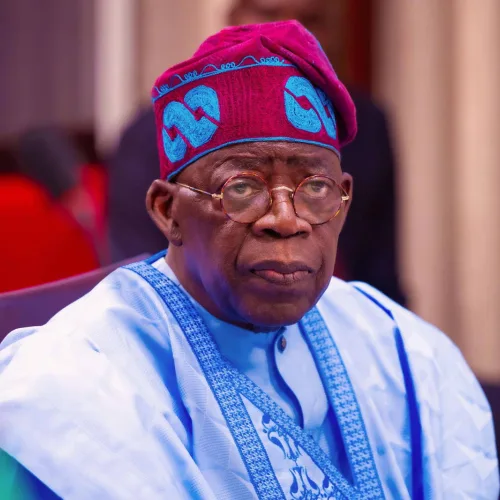
The ongoing debate about President Bola Ahmed Tinubu’s educational certificates is not and should not be the defining issue in a Nigerian presidential election. We cannot always reduce serious questions of governance in a presidential election to fitful hysteria about the academic credentials of candidates. For a sitting president, the certificate controversy is not very useful as a measure of presidential eligibility or performance.
More importantly, the prominence being accorded this controversy is distracting Nigerians from the substantive issues on which both Tinubu and his challengers should be judged in this election. Quite frankly, any debate about Tinubu’s educational qualifications should have been settled during the 2023 presidential election, if not earlier, not after Tinubu had been sworn in and certainly not now that he is three years into his presidency. As an incumbent, Tinubu’s policies affect Nigerians far more than his certificates. The same applies should any other candidate win the next election. It is how that candidate governs as president that will affect Nigerians, not the certificates they presented to INEC. I thought much the same in 2015 during the controversy over the late President Muhammadu Buhari’s certificate, and I feel the same now.
We must note, however, the substantive differences between the Buhari and Tinubu cases. In 2015, Buhari was a challenger, not an incumbent, and the controversy centred on a single issue: Buhari did not submit a secondary school certificate to INEC. So, the question was: did he complete secondary school, and if so, where was the certificate?
Section 131(d) of the Nigerian Constitution requires a presidential candidate to have been “educated up to at least School Certificate level or its equivalent”, while Section 318(1)(d) further gives INEC some latitude to determine “any other qualification acceptable” to it as an equivalent qualification. The Constitution, in other words, only establishes a minimum educational threshold, but it does not insist on the particularity of a secondary school certificate as the only means by which that threshold can be met. It also gives INEC the power to determine what other qualifications are acceptable to it as equivalent to the minimum.
Therefore, once INEC deems anyone’s submission acceptable, the matter should end there. This was the case with Buhari in 2015. Buhari attended Sandhurst, one of the most elite military schools in the world. He had nearly three decades of active military service, rising to the position of Major-General, not to mention that he was a former military head of state. By any objective measure, all of these qualifications were more than sufficient justification for INEC to have accepted his submission, even if he did not present any secondary school certificate.
In Tinubu’s case, however, there are not one but three issues. First, according to social media reports, Tinubu has presented only his Chicago State University undergraduate degree to INEC. If true, it implies that, like Buhari, either Tinubu did not attend primary and secondary schools, did not complete them, or at least does not now have the certificates to show that he did. Secondly, as the argument goes, if Tinubu did not attend or complete secondary school, or otherwise has no certificate for it, how then did he get into university in the first place? And third is the more consequential allegation that the degree certificate itself may not be genuine. This is effectively an allegation of forgery, and it is where the similarity with Buhari’s case ends.
Now, it is normal and legitimate practice for candidates and parties to turn questions about the educational and other qualifications of their opponents into campaign issues. But for voters seeking clarity, much of this controversy is rather pointless except where wrongdoing is conclusively proven by relevant authorities or courts of law, which has yet to happen.
First, the world over, higher educational qualifications can supersede or override lower ones. A WAEC result supersedes a primary school certificate, and a university degree, in turn, supersedes a secondary school certificate, and so on. Therefore, like Buhari’s military training at Sandhurst, Tinubu’s university degree supersedes the minimum education required. This is why INEC is correct to have accepted it in both 2023 and 2027, precisely as it did for Buhari in 2015, 2019, and all his earlier contests. But even if Tinubu had not submitted any educational certificates at all, his work experience and record of public service would be sufficient to qualify him. After all, the Constitution makes clear that education, training, work experience, and public service are among the range of equivalent qualifications INEC should accept.
Moreover, the exact words used in the Constitution are “to be educated up to at least School Certificate level or its equivalent”. I can educate myself up to the equivalent of secondary school level or higher without ever attending any school at all, and I would expect INEC and everyone else to have no problems with my application merely because I do not present a paper certificate. If anything, I would expect to be patted on the back for lifting myself by my own bootstraps. The operative term “to be educated” cannot be reduced only to the possession of paper certificates, and as a country, we must learn to adjust our cultural obsession with paper qualifications, not just in election matters, but indeed across all areas of human endeavour.
The question of how Tinubu got into university without a secondary school certificate is also needless. In the United States, as in many countries, age, work experience, written essays, sports or musical talent, etc., are also acceptable for university admissions in many cases, and I think Nigerian universities should also broaden their admission requirements likewise. I don’t know Tinubu, I don’t speak for him or his government, but I honestly believe that the question of how he gained admission into university without a secondary school certificate is entirely redundant unless, once again, there is conclusive evidence of wrongdoing on his part.
The allegation of forgery is more serious, but it is a matter of evidence only. If anyone can show Nigerians a letter from Chicago State University that it did not issue Tinubu’s certificate, or if anyone can show a ruling by a court in the United States or Nigeria that Tinubu’s Chicago State University certificate is fake, then we would have a very serious case on our hands. Only a court or Chicago State University itself can determine this allegation, and so far, none of them has made such a determination, at least to the best of my knowledge. Without conclusive evidence, therefore, much of the debate is prejudicial if the case is in court. And if it is not in court, then it is a pointless distraction in an otherwise serious election.
Most importantly, the intense focus on this controversy is shortchanging Nigerians in this election. As an incumbent, President Tinubu has introduced some of the most consequential political and economic reforms in Nigeria’s recent history. Millions of Nigerians are groaning under the weight of some of those reforms, while the government argues that they are necessary to put the economy on a more sustainable footing. The least opposition parties and candidates can do in this election is to engage those reforms critically and frontally.
Opposition parties, candidates, and their support groups should be telling Nigerians what is wrong with Tinubu’s political and economic reforms, what their own alternative policies are, and why those alternatives would produce better outcomes for Nigerians. They should be telling us about the consequences of fuel subsidy removal, the exchange-rate reforms, the rising debt profile, insecurity, and the government’s broader record of performance.
More importantly, they should be offering Nigerians their own alternative policies. This is what a presidential election should be about, and it is the only way Nigerians can know the difference between the incumbent and those challenging him for the same office. This election is for Tinubu’s challengers to show Nigerians that they can do better, not to focus on the academic credentials of a candidate who has already been president for more than three years. Nigeria cannot afford to turn yet another presidential election into a pointless chatter about school certificates.
Comments
Start the conversation about this story.