






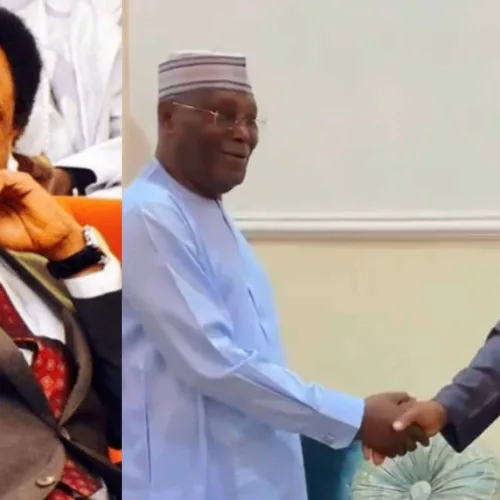
Former Kaduna Central Senator, Shehu Sani, has ruled out the possibility of former Vice President Atiku Abubakar and Labour Party presidential candidate Peter Obi stepping down for each other ahead of the 2027 presidential election.
The former lawmaker made this known on Tuesday while speaking as a guest on Frontline, a current affairs programme on Eagle 102.5 FM, Ilese-Ijebu, Ogun State, where he said opposition parties had waited too long to resolve their differences and agree on a single presidential candidate capable of challenging President Bola Tinubu.
His comments followed renewed efforts by opposition parties and groups to form alliances ahead of the 2027 elections.
Recall that a major political realignment ahead of the 2027 presidential election, the African Action Congress (AAC), Accord Party, and Social Democratic Party (SDP) have officially formed a unified coalition named the Movement for Democratic Renewal (MDR). Announced following a high-level strategic summit in Port Harcourt, the alliance brings together the 2023 presidential candidates of these platforms—activist Omoyele Sowore (AAC), energy entrepreneur Dr. Gbenga Olawepo-Hashim (Accord), and legal practitioner Prince Adewole Adebayo (SDP). This joint front is designed to create a potent, policy-driven opposition to counter the growing dominance of President Bola Ahmed Tinubu and the ruling All Progressives Congress (APC).
The coalition is specifically focused on preventing what it warns could become “a coronation disguised as an election,” actively resisting a drift toward a one-party state. Rather than acting as a standard anti-incumbent vehicle, the MDR aims to build a broad-based, grassroots alternative by heavily mobilizing civil society, youth organizations, and labor unions across regional lines. While the group has prioritized human rights advocacy, including calls for the release of detained figures like Mazi Nnamdi Kanu, they have intentionally set aside individual ambitions, stating that a single consensus presidential ticket and finalized internal voting modalities will be established following extended nationwide consultations.
However, Sani said the recent meetings were unlikely to produce the desired result because the major presidential contenders had already established their individual political structures.
“These are decisions they ought to have taken before now,” he said.
According to him, the situation had become more complicated because political parties had already submitted their candidates to the Independent National Electoral Commission, INEC, and the names had been published.
Sani said the stage reached in the electoral process made it unrealistic for the major opposition presidential candidates to suddenly withdraw for one another.
“It’s not possible for Atiku to step down for Peter Obi and it’s not possible for Peter Obi to step down for Atiku,” he said.
He argued that both politicians had already invested significant political capital in their presidential ambitions.
Sani noted that Atiku had also selected former Rivers State governor, Rotimi Amaechi, as his running mate.
He said asking Amaechi to abandon the ticket at this stage would further complicate the possibility of restructuring the opposition presidential arrangement.
“Atiku has already picked his vice-president, which is Rotimi Amaechi,” Sani said.
The former senator also noted that Peter Obi had already emerged as a presidential candidate and was mobilising supporters around his own political platform.
Sani said the opposition would have had a better chance of producing a formidable challenge to Tinubu if the parties had negotiated a common candidate much earlier.
He pointed to the period when some of the political actors were still within the African Democratic Congress as a missed opportunity.
“If they were able to work that out when they were all in ADC, that would have been better for them,” he said.
According to him, the various opposition figures have now taken positions, mobilised supporters, printed campaign materials and commenced preparations for the election.
Sani therefore described the continued meetings aimed at producing a single candidate as unlikely to achieve much.
“If they couldn’t put their house in order when they were all in ADC, is it now that everyone has taken position, has mobilised his people, printed his posters and billboards, and the names are in INEC and have been documented that you’re talking of one candidate?” he asked.
He said the opposition leaders could continue to meet and negotiate, but expected the discussions to end without a major breakthrough.
Sani maintained that the problem was not simply the absence of political meetings but the unwillingness of the major contenders to sacrifice their individual ambitions.
“If Atiku was interested in one candidate, he would have dropped down for Peter Obi. If Peter Obi was interested in one candidate, he would have dropped down for Atiku,” he said.
He recalled that the APC successfully resolved a similar challenge ahead of the 2015 election by rallying different political interests behind Muhammadu Buhari.
Sani said the opposition currently lacked the level of sacrifice that enabled the APC to defeat former President Goodluck Jonathan.
“That was what APC did in 2014. Everyone sacrificed ambition and rallied around Buhari, and then Buhari defeated Jonathan,” he said.
He argued that the situation was different among the current opposition figures because their individual ambitions appeared stronger than their willingness to compromise.
Sani also said the regional dimension of the 2027 presidential contest would make the negotiations even more difficult.
He noted that Atiku, being from the North, would face questions about how he intended to secure substantial support from the South.
He said the emergence of a Southern presidential candidate was already being viewed by many as part of the political expectation surrounding the next election.
“This is the turn for the South to produce an eight-year president,” Sani said.
He argued that asking Atiku to step aside for Obi could create resistance among Atiku’s supporters in the North.
Similarly, he said asking Obi to abandon his ambition in favour of Atiku could alienate supporters who believe the South should produce the next president.
Sani therefore said the opposition’s failure to resolve the issue early had weakened its chances of presenting a united front.
He maintained that political alliances must be built around realistic calculations rather than last-minute meetings.
According to him, the opposition can continue its discussions, but the current circumstances make a single presidential ticket extremely difficult to achieve.
Sani’s position comes as opposition parties continue efforts to build a coalition capable of challenging the APC and Tinubu in 2027.
Comments
Start the conversation about this story.