






The Minister of Defence, General Christopher Gwabin Musa (retd.), has unveiled a six-point framework for strengthening election security and protecting the integrity of Nigeria’s 2027 general elections.
Musa made the disclosure on Tuesday at the 8th edition of the Blueprint Newspapers Public Lecture, Impact Series and Awards Ceremony at the Bola Ahmed Tinubu International Conference Centre in Abuja.
The event was held under the theme, “Security Challenges and the Integrity of Nigeria’s 2027 Elections.”
Election security is national security
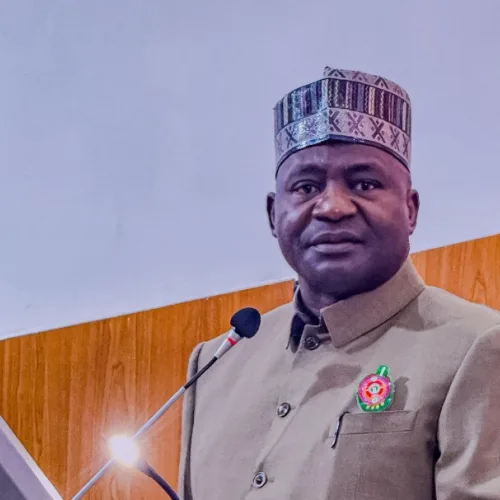
Musa, who was represented by his Special Adviser on Policy and Research, Major General Olufemi Akinjobi (retd.), said the changing nature of security threats had made it necessary to broaden the understanding of election security beyond the protection of polling units, electoral materials and personnel.
“Today’s threats rarely announce themselves with uniforms or conventional weapons. They emerge through cyberspace, spread through manipulated information, exploit economic hardship, inflame ethnic and religious divisions, and undermine confidence in public institutions,” he said.
According to him, such threats seek not only to influence how citizens vote but also whether citizens believe in democracy itself.
“Election security can no longer be viewed simply as the protection of polling stations. It is, fundamentally, the protection of democratic legitimacy,” he added.
Early planning crucial to election security
The Defence Minister stressed that successful election security could not be achieved through last-minute deployment of security personnel.
“The successful election security is not achieved through last-minute deployments. It is achieved through months of planning, intelligence-led operations, inter-agency coordination, effective communication and continuous assessment of emerging threats,” Musa said.
He said security preparations must begin long before campaigns and continue beyond the conclusion of voting, stressing that security should be treated as a continuous process rather than an event limited to election day.
Musa proposes SECURE framework
The minister proposed what he described as the “SECURE Framework” for strengthening election security and democratic resilience.
The framework comprises Strategic Intelligence Integration, Electoral Cyber Resilience, Civil-Military Coordination, Unified Strategic Communication, a Responsible Information Environment and Engaged Citizens.
He said modern election security must be intelligence-led, supported by threat assessments, early warning systems and real-time information sharing among security, intelligence and electoral institutions.
Musa also stressed the need to protect electoral systems, communication networks and information platforms against cyber intrusion, digital sabotage and malicious interference.
Security agencies must strengthen coordination
Musa said the constitutional roles of security agencies must continue to be respected while coordination, interoperability and joint planning are strengthened.
He said seamless collaboration, rather than institutional competition, was necessary for effective responses to national emergencies and major public events.
The minister also identified unified strategic communication as essential, saying timely and accurate public communication was necessary to sustain confidence before, during and after elections.
Armed Forces reaffirm constitutional neutrality
Musa reaffirmed that the Armed Forces of Nigeria had no partisan interest in the outcome of elections.
He said the Armed Forces were defenders of the Constitution and, where lawfully authorised, would provide Military Aid to Civil Authority in support of other security agencies.
“The Armed Forces owe allegiance neither to political parties nor to individual candidates. Our allegiance is to the Constitution of the Federal Republic of Nigeria. Our loyalty is to the Nigerian people,” he said.
Minister calls for collective responsibility
Musa said securing the 2027 elections could not rest on government and security agencies alone.
He urged political parties to place national interest above partisan advantage and called on candidates to recognise that political competition was not warfare.
He also tasked the media with reporting with courage, accuracy and restraint, while urging civil society to deepen civic education and promote peaceful participation.
Musa called on traditional and religious leaders to remain voices of moderation and reconciliation and urged young Nigerians to reject attempts to recruit them as instruments of violence or manipulation.
He said every Nigerian had a responsibility to reject violence, respect lawful authority, verify information before sharing it and participate peacefully in the democratic process.
“Every institution has a role. Every citizen has a responsibility. Every vote carries not only a political choice but also a commitment to the future of our Republic,” he said.
Comments
Start the conversation about this story.