





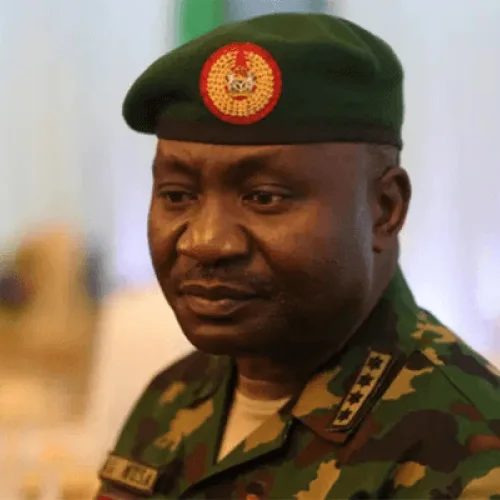
The Minister of Defence, General Christopher Gwabin Musa (Rtd), has said that the responsibility of protecting Nigeria’s democracy and ensuring the integrity of the 2027 general elections rests not only on security institutions but also on the media, political actors, religious and traditional leaders, civil society organisations and citizens.
Speaking on Tuesday at the 8th Edition of the Blueprint Newspapers Impact Series and Awards Ceremony in Abuja, the Minister warned that Nigerians should not rely solely on security agencies to safeguard democracy, stressing that the task requires a collective national effort.
Delivering a keynote address titled “Security Challenges and the Integrity of Nigeria’s 2027 Elections,” Musa said democracy is sustained by public trust and active citizen participation rather than by institutions alone.
Represented by Major General Olufemi Akinjobi (Retd.), his Special Adviser on policy and research, the Minister said, “Democracy is never secured by institutions alone. It is secured by a people who collectively believe that their nation is worth protecting.”
The Minister described election security as an issue of national security, noting that the nature of threats to democratic processes has changed significantly over the years.
According to him, discussions on election security were previously focused on election-day activities such as the deployment of personnel, protection of polling units and movement of electoral materials.
However, he said modern threats now emerge through cyberspace, manipulated information, economic hardship, ethnic and religious divisions and efforts to erode confidence in public institutions.
“Today’s threats rarely announce themselves with uniforms or conventional weapons. Increasingly, they seek not merely to influence how citizens vote, but whether citizens believe in democracy itself,” he said.
Musa warned that misinformation, cyber interference and digital manipulation have become major threats to electoral integrity globally, adding that Nigeria is not immune from such challenges.
He noted that advances in Artificial Intelligence have created development opportunities but have also made it easier to produce fabricated videos, cloned voices and manipulated images capable of misleading millions of people within a short time.
“The greatest threat to an election today may not necessarily be the individual carrying a weapon near a polling unit.
“It may well be the anonymous actor operating behind a computer screen, deliberately manipulating information, exploiting social divisions and attempting to weaken confidence in democratic institutions,” he stated.
The Minister therefore called for greater emphasis on cyber resilience, strategic communication and the defence of truth as critical elements of election security.
Reflecting on Nigeria’s democratic journey since 1999, Musa said the country has demonstrated resilience through continuous institutional improvements despite recurring challenges.
He cited the 2023 general elections as evidence of both progress and areas requiring further improvement, noting that security agencies conducted one of the largest coordinated election security operations in Nigeria’s democratic history.
“While there were isolated incidents in some locations, millions of Nigerians exercised their democratic rights peacefully.
“This reflected both the resilience of our citizens and the dedication of those charged with protecting the process,” he said.
The minister stressed that successful election security requires months of planning, intelligence gathering, inter-agency coordination and effective communication rather than last-minute deployments.
He also clarified the constitutional role of the Armed Forces in election security, stating that the military remains non-partisan and committed solely to the Constitution.
“The Armed Forces owe allegiance neither to political parties nor to individual candidates. Our allegiance is to the Constitution of the Federal Republic of Nigeria. Our loyalty is to the Nigerian people,” he said.
Musa added that the military’s involvement in elections is limited to constitutionally authorised support to civil authorities and other security agencies where necessary.
As part of preparations for the 2027 elections, the minister unveiled what he described as the secure framework for strengthening election security and democratic resilience.
The framework comprises six pillars: Strategic Intelligence Integration, Electoral Cyber Resilience, Civil-Military Coordination, Unified Strategic Communication, Responsible Information Environment, and Engaged Citizens.
He explained that Strategic Intelligence Integration would focus on threat assessments, early warning systems and information sharing among security, intelligence and electoral institutions.
Under Electoral Cyber Resilience, he advocated stronger protection of electoral technologies, communication networks and digital platforms against cyberattacks and interference.
The Civil-Military Coordination pillar, he said, would enhance collaboration and interoperability among security agencies while respecting their constitutional mandates.
Musa noted that Unified Strategic Communication was necessary because silence often creates opportunities for misinformation, making timely and coordinated public communication essential before, during and after elections.
He further argued that creating a Responsible Information Environment requires collaboration among government, media organisations, technology companies, civil society groups and citizens to combat false narratives and promote fact-based public discourse.
The final pillar, Engaged Citizens, emphasises the responsibility of Nigerians to reject violence, verify information before sharing it and participate peacefully in the democratic process.
“Ultimately, democracy is protected by its citizens,” he said.
The minister assured Nigerians that the Ministry of Defence would continue to work closely with the Office of the National Security Adviser, the Armed Forces, the Nigeria Police Force, the Department of State Services, the Defence Intelligence Agency, the Independent National Electoral Commission (INEC) and other relevant institutions to ensure peaceful and credible elections in 2027.
He said efforts would focus on strengthening inter-agency planning, enhancing intelligence collaboration, improving operational readiness and protecting critical national infrastructure.
Musa also pledged continued investment in the professionalism of the Armed Forces, stressing that discipline, respect for human rights and fidelity to the Constitution remain central to maintaining public confidence.
“The Armed Forces have no partisan interest in the outcome of elections. Our institutional interest is simple: that Nigeria remains peaceful, united and secure,” he said.
The minister called on political parties and candidates to place national interest above partisan considerations and avoid violence during the electoral process.
He urged the media to continue reporting with courage, accuracy and restraint, while encouraging civil society groups to deepen civic education and promote peaceful participation.
He also charged traditional and religious leaders to remain voices of moderation and reconciliation within their communities and appealed to young people not to allow themselves to be used as instruments of violence or political manipulation.
“Every institution has a role. Every citizen has a responsibility. Every vote carries not only a political choice, but also a commitment to the future of our Republic,” he said.
Concluding his address, Musa said the ultimate objective of preparations for the 2027 general elections should be the strengthening of democratic confidence, national unity and constitutional governance.
“The election of a President, Governor or Legislator is undoubtedly important. But there is something even greater that must emerge victorious in 2027: Nigeria herself,” he said.
According to him, history will remember not merely whether another election was conducted but whether Nigerians collectively succeeded in strengthening the Republic and preserving the integrity of its democratic institutions.
Please follow and like us:
Comments
Start the conversation about this story.