






…NWC consults with APC governors but not surrendering authority – Yilwatda
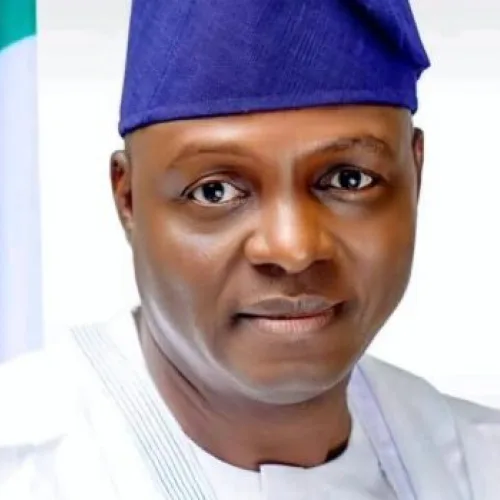
Professor Nentawe Goshwe Yilwatda is the National Chairman of the African largest political party – the All Progressives Congress (APC). The Plateau state-born politician is the immediate past Nigeria’s Minister of Humanitarian Affairs, Disaster Management, and Social Development. In this interview with BODE OLAGOKE, he speaks on his choice as Blueprint’s Person of the Year, the one-year journey as APC national chairman, his achievements and challenges, as well as legitimate issues from the primary elections, and why no group or individual candidate can give APC sleepless nights in 2027 elections. Excepts
National Chairman Sir, this paper is honouring you as its 2025 Person of the Year. How do you feel?
I feel deeply honoured and humbled by this recognition. An award of this nature is not just a personal recognition; it is also an acknowledgement of the work that we have collectively been doing to strengthen our party and contribute to the development of our country
Let me therefore appreciate the management and editorial board of Blueprint Newspapers for considering me worthy of this honour. I accept it with gratitude, but also with a deep sense of responsibility because every honour comes with an obligation to do more.
I have always believed that public office is not a reward; it is a call to service. When I became National Chairman of the All Progressives Congress, I understood very clearly that I was taking responsibility for the leadership of a party that is not only the governing party but also a political platform with millions of members across the country. That responsibility requires humility, discipline, consultation and a willingness to listen.
The award therefore belongs, in many ways, to the thousands of APC members, leaders, governors, legislators, ministers, National Working Committee members and supporters who have continued to work tirelessly to strengthen the party.
The past year has been one of immense responsibility, purposeful service and collective accomplishment. We have had our challenges, but we have also made considerable progress in strengthening the structures of the party, deepening our membership base, improving internal processes and positioning the APC for the 2027 elections.
So, I receive the award with gratitude, but more importantly, as a reminder that there is still much more work to be done.
So what should Nigerians expect from you in the years to come in terms of contributions to national development?
They should expect continued service and a stronger commitment to building institutions, strengthening democracy and contributing to the development of Nigeria.
My background has always taught me that sustainable development does not happen by accident. It is built through institutions, knowledge, discipline, innovation and purposeful leadership. Whether as an academic, public servant, minister or now as National Chairman of the APC, I have always seen leadership as an opportunity to solve problems and improve the lives of people.
At the party level, my immediate responsibility is to help build a political institution that is stronger, more democratic, more inclusive and more responsive to the aspirations of Nigerians. I want an APC that is firmly rooted in the grassroots, an APC where the ordinary member matters and where technology, data and modern organisational systems are used to improve the way the party operates.
That is why we embarked on electronic membership registration and revalidation. It is not merely about producing numbers. It is about knowing our members, understanding where they are, understanding their needs and building a political organisation that can communicate with them effectively. As I have said before, our electronic registration gives us real-time access to our members and strengthens our capacity for mobilisation and credible internal elections.
At the national level, I will continue to support policies and initiatives that promote economic growth, youth empowerment, human capital development, infrastructure, social protection and inclusive governance.
Nigeria is a country of enormous potential. Our responsibility as leaders is to create an environment where that potential can be translated into opportunity for the ordinary Nigerian.
Having been in the office for a year now, how has the journey been like, Sir?
It has been challenging, demanding and extremely rewarding. I assumed office at a time when the party had gone through its own internal difficulties and there were many expectations about what the new leadership should accomplish. I knew from the beginning that there was no magic wand. You cannot build a strong political institution overnight. It requires patience, consultation, discipline and continuous engagement.
The first year has therefore been a period of rebuilding confidence, strengthening party structures, improving internal communication and preparing the organisation for the enormous political responsibilities ahead.
We have travelled across the country, engaged governors, legislators, state party leaderships, stakeholders and ordinary members. We have listened to grievances, resolved disputes where possible and strengthened mechanisms for managing disagreements.
We also embarked on one of the most important organisational reforms in the history of the party – the electronic membership registration and revalidation exercise. The objective is to digitise our membership register, improve the integrity of our records and make the party more data-driven.
We have also successfully conducted our National Convention and secured a fresh mandate for the National Working Committee. That was significant because it demonstrated that the party could manage its internal processes and arrive at consensus while preserving institutional continuity. At the March 2026 Convention, I pledged that the NWC would build a stronger, more transparent, inclusive, disciplined and united party.
So, yes, it has been a demanding year. But when you look at where we started and where we are today, there is a lot to be encouraged about.
Many expressed doubt over your ability to effectively manage a political party in view of your background as an academic. What has been your driving force in superintending over Africa’s largest political party?
My driving force is service. I have never approached leadership from the perspective of whether I am coming from the academia, politics, administration or any other professional background. Leadership is fundamentally about understanding people, understanding systems, solving problems and building consensus.
In fact, my academic background has been an advantage in many respects. Academia teaches you to analyse problems objectively, interrogate evidence, listen to different perspectives and arrive at conclusions based on facts. Party administration also requires those qualities.
But beyond academic training, I have worked in government and have had extensive exposure to public administration, development programmes and political organisation. I have therefore had the opportunity to understand both the technical and political dimensions of governance.
The most important lesson, however, is that no chairman can run a national political party alone. The APC is bigger than any individual. I work with the National Working Committee, governors, legislators, ministers, state executives, local government structures, ward leaders and millions of ordinary members.
My job is to provide leadership, create the environment for people to work together and ensure that the rules of the party are respected.
I also believe strongly in data. Politics is often driven by emotion, but successful political organisation requires facts. That is one reason I have consistently emphasised the importance of our electronic membership database.
Within the last 12 months of your leadership, the party has recorded historic milestone achievements. Can you share some of them with us?
There are several. First is the strengthening of internal party organisation. We have worked deliberately to make the APC more institutionalised and less dependent on personalities. We have strengthened engagement with state chapters and improved coordination between the national and sub-national structures.
Second is the electronic membership registration and revalidation exercise. This is a major political reform because a modern political party cannot continue to operate entirely on manual records. We want to know our members, where they are and how to communicate with them. The system is also designed to strengthen internal democracy and improve the credibility of our primaries.
Third is membership expansion. In May, I stated that the party’s records showed about 12.9 million registered members submitted by the APC in its membership data exercise. I have always said that the real strength of APC is not simply in governors or elected officials; it is in ordinary Nigerians; young people, women, farmers, artisans, professionals and other citizens who believe in our platform.
Fourth is the successful conduct of our National Convention and the renewal of the mandate of the NWC. That has provided stability and continuity at the national level.
Fifth is our electoral performance. We have continued to win elections and by-elections in different parts of the country. What is particularly important to me is that our growth is not simply about defections. It is about grassroots acceptance, effective mobilisation and the performance of governments elected on our platform. I have said repeatedly that we cannot take anyone for granted.
On our preparation for 2027, we have moved very early to organise our candidates, structures and processes. The party successfully uploaded its presidential and National Assembly candidates to the INEC Candidate Nomination Portal, including President Bola Ahmed Tinubu and Vice President Kashim Shettima, as our presidential ticket for 2027.
We have also moved ahead with the uploading of governorship and State House of Assembly candidates.
And finally, perhaps the most important achievement is that we have been able to keep the party together despite the pressures that naturally accompany a large political organisation. The APC today is a more organised, more data-driven and more election-ready political platform.
What in your view are the major obstacles in party administration in Nigeria?
The greatest challenge is managing human expectations and interests within a political organisation.
Politics is about people, and people have ambitions. Every aspirant wants to win. Every leader wants his or her interests protected. Every member believes he or she deserves an opportunity. That is normal. The challenge arises when individual interests collide with institutional rules.
The second challenge is managing the consequences of electoral contests. Once you have many people contesting for one position, somebody will win and others will lose. The emotions that accompany such contests can be very intense. That is why reconciliation is an essential component of party administration.
The third challenge is maintaining discipline while remaining inclusive. A political party must be broad enough to accommodate different opinions, but there must also be rules. Without discipline, an organisation cannot survive.
The fourth challenge is communication. There is a saying I strongly believe in: good governance without communication is invisible. I have visited many states and seen projects and programmes that were not adequately communicated to the people. We must therefore improve our communication of what governments at the federal and state levels are doing.
Another challenge is the transition from traditional politics to modern political organisation. We need to use technology, data and evidence much more effectively.
These are challenges, but they are not insurmountable.
A school of thought is of the opinion that you were brought by President Bola Ahmed Tinubu for the perfection of his second-term aspirations. How far will you agree with this view, and how far have you gone in actualising this assignment if it is true?
Let me put it this way: President Bola Ahmed Tinubu is the leader of our party and the President of the Federal Republic of Nigeria. As National Chairman, one of my responsibilities is to strengthen the party and ensure that the APC is capable of winning elections and delivering on its programmes.
So, naturally, the re-election of the President is an important political objective of the party. But I do not see my job as simply about securing a second term for one individual. My responsibility is broader: to build an institution that can win elections because Nigerians believe in what it represents.
President Tinubu deserves a second term because we believe Nigerians should have the opportunity to consolidate the reforms and programmes that his administration has commenced. I have consistently said that his administration is undertaking reforms that previous governments spoke about but did not implement.
There is also a principle of fairness. President Tinubu supported the late President Muhammadu Buhari for eight years when he could have pursued his own presidential ambition. I have argued that the North should reciprocate that support in the spirit of equity and fairness.
But ultimately, elections are decided by Nigerians.
Our responsibility as a party is to take our message to the people, communicate the achievements of our government, present our candidates, mobilise our members and convince Nigerians that continuity under the APC is in their interest.
How is your office you handling the many petitions arising from the last primary elections?
We anticipated that there would be disagreements because primaries are competitive exercises.
Where there are many aspirants competing for one position, somebody must emerge and others must lose. The important thing is what happens after the contest.
Our position has always been that the APC must operate according to its constitution, the Electoral Act and the rules governing each primary.
In the recent primaries, we allowed direct primaries in many places because consensus was not acceptable to all the aspirants. As I explained previously, we cannot impose consensus where the aspirants themselves reject it. In fact, in some instances, people who were endorsed by governors did not win, which demonstrates that the process cannot simply be reduced to the wishes of one individual.
We have established mechanisms for dealing with complaints. We have the Presidential Conflict Resolution Committee and the Party Conflict Resolution Committee. Petitions are being reviewed, and where there are legitimate issues requiring correction, we will address them.
I have also made it clear that the party would not rush to make final declarations in disputed cases without allowing the appropriate appeal mechanisms to work. That is why, in some instances, final declarations were withheld pending the review of petitions.
Our objective is not to silence people. Our objective is to ensure that grievances are handled institutionally.
Is there likely to be a kind of National Reconciliation Panel before the 2027 general elections?
Reconciliation is already taking place, and we will continue to strengthen it.
I do not think reconciliation should be something we remember only when an election is approaching. It has to be a continuous process.
We have already activated conflict-resolution mechanisms within the party. Following the primaries, we have been engaging aspirants, candidates, governors, state leaders and other stakeholders to ensure that those who contested and did not emerge do not feel excluded from the party.
The message is simple: you may lose a primary election without losing your place in the party. A primary is an internal contest; the general election is a collective assignment.
Where a broader reconciliation mechanism is necessary, the party will not hesitate to establish one. We have done this in different forms and will continue to do so.
But reconciliation must also be accompanied by discipline. You cannot reconcile people while allowing them to continue violating the rules of the organisation.
Our objective is to enter 2027 as one family.
What has been your relationship with the Progressive Governors’ Forum (PGF)? Is it true that you have yielded party control to the sub-national chief executives?
I have an excellent working relationship with the Progressive Governors’ Forum.
The PGF is an important component of the APC because governors are elected leaders of the party at the state level. They control important political structures and have a direct relationship with our members and voters. But cooperation is not the same thing as surrendering control.
The APC is governed by its constitution and organs. The National Working Committee has its responsibilities; the National Executive Committee has its responsibilities; state executives have theirs; and governors also have their constitutional and political responsibilities.
I have never surrendered the authority of the National Working Committee to the governors. What we have done is establish a culture of consultation.
In fact, the relationship between the NWC and the PGF has become stronger because we understand that political success requires all components of the party to work together. The governors and the NWC have held several meetings on party programmes, the congresses, membership registration, the primaries and preparations for 2027.
I do not believe in a National Chairman who wants to operate as though governors do not exist, neither do I believe governors should run the national party. We need partnership, not rivalry.
Next year is a crucial year for the ruling party. How prepared is APC, in the face of a new drive by the opposition pressure group — the G100 — to present a consensus presidential candidate against President Bola Ahmed Tinubu in January 2027?
We do not underestimate anybody. That has been my consistent position. No individual or group gives us sleepless nights, but we pay attention to every political development.
Democracy allows people to organise, form alliances and present candidates. If the G100 or any other group believes it can produce a consensus candidate, that is entirely within its democratic rights.
But we are not sitting down and waiting for them? Our own preparation has already begun. We have strengthened our membership database, organised our structures, conducted our congresses and convention, concluded our primaries and begun the process of submitting our candidates.
Our presidential ticket is already settled. President Bola Ahmed Tinubu and Vice President Kashim Shettima are our candidates for the 2027 presidential election, and their nominations have been uploaded to the relevant electoral platform.
Beyond the presidential election, we are also building structures at the grassroots. The most important thing for us is not the name of the opposition candidate. It is our ability to convince Nigerians.
If an opposition group produces one candidate, that does not automatically translate into electoral victory. Elections are won through organisation, credible candidates, strong structures, effective communication, grassroots mobilisation and, above all, public acceptance.
The APC will therefore remain focused, disciplined and organised.
Chairman Sir, if general election is held today, what is your expectation, especially in the zones where presidential candidates like Atiku Abubakar, Peter Obi and Kwankwaso are very strong?
My expectation is that the APC will win. But I will not sit here and pretend that there are no competitive areas. Politics is competitive, and we respect every political opponent.
What gives us confidence is the strength of our organisation, our nationwide structure, the performance of our elected officials, our membership base and the work we are doing at the grassroots.
I have consistently said that the APC’s strength goes beyond governors and political office holders. It is rooted in ordinary Nigerians—young people, women, farmers, artisans, professionals and communities across the country.
In the North-West, for example, there is a lot of speculation about the strength of the opposition. But we have continued to engage the people and strengthen our structures. The same principle applies to the South-East, South-South, North-Central and South-West.
Take the South-East. We recognise that Peter Obi has significant political influence in the zone. We are not going to dismiss that. Our strategy is to engage the people, communicate our programmes and demonstrate that the APC is a national party with a national agenda.
The same applies to Kano and the wider North-West where Kwankwaso has a political base. We are not taking that for granted. We are building our structures and talking directly to the people.
As for Atiku Abubakar and other opposition figures, we respect their experience. But elections are not won by political history or media visibility alone. They are won by votes. And votes come from the people. That is why our focus is not on abusing opponents or wishing away their strengths. Our focus is on organisation, mobilisation, governance and persuasion.
We are going to every part of Nigeria. We will tell Nigerians what the Tinubu administration has done, what it is doing and what it intends to accomplish. We will explain the economic reforms, infrastructure projects, social interventions, investments in human capital and the steps being taken to reposition the Nigerian economy. We will also listen to Nigerians.At the end of the day, Nigerians will decide.
But if you ask me whether I am confident about the APC’s prospects in 2027, my answer is an unequivocal yes. We are preparing to win, but we will never take the Nigerian people for granted. That is why I have repeatedly said: we do not underestimate anyone; that is why we work every day.
Comments
Start the conversation about this story.