





By Augustine Idiagbon
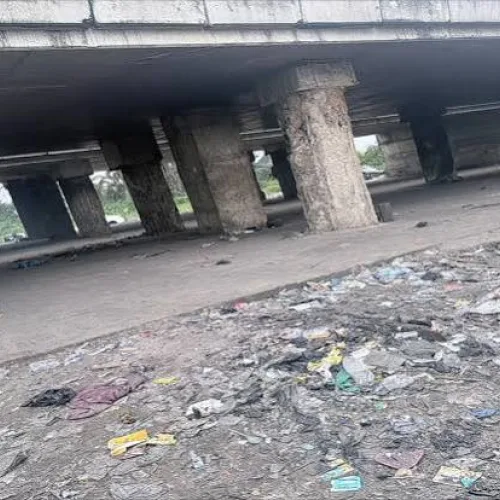
THE recent vandalism of the Alakija-Festac Bridge has raised fresh concerns over the protection of critical infrastructure and the activities of persons involved in scrap-metal collection.
The incident reportedly involved the removal of iron rods embedded in concrete sections of the bridge, prompting arrests and the visit by Lagos State Governor, Babajide Sanwo-Olu.
The governor, during an on-the-spot assessment, said the bridge remained structurally sound and safe for use despite the vandalism.
Sanwo-Olu said some suspects had been arrested, while security agencies were working to apprehend others allegedly involved in the incident.
He also warned that persons caught destroying public infrastructure would face the full weight of the law.
The incident has generated different perspectives, particularly over whether waste pickers were responsible for removing the materials from the bridge.
Some residents and commentators have linked the incident to scavengers searching for iron and other valuable materials for recycling or resale.
However, the President of the Association of Scrap and Waste Pickers of Lagos, Friday Oku, has consistently condemned vandalism.
Oku had earlier advocated proper registration, profiling and identification of legitimate waste pickers to distinguish them from criminals operating under the guise of scrap collection.
In 2022, the association said it had registered thousands of waste pickers in Lagos to facilitate identification of genuine operators.
This approach is important because blaming an entire occupational group without establishing individual culpability could obscure the actual network behind infrastructure vandalism.
The authorities should therefore determine precisely who participated in the Alakija incident and whether the suspects belong to any recognised waste-picking or scrap-trading association.
They should also establish where the recovered materials were taken, who purchased them and whether other persons financed or facilitated the operation.
The investigation should extend beyond those physically removing materials from the bridge.
It should also examine the market that creates demand for stolen public infrastructure, because vandalism remains profitable only when there are willing buyers.
The Alakija incident is also not an isolated case in Lagos.
In previous incidents, the authorities reported vandalism of bridge components, reflective road studs, safety lights, manhole covers and other public infrastructure.
The Federal Controller of Works in Lagos, Olufemi Dare, had previously raised concerns about vandals breaking concrete structures to remove embedded iron rods.
Dare urged Nigerians to protect public infrastructure as they would protect their personal property and report suspicious activities to the relevant authorities.
The warning remains relevant to the Alakija incident.
A bridge is not merely a physical structure; it is a critical public asset supporting transportation, commerce, emergency response and daily movement.
Any unauthorised interference with its components could create serious safety implications, even when immediate structural failure does not occur.
The greater concern, therefore, is how Lagos and other parts of Nigeria can prevent similar attacks on critical infrastructure.
Government cannot deploy security personnel to every bridge, road, drainage facility, power installation or public asset.
Residents must consequently become an important part of the infrastructure-protection system.
A commuter who notices suspicious activity around a bridge should report it promptly rather than assume that someone else will act.
Community leaders, transport operators, traders and other stakeholders can also assist security agencies by providing timely information.
At the same time, legitimate waste pickers should be encouraged to operate within a transparent system of registration, identification and accountability.
Such a system would protect genuine operators while making it more difficult for criminals to hide within the informal recycling sector.
Government agencies should equally strengthen surveillance around vulnerable infrastructure and maintain effective monitoring of facilities that have previously been targeted.
But surveillance alone will not solve the problem.
There must also be effective investigation, prosecution and appropriate punishment for persons found guilty of vandalising public assets.
The buyers and financiers of stolen infrastructure should equally be pursued because targeting only those at the point of vandalism may leave the larger network intact.
For Lagos residents, the Alakija incident should serve as a reminder that public infrastructure ultimately belongs to the people.
The bridge is used by workers, traders, students, families, emergency responders and other residents whose livelihoods depend on functioning transport infrastructure.
When public infrastructure is vandalised, government bears the cost of repairs, but the wider society bears the consequences.
Protecting such assets is therefore not simply a government responsibility.
It is a civic obligation shared by residents, communities, businesses, waste workers, security agencies and other stakeholders.
The Alakija experience provides an opportunity for Lagos to strengthen that collective responsibility.
Rather than condemning an entire group, the authorities should establish the facts, identify the perpetrators and dismantle the network that makes infrastructure vandalism profitable.
For residents, the message is straightforward: protecting public infrastructure is protecting ourselves.
The Alakija Bridge belongs to Lagos, but its protection is a responsibility shared by everyone.
M.P
Tags: Alakija Bridge collective duty Protecting public assets
Comments
Start the conversation about this story.