





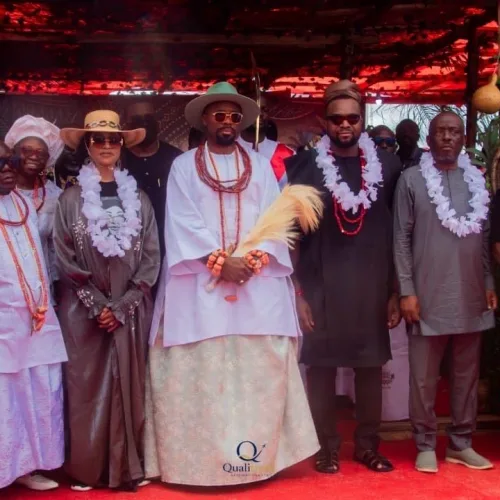
Ogiame Atuwatse 111, Olu of Warri, (Centre), Bosun Tijani, Minister of Communications and Digital Economy (right) and Hannatu Musawa, the Minister of Art, Culture, Tourism and the Creative Economy (left) with Godwin Ebosa, the national leader of Oboghoro Community (2nd right) and other leaders, at the closing ceremony.
…Fishing festival, seafood market exhibition, etc, mark a two-week aquaculture revival
…As FG begins installation of telecom towers across rural communities
Riverine communities in Delta State are receiving support for there efforts to reduce Nigeria’s estimated $1bn monthly seafood import.
For two weeks, a project to strengthen riverine activities and the environment’s ecosystem was held with a target of reducing fish and other seafood importation.
Thus, more than four ethnic nationalities of the riverine Delta State, weekend, gathered at the Oboghoro Community in Warri North Local Government Area for the grand finale of the pioneer edition of Bini Riva Life Festival, showcasing their riverine heritage and potentials that could contribute to reduction seafood importation, among other things.
It is believed that this is possible if priority attention is given to the development of the riverine communities of the Niger Delta region.
Organisers said the festival was aimed at drawing attention to the enormous potential of Nigeria’s riverine communities, particularly in areas such as fisheries, tourism, transportation, sports, creative industries, and other components of the blue economy.
The two-week-long event seen as more than a cultural celebration saw the people demonstrating their unity and peaceful coexistence even as it is believed to have the potential to generate significant economic activity that can stimulate infrastructural development in the host communities.
Read also: BOI lauds Tinubu’s support for the over subscribed N250b bond
The festival which featured series of activities focused on advancing the development and integration of the Riverine Economy of the fishing and marine logistics to unlock the potential of the blue economy of the riverine areas featured an eco-system of marine logistics powering a 3-day fishing festival and a commercial seafood market across several communities on the Benin River.
The festival, a renaissance celebration of the communities, activities and festivals around riverine connectivity, culture and commerce took participants on a tour and expedition to experience fishing festivals, river games, riverside runs, seafood market festivals, culture and history, museums, art, photography and lifestyle experiences. This evoked the unity and oneness of flowing water supporting diverse natural ecosystems and people.
The theme of ‘BINI Riva Life’ acknowledged the importance of connectivity as a catalyst for economic participation, education, innovation and cultural exchange. According to the organizers, riverine communities across Nigeria continue to demonstrate enormous potential when provided with access to digital infrastructure and communication services.
At the closing ceremony of the event that was also organized to commemorate the fifth coronation anniversary of the Olu of Warri, His Majesty Ogiame Atuwatse III, Bosun Tijani, Minister of Communications and Digital Economy, said that the federal government has commenced plans to install 3,700 telecommunications towers across rural communities in Nigeria as part of efforts to bridge the digital divide and connect underserved populations to the rest of the country and the global community.
Tijani said that the initiative was designed to ensure that no community, particularly those in difficult-to-reach riverine areas, was left behind in the Federal Government’s drive to expand digital connectivity nationwide.
President Bola Ahmed Tinubu had approved the programme as part of the administration’s broader ambition to build a $1 trillion economy. The first phase of the deployment had already commenced in Delta State, with a telecommunications tower currently being installed in the area.
“It is important to ensure that we connect every part of this country, including the riverine communities,” he stated, adding that the government would return to the area in October to officially flag off the networks. The project, he noted, was expected to make significant progress before the middle of next year.
Tijani said the ultimate objective was not merely to connect riverine communities to other parts of Nigeria, but also to give residents direct access to the global digital economy.
“Before mid next year, all riverine communities in Nigeria will be connected to the rest of the country, but they’ll also be connected to the world as well,” he said.
The minister noted that many of the communities targeted by the project had contributed significantly to Nigeria’s economic development, stressing that providing them with modern digital infrastructure would create opportunities for them to contribute even more to national growth.
He said the Federal Government’s $1 trillion economic ambition could not be achieved if significant portions of the population remained excluded from digital connectivity.
“These communities are areas that are giving so much to our country, and we believe that there’s still much more to give you too,” Tijani said.
He added that the administration was determined to ensure that the benefits of digital transformation reached communities irrespective of their geographical location.
Hannatu Musawa, the Minister of Art, Culture, Tourism and the Creative Economy, speaking on the topic, “The Economy of Creativity and Festivals for Culture and Tourism”, challenged the organisers of the festival to transform the annual cultural celebration into a sustainable tourism and economic platform.
She said, “What we have witnessed here is more than a festival. It demonstrates something central to the vision of the Federal Ministry of Art, Culture, Tourism and the Creative Economy: our culture is not only our inheritance; properly developed, it is also an economy.
“Our festivals create opportunities far beyond the performance ground. They support fishermen and boat operators, food vendors and artisans, hotels and transport providers, musicians, filmmakers, photographers, fashion designers and young digital creators. They attract visitors, stimulate enterprise and give communities an opportunity to tell their stories to the world”, she stated, adding, “That is the economy of creativity.”
She noted that Nigeria possessed an extraordinary cultural advantage. From our riverine traditions and fishing festivals to our Durbars, carnivals and masquerades; from our cuisine, music and dance to fashion, film, crafts and contemporary entertainment, we possess cultural assets capable of attracting the world.
The challenge is to transform these assets into sustainable economic value while protecting their authenticity, she said.
“Here in our riverine communities, water is more than geography. It is transportation, livelihood, food, memory, recreation and culture. Bini Riva Life brings these elements together — the waterways, boats, fishermen, cuisine, cultural performances and community life — into one compelling destination story.
Our task is therefore to move deliberately from events to destinations, and from destinations to economic assets.
A successful festival should not end when the music stops. It should leave stronger local businesses, better visitor experiences, documented cultural assets, increased digital visibility, new tourism routes, investment opportunities and reasons for visitors to return”, she stated, noting that this is why standards and excellence matter.
She continued, “If our destinations are to compete globally, we must measure quality, authenticity, sustainability, safety, visitor experience, cultural integrity and economic impact. Credible African-led private-sector frameworks such as the African Standards & Excellence Initiative — ASEI can complement our national ambition through assessment, recognition, benchmarking and continuous improvement across tourism, hospitality, culture, heritage and the creative economy.
Our cultural products must not only be beautiful; they must be excellent. Our destinations must not only be visited; they must be competitive. And our festivals must not simply attract crowds; they must create measurable economic value.
This connects directly with our Ministry’s Destination 2030 — Nigeria Everywhere, our national Global Soft Power and Tourism, Musawa stated.
“Do not allow Bini Riva Life to remain simply an annual event. Build it into a destination platform”, she counseled.
Godwin Ebosa, the national leader of Oboghoro community, had earlier commended the Federal Government delegation for its interest in the socio-economic development of riverine communities.
Ebosa also pledged the continued support of residents for government programmes aimed at improving the welfare and economic prospects of rural communities.


Comments
Start the conversation about this story.