





The Chairman of the Nigerians in Diaspora Commission (NiDCOM), Hon. Abike Dabiri-Erewa, on Monday said the world has fundamentally shifted into an era driven by Artificial Intelligence (AI), rapid digital transformation, and fierce global competition.
This is as she urged graduates of the need to view the global stage not as an escape route, but as a launchpad for national impact.
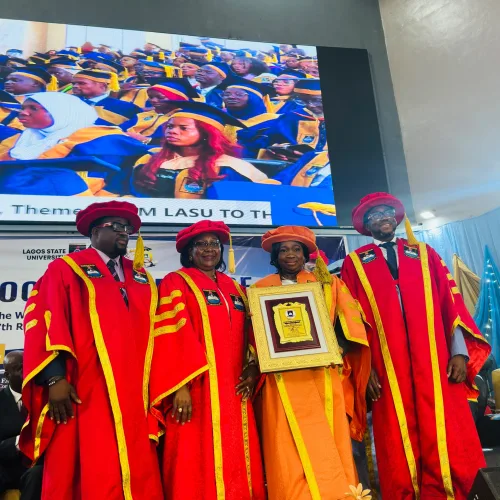
She disclosed this while delivering the 29th and 30th convocation lecture of Lagos State University (LASU), which was entitled: “From LASU to the World: Harnessing the Nigerian Diaspora as the 7th Region for National Development.”
Speaking on the JAPA syndrome, Hon. Dabiri-Erewa reconfigured the popular concept of brain drain (JAPA) into an asset, validating the choices of graduates who intend to move abroad while redefining their relationship with their homeland.
She advised the graduating students that while a certificate opens doors, it is character, competence, courage, and hard work that sustain success.
Addressing the specific challenges of graduating in 2026, the NiDCOM boss noted: “Yes, some of you will ‘Japa’, and that’s good, but go and learn, or earn and excel.”
“But remember this: You can leave Nigeria, but do not let Nigeria leave you. We are no longer saying, don’t go. We are saying, Go, shine, remember home, and go legally.”
Hon. Dabiri-Erewa, who distilled the transition from “graduation to greatness” into three actionable mandates, urged the new graduands to look past the passive hunt for a job and actively seek out complex problems to solve.
“Your education should equip you to create value, not simply to collect a certificate,” she noted.
She further advised the youth to step out of the shadows, let their work speak for them, network aggressively, and put their skills on display for the global market.
Added to this, she charged the graduating students, as they become new alumni of the university, to carry the flag with unyielding pride, correct negative international narratives through their personal conduct, invest back home, and intentionally mentor those coming behind them.
In her lecture, which focused on redefining Nigeria’s borders, she noted that beyond the traditional six geopolitical zones lies Nigeria’s “7th Region”—a global community of over 20 million Nigerians scattered across Africa, Europe, North America, Asia, and the Middle East.
While acknowledging that diaspora remittances reached a massive $20 billion last year, she advised the graduates that financial inflows are only a fraction of their true potential.
The ultimate value of the 7th Region, according to her, lies in human capital, knowledge transfer, technology sharing, and global networks.
“Whether the graduates choose to stay in Nigeria to tap into emerging sectors like agriculture, technology, the creative industries, and manufacturing, or travel to join the diaspora as doctors in Toronto or engineers in Berlin, both pathways are deeply patriotic,” Dabiri-Erewa stated.
Please follow and like us:
Comments
Start the conversation about this story.