





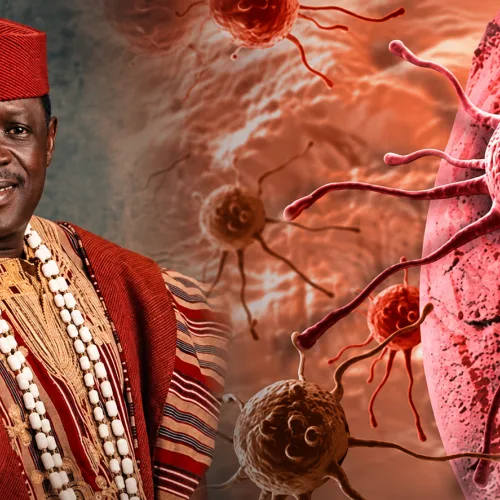
Veteran Yoruba actor Taiwo Hassan, popularly known as Ogogo, is reportedly battling stage-four cancer, according to his daughters, who have appealed for medical help for their father.
- What is cancer?
- What are the stages of cancer?
- Stage 0
- Stage 1
- Stage 2
- Stage 3
- Stage 4
- ALSO READ: Nollywood actors rally support for Ogogo over cancer treatment
- What does stage-four cancer mean?
- What are the common symptoms of cancer?
- Can someone have cancer without obvious symptoms?
- Can stage-four cancer be treated?
- Does stage-four cancer mean there is no hope?
- What are the survival chances for stage-four cancer?
- What is a five-year survival rate?
- What factors affect cancer survival?
- What is palliative care?
- What is known about Ogogo’s condition?
- What Ogogo’s case highlights
Ogogo’s daughters, Lima and Kira Taiwo, made separate appeals on social media on Monday, asking medical professionals and people with connections to cancer specialists or hospitals to help with his treatment.
Lima said the family was not seeking financial donations but medical assistance for the actor.
“Please, I’m begging you. If you know somebody that knows somebody that will be willing to treat him, anything, we’re willing to try anything. We’re not here to ask for money. Nobody’s here to ask for money,” she said.
Kira also disclosed that her father had been diagnosed with stage-four cancer.
The reports about Ogogo have raised questions about what cancer stages mean, what happens when cancer reaches stage four, the symptoms associated with cancer and whether people diagnosed with advanced cancer can survive.
Cancer is a group of diseases in which abnormal cells grow uncontrollably and can invade nearby tissues or spread to other parts of the body.
There are many types of cancer, including breast, prostate, lung, liver and colorectal cancer. They do not all behave in the same way, and treatment and survival can vary widely depending on the type.
According to the World Health Organisation, cancer is one of the leading causes of death worldwide, but many cancers can be treated effectively, particularly when they are detected early and appropriate treatment is available.
What are the stages of cancer?
Cancer staging is used by doctors to describe how much cancer is present in the body and how far it has spread.
The exact staging system differs from one type of cancer to another. Doctors may consider the size of the primary tumour, whether nearby lymph nodes are affected and whether the cancer has spread to other parts of the body.
For cancers that use the commonly used stage 0 to stage 4 system, the stages generally mean:
Stage 0
Stage 0 generally refers to abnormal cells that have not invaded nearby tissue. It is sometimes called carcinoma in situ.
Stage 1
Stage 1 generally means the cancer is relatively small and has not spread far from where it started.
Stage 2
Stage 2 generally indicates a larger tumour or greater local spread than stage 1. Depending on the type of cancer, nearby lymph nodes may also be involved.
Stage 3
Stage 3 generally means the cancer has spread further into nearby tissues or lymph nodes. It does not necessarily mean that it has spread to distant organs.
Stage 4
Stage 4 is generally the most advanced stage in cancers that use the four-stage system.
It usually means the cancer has spread to distant parts of the body. This is known as metastatic cancer.
However, the meaning of stage four can vary according to the type of cancer. The staging system used for breast cancer, for example, is not necessarily identical to that used for another cancer.
ALSO READ: Nollywood actors rally support for Ogogo over cancer treatment
What does stage-four cancer mean?
When cancer spreads from the place where it first developed to another part of the body, it is described as metastatic cancer.
For example, cancer that begins in one organ may later spread to the liver, lungs, bones or brain.
The symptoms of metastatic cancer can also depend on where it has spread. The National Cancer Institute says cancer that has spread to the bones can cause pain or fractures, while spread to the brain can cause headaches, seizures or dizziness. Cancer that spreads to the lungs can cause shortness of breath, while spread to the liver can cause jaundice or swelling in the abdomen.
Not every person with stage-four cancer will experience these symptoms.
What are the common symptoms of cancer?
Cancer symptoms vary according to the type of cancer and the part of the body affected.
Possible symptoms include unexplained weight loss, persistent tiredness, unusual bleeding, persistent pain, a lump or swelling, changes in bowel or bladder habits, persistent cough, difficulty swallowing and changes to the skin.
Advanced or metastatic cancer can also cause symptoms such as significant fatigue, weight loss and swollen lymph nodes.
However, having one or more of these symptoms does not automatically mean that a person has cancer.
Many of these symptoms can be caused by other illnesses. A persistent or unusual symptom should therefore be assessed by a healthcare professional rather than self-diagnosed.
Can someone have cancer without obvious symptoms?
Yes.
Some cancers may cause few or no noticeable symptoms in their early stages. This is one reason screening is recommended for certain cancers and groups of people.
The WHO says early diagnosis can improve the chances that cancer will respond to treatment and can reduce delays in care.
Can stage-four cancer be treated?
In many cases, yes.
Treatment depends on the type of cancer, where it started, where it has spread, the characteristics of the cancer, the person’s general health and how the cancer responds to treatment.
Depending on the circumstances, doctors may use chemotherapy, immunotherapy, targeted therapy, hormone therapy, radiation therapy or surgery.
However, not every treatment is suitable for every patient.
For some people with metastatic cancer, treatment may aim to shrink or control the cancer, slow its growth, relieve symptoms and help the patient live longer.
In other cases, doctors may focus more heavily on controlling symptoms and maintaining quality of life.
Does stage-four cancer mean there is no hope?
No.
Stage four is a serious diagnosis, but it does not by itself provide enough information to predict how long an individual patient will live.
The American Cancer Society says people with the same type and stage of cancer can still have different outcomes. Doctors consider several factors when assessing a patient’s prognosis.
Some advanced cancers can be controlled for long periods with treatment.
Advances in cancer treatment have also improved survival for some patients with advanced disease. The American Cancer Society reported that survival for several advanced cancers has improved over time, although outcomes remain very different depending on the cancer type.
What are the survival chances for stage-four cancer?
There is no single survival rate for stage-four cancer.
This is one of the most important points to understand.
Survival statistics are usually calculated according to the specific type of cancer and how far it has spread. For example, the five-year relative survival rate for distant non-small cell lung cancer is different from that of distant breast cancer, melanoma or other cancers.
The NCI explains that prognosis depends on factors including the type and stage of cancer, the patient’s health and how the cancer responds to treatment.
Therefore, it would not be medically accurate to say that someone diagnosed with stage-four cancer has a particular percentage chance of survival without knowing the type of cancer and other clinical details.
What is a five-year survival rate?
A five-year survival rate is a statistic used to describe how many people with a particular cancer are alive five years after diagnosis or treatment, depending on how the statistic is defined.
It is based on groups of patients and cannot predict exactly what will happen to an individual.
For example, current SEER data show that survival differs substantially depending on the cancer and whether it is localised, regional or has spread to distant parts of the body.
This is why doctors do not normally use a general “stage-four cancer survival rate” when discussing an individual patient.
What factors affect cancer survival?
Several factors can influence a person’s prognosis.
They include:
- The type of cancer
- The stage of the cancer
- Where the cancer has spread
- The characteristics of the cancer
- The patient’s age and general health
- How well the cancer responds to treatment
- Whether effective treatment is available
- The patient’s ability to receive and continue treatment
Cancer stage is important, but it is only one part of the picture.
What is palliative care?
Palliative care focuses on improving the quality of life of people living with serious illness.
It can help manage symptoms such as pain, difficulty breathing and other problems associated with cancer or its treatment.
Palliative care does not necessarily mean that cancer treatment has stopped or that doctors have given up on the patient.
The WHO describes palliative care as an important part of cancer care and says it can help relieve suffering and improve the quality of life of patients and their families.
Palliative care can therefore be provided alongside cancer-directed treatment where appropriate.
What is known about Ogogo’s condition?
Public information about Ogogo’s health remains limited.
His daughters have publicly said that he is battling stage-four cancer and have appealed for medical assistance. Punch reported that the family said hospitals had refused to continue treating him, while the daughters called for medical professionals and cancer specialists to help with his case.
The public reports do not establish the specific type of cancer Ogogo has, the extent to which it may have spread or his detailed medical prognosis.
It would therefore be inappropriate to give a specific survival percentage or predict how long he may live based only on the reported stage-four diagnosis.
Those questions can only be properly assessed by his medical team after reviewing his diagnosis, scans, pathology results, treatment history and overall health.
What Ogogo’s case highlights
Ogogo’s situation has drawn attention to the seriousness of cancer and the importance of early detection and access to treatment.
The WHO says cancer is more likely to respond to treatment when it is detected early, although the outcome varies by cancer type.
At the same time, a diagnosis of stage-four cancer should not be treated as a fixed prediction of death.
The stage tells doctors how far the cancer has spread. The type of cancer, its biological characteristics, the areas affected, available treatment and the patient’s response to that treatment all help determine the outlook.
For Ogogo, his family is currently seeking further medical assistance. Until more medical details are made public, his exact prognosis cannot responsibly be determined from the stage-four diagnosis alone.
Comments
Start the conversation about this story.