





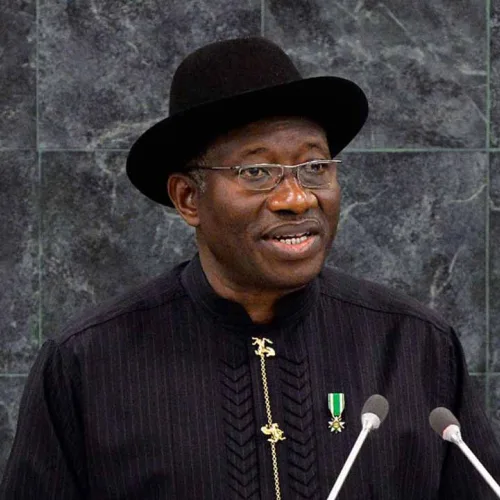
Former President Goodluck Jonathan has criticised the growing practice of serving governors, senior political officeholders, and other influential political actors converging on states during off-cycle elections, warning that the trend could undermine Nigeria’s democratic stability.
Jonathan made the call in a statement on the recent Osun State governorship election, where he commended the Independent National Electoral Commission (INEC), security agencies, political parties and the people of the state for the peaceful conduct of the poll.
He, however, expressed concern over what he described as an emerging trend in political conduct during off-cycle elections, particularly the presence of serving governors, senior government officials, party leaders and their aides from outside the state.
According to him, the development witnessed during the recent governorship elections in Osun, Ekiti and Ondo states was unusual and should not become normal practice in a democratic society.
Jonathan recalled that similar situations occurred during the 2013 Anambra and 2014 Ekiti governorship elections while he was president.
He said he had ordered party leaders and senior government officials to leave the states after being briefed about their presence.
The former president acknowledged the right of political parties to campaign, mobilise supporters and deploy their legitimate structures, but warned that excessive mobilisation involving serving governors and senior public officials on election day could create fear and undue pressure.
“The conduct witnessed around the recent elections in Osun, Ekiti and Ondo States was, in my view, unusual. It is not a practice that should become normal in a democratic society.
“I recall that, as President, similar situations arose during the 2013 Anambra and 2014 Ekiti governorship elections. On those occasions, senior political leaders mobilised and descended upon the states. Upon being briefed, I ordered party leaders and senior government officials to leave the states immediately.
“This trend is unwholesome. If left unchecked, it could threaten our fragile democracy and have serious long-term implications for democratic stability.
“Political parties are entitled to campaign, mobilise their supporters and deploy their legitimate party structures. That is an essential part of democracy. However, there is a point at which political mobilisation, particularly when it involves the overwhelming presence of serving governors, senior public officials and powerful political actors from across the country on election day, can create an atmosphere of apprehension, intimidation, bullying and undue pressure.
“We must ask ourselves whether the increasing deployment of political power and large-scale mobilisation by senior office holders on election day in states holding elections is consistent with the spirit of free, fair and peaceful democratic competition.
“This hardly happens in other democratic countries.
“We must not allow political competition to become a contest in which victory is perceived as something that must be achieved at all costs.
“There is also the question of precedent. If the current trend becomes established, what happens when governors from opposing political parties begin to descend on every state holding a competitive election? What happens when each party seeks to match political power with political power, governmental influence with governmental influence, and mobilisation with counter-mobilisation?
“Such a development would not strengthen our democracy. It would deepen political tensions and could make elections increasingly resemble battles for political survival rather than peaceful contests for the mandate of the people,” the statement partly reads.
Continuing, Jonathan called on the National Peace Committee to convene a stakeholders’ meeting to examine emerging practices surrounding elections and establish acceptable standards for political conduct.
He said the proposed engagement should include the leadership of registered political parties, INEC, relevant security agencies, the National Assembly, the Nigerian Bar Association (NBA), the Nigeria Governors’ Forum, civil society organisations and the media.
Jonathan said the National Peace Committee was well positioned to lead the conversation because of the confidence and moral authority it had built in bringing political leaders together during periods of national tension.
“An early national conversation can help us establish appropriate boundaries and expectations for political conduct before practices that are unusual today become accepted as normal tomorrow.”
Comments
Start the conversation about this story.