





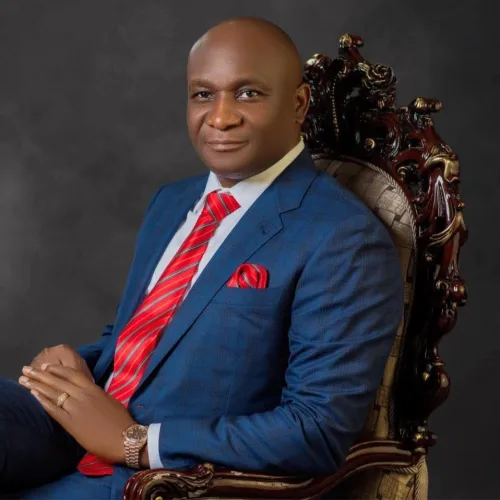
In the quiet riverine community of Ayakoro in Ogbia Local Government Area of Bayelsa State, a dynamic leader was born on August 19, 1975, who would one day help reshape the fortunes of the entire Niger Delta. That Leader is Dr. Samuel Ogbuku. Today, as Managing Director and Chief Executive Officer of the Niger Delta Development Commission (NDDC) and Paramount Ruler of Ayakoro Kingdom (Daufa VI), his journey from the creeks of Bayelsa to the centre of regional development stands as one of the most compelling stories of service and impact in contemporary Nigeria.
Roots in Ayakoro
Dr. Ogbuku’s early years were shaped by the realities of the Niger Delta region: its beauty, its struggles, and its unfulfilled promises. Though he spent much of his childhood in Port Harcourt, regular visits home to Ayakoro left a lasting impression. The underdevelopment he witnessed in his ancestral community planted a quiet determination: if opportunity ever came, he would use it to change the lives of his people.
He began his formal education at Christ the King School, Oromenike, Port Harcourt, obtaining his First School Leaving Certificate in 1987. He proceeded to Government Secondary School, Borokiri, before gaining admission into the University of Port Harcourt. There he earned a Bachelor of Science degree in Political and Administrative Studies in 2000. He later obtained a Postgraduate Diploma in Sociology, Industrial Relations and Personnel Management, a Master’s degree, and finally a Doctor of Philosophy in Political and Administrative Studies and Development Studies in 2021. Education, for him, was never merely personal advancement; it was preparation for service.
From Activism to Administration
As a young man, Ogbuku was deeply involved in the Niger Delta struggle. He served as Public Relations Officer of the Ijaw Youth Council (Central Zone) and cut his teeth in student activism. Those early years taught him the language of agitation, but also the limits of confrontation. He gradually moved into structured public service.
Between 2005 and 2007 he worked as Personal Assistant to the Special Assistant to the Minister of State for Petroleum. From 2007 to 2012 he served as Chief of Staff at the Bayelsa State Government House, at the time one of the youngest people to hold that position in Nigeria. He later managed Fulfilled Farms Nigeria Limited, deepening his interest in agriculture and aquaculture, before serving as Senior Special Assistant on Niger Delta Affairs to the Deputy President of the Senate. These roles gave him practical experience in governance, crisis management, personnel administration, and the complex politics of the oil-producing region.
He had the rare privilege of being appointed twice as MD/CEO of the NDDC by two Nigerian Presidents; first by President Muhammadu Buhari in November 2022, and again by President Bola Ahmed Tinubu in August 2023 for a fresh four-year tenure.
Ogbuku arrived at the NDDC with both institutional knowledge and lived experience of the challenges he was expected to solve.
Transforming the NDDC
The NDDC Ogbuku inherited carried a heavy burden of unfinished projects, public scepticism, and institutional turbulence. He responded with a clear philosophy: move the Commission from “transaction to transformation.” The focus shifted decisively toward completing legacy projects, improving transparency, and delivering visible results.
Under his leadership, the Commission has made measurable progress in infrastructure. Thousands of kilometres of roads have been constructed or rehabilitated, dozens of bridges and jetties completed, and major connecting projects such as the Ogbia-Nembe Road, the Ibeno Bridge, and the Kaa-Ataba Bridge advanced or delivered. Electrification initiatives, including the “Lighting Up the Niger Delta” programme, have brought power to communities that had lived for years in darkness.
In healthcare, the NDDC constructed and equipped numerous health centres and revived free medical outreach programmes that have provided tens of thousands of patients with care, including thousands of surgeries. Education and youth empowerment received renewed attention through expanded scholarship schemes, school rehabilitation, and skills programmes designed to give young people alternatives to restiveness.
King Ogbuku has also emphasised institutional reform, working with professional partners to strengthen governance systems and prioritise accountability. His administration secured significant budgetary support and focused resources on completing abandoned projects rather than endlessly initiating new ones.
Returning Home as Traditional Ruler
In June 2026, Dr. Ogbuku was installed as Paramount Ruler of Ayakoro Kingdom with the title Daufa VI, succeeding the late monarch after serving as Deputy Paramount Ruler. The dual role technocrat by day and traditional father by night reflects the depth of his connection to his roots. He has pledged to lead with humility, promote peace and unity, and work with stakeholders for the sustained progress of Ayakoro and the wider region.
A Living Legacy
Dr. Samuel Ogbuku’s story is still being written. At just over fifty, he continues to occupy one of the most demanding development positions in Nigeria while simultaneously carrying traditional responsibilities in his hometown. What distinguishes his trajectory is consistency of purpose: a young man from Ayakoro who never lost sight of the community that raised him, and who has used every platform activism, government, private enterprise, and now the NDDC to push for tangible change.
Conclusion
Dr. Samuel Ogbuku’s journey from Ayakoro to the leadership of the NDDC shows that true impact begins with a deep love for one’s people. Through hard work, focus, and a clear vision, he continues to turn challenges into progress for the Niger Delta. His legacy is still growing, but the difference he is making is already being felt in communities across the region.
From the mangrove creeks of Bayelsa to the boardrooms of regional development, his path illustrates a simple but powerful idea: impact is possible when knowledge, experience, and genuine attachment to place are combined with the courage to confront difficult institutions. In the Niger Delta, that combination is already producing results that communities can see and feel.
Martins Ibigomie Ogolo
Public Affairs Analyst
[email protected]
Comments
Start the conversation about this story.