





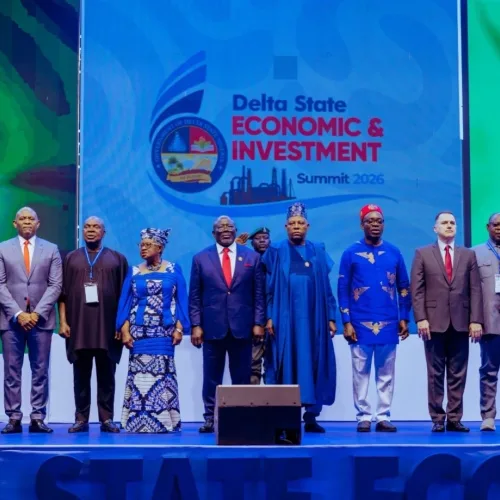
Economic observers believe that the recently concluded Delta State Economic Summit has already started fast-tracking the economic narrative of Nigeria’s ‘Big Heart’ State.
Top Delta State Government officials and economic experts at the Summit, as well as members of the Economic and Investment Committee, stated that the successful conclusion of the Economic and Investment Summit in Asaba marked a defining moment in the state’s economic journey.
Already, the online image of the State at the moment is fully garnished with reflections of the economic summit, lauded by top names from the investment hubs around Nigeria and beyond.
The state, created in 1991, which now has an estimated population of 7.8m people, is now the 3rd biggest per capita income of $6,025, meaning that people who reside in the state are the 3rd richest on average. The state has $40bn as its state gross domestic product.
Findings indicated that by the time Gov. Sheriff Oborevwori took over in 2023, the size of the state’s economy was only at ₦14.50 trillion, having grown from ₦9.20 trillion in 2019. The state’s internally generated revenue is about N84bn, built on oil, agriculture, services, and the new surge in non-oil sectors.
By 2026, Delta State, the State with the most towns and cities such as Warri, Asaba, Effurun, Ughelli, Sapele, Kwale, Abraka, Burutu, Koko, Oghara, Ozoro, Ogwashi Ukwu, Agbor, Osubi, and Bomadi, is surging with vibrancy. It is now one of the top five largest economies in Nigeria, anchored by a robust non-oil sector, expanding internal revenue, and aggressive private-capital investment initiatives led by Governor Sheriff Oborevwori.
Now, just after three years, Delta State’s economy seems to be the cynosure of global attention as investors from Nigeria and beyond have made demonstrable inroads. They are believed to be making definite stakes, and these were redefined at the economic summit.
Delta State has recorded an 18.34% growth rate within the last three years to N16.97 trillion GDP. What seems significant is that non-oil activities, which began in the last administration, have grown to 71.43%, leaving oil and gas at 28.57%.
Investors usually look out for the growth rate of internally generated revenue (IGR), which seems to help interpret the vibrancy rate of the local economy. Delta State’s IGR has grown from N84 billion in 2023 to over ₦200 billion under recent financial reforms. This may be why the introduction of the $100 million Viability Gap Fund (VGF) by Gov. Oborevwori seems to be seen as an economic masterstroke designed to attract foreign and domestic private-sector capital into infrastructure and enterprise.
This is expected to galvanise the agriculture & agribusiness sector, which comprises about 32% of the non-oil GDP, focusing on staples like cassava and rice, alongside industrial crops like rubber and palm oil.
The energy & industrialisation business sector, with gas gathering hubs, steel complexes at Aladja, and special economic zones like the Kwale Industrial Park, serves as major industrial focal points.
Governor Oborovwori laid the tracks for the economic summit with tangible evidence of leadership. He cleared all doubts that foreign investors were on hand when he commended those he called foreign delegations for participating fully in the three-day summit and undertaking inspections of strategic investment locations, including the Kwale Special Economic Zone.
He described the sustained engagement of foreign investors as evidence of confidence in the state’s investment prospects. He made it clear to the international investment community that Delta State is ready for business.
The thematic areas of focus of the summit, according to participants at the three-day event, looked at the Delta Special Economic Zone (DSEZ), promoting structured industrial clusters to attract manufacturing and enterprise.
It also looked at agriculture, agri-business and livestock especially the expanding value chains in areas like palm oil, cassava, rice, aquaculture, poultry, and ranching; energy ecosystem such as tapping into oil and gas enhancements, power projects, and renewable energy alternatives; solid minerals & mining with eye on developing commercial prospects in industrial clay, kaolin, coal, and lignite; blue economy & transport infrastructure; digital economy & innovation with hope to scale ICT infrastructure, expand fiber optics, and support tech hubs and startups; tourism, hospitality & the creative economy; and infrastructural development & human capital with an eye on improving public facilities, road networks, security, education, and sports development.
The governor helped investors to make investment decisions when he declared that the state would no longer rely solely on oil revenue. What he wants is for local and foreign investors to take advantage of the vast opportunities across critical sectors of the economy, saying his administration has intensified efforts to diversify the state’s economic base.
Economic summit observers all over the world usually watch the language of the host states because such assurances play critical roles in projecting key performance indices (KPIs). On this, the governor described the summit as more than a policy dialogue. The governor expressed optimism that the ideas, partnerships and commitments emerging from the summit would culminate in tangible investments capable of accelerating industrialisation, expanding employment opportunities and positioning Delta State as one of Nigeria’s leading investment destinations.
Responses began flooding in. Roberto Fronseca, a Brazilian agribusiness investor, unveiled plans to partner with the Delta State Government to develop a modern cattle and beef value chain, covering cattle breeding, ranching, slaughterhouses, beef processing, cold storage, refrigerated transportation and distribution networks.
Fonseca said Delta possesses climatic and environmental conditions similar to those that enabled Brazil to become the world’s largest cattle and beef producer, adding that the partnership could position the state as a major livestock production hub for Nigeria and neighbouring African markets.
Mosra Energy Managing Director, Ramos Olukayode, confirmed that Delta State has over 200 million tonnes of coal deposits in Obomkpa, Ugbodu and Ukunzu, exceeding the estimated reserves in Enugu and Kogi states. This revelation seems to speak to power sector assurances that investors coming to Nigeria need badly.
He disclosed plans to build a 600-megawatt power plant at Obomkpa, with over 200 hectares already secured for the project. This was seen as more than assurances.
The vice president leads the top-level seal:
The summit’s importance was further reinforced by the convergence of ideas from Vice President Kashim Shettima, who provided the national economic context by describing Delta as “a first-order investment destination”.
The stamp of assurance was further sealed by Governor Sheriff Oborevwori; Ngozi Okonjo-Iweala, the WTO Director-General; Charles Soludo, the Anambra State Governor; Austin Avuru, an energy expert; Patrick Lumumba, a Pan-African scholar; Taiwo Oyedele, the Finance Minister; and Tony Elumelu, one of Africa’s leading investors.
Their interventions, though delivered from different perspectives, point towards a common economic conclusion: Delta possesses the resource base, strategic location, human capital and policy foundation required to become one of Nigeria’s leading investment destinations.
Tony Elumelu, an indigene of the state and Chairman of Heirs Holdings, endorsed Delta State as one of Nigeria’s emerging investment destinations, declaring that the state is ready for profitable investments while calling for a partnership with the state government to unlock its huge power potential.
Speaking at the Delta State Economic and Investment Summit, Elumelu said the visible transformation taking place under the current administration had strengthened investor confidence in the state.
“I want to congratulate our governor for his visionary leadership and for what he is doing for the people of Delta State,” he said.
The billionaire investor noted that as an indigene of the state, he has closely monitored its development and is encouraged by the growing pace of private sector investments.
Delta’s Viability Gap Fund seemed to bring a spike and spark, and many already saw a model in the making for other states, as confirmed by Daniel Anazia, founder of Sunbridge Consulting. He said if the $100 million fund is implemented with transparency and professionalism, the fund could become a model for other states in Nigeria and a major turning point in the state’s economic development.
The summit proved that it is about talking and starting to do right away. The private sector reaffirmed its confidence in the state. A firm, 4Clans Nigeria Limited, in collaboration with the Delta State Government, is agreeing to transform portions of the Asaba Waterfront into a major economic and urban development hub to be known as NigerCity Bay.
Medical tourism, next to education abroad, is believed to have sapped Nigeria’s foreign exchange to no end. The governor seems to have a plan for every critical sector and showed how his administration’s investment in healthcare is expected to reduce over N100bn spent annually by Delta on medical tourism abroad.
The governor harped on how the prosperity of future generations of Deltans has been his administration’s goal. He spoke while receiving a delegation of Brazilian and Malaysian investors who paid him a courtesy visit during the summit. Oborevwori said the summit was designed to showcase Delta’s vast economic potential and reassure local and foreign investors that the state.
Top groups, including Transcorp, Manitoba, InfraCredit, and CNG Initiative, moved fast to pledge investments in the state.
The attention to power as a critical resource for industrial promotion was clearly demonstrated. The state unveiled a roadmap to unlock its nearly 3,000 megawatts of installed electricity generation capacity. They showed plans to establish a Delta State Electricity Regulatory Commission and a Delta State Rural Electrification Agency.
Investors from Brazil, Malaysia, and the United States complemented the expectations when they expressed strong interest in investing in the state’s agriculture, energy, and industrial sectors. They did an inspection tour of key investment sites across the state.
Conclusion:
Investments so far lined up in Delta State as a result of the recent summit are estimated at over $10bn in the next five years. The canning industry alone, which may be a reality, is expected to yield over 100,000 jobs in the early stages, plus the propensity to resolve the herders-farmers clashes that create fuel for insecurity in the region.
When these prospects begin to touch down, many may look back and remember the vision that propelled the economic summit.


Comments
Start the conversation about this story.