





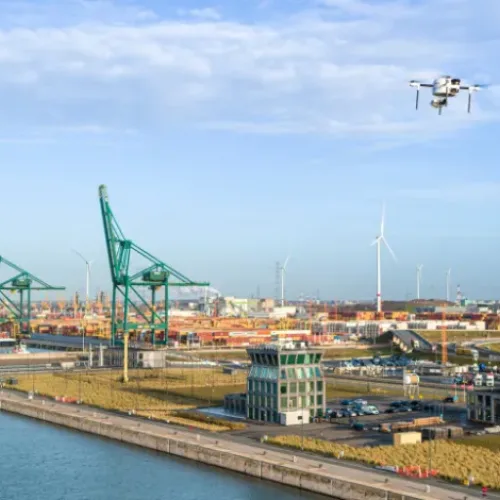
Six autonomous drones now operate across the Port of Antwerp-Bruges in Belgium, launching from fixed docking stations, flying scheduled missions beyond the visual line of sight and returning to recharge without an on-site pilot. About 18 missions are conducted each day across more than 120 square kilometres of port estate. Their imagery is streamed to a central command centre, supporting infrastructure inspection, environmental monitoring, security and incident response.
The important story here is not the drones. It is visibility.
A major port is difficult to observe. It is large, constantly moving and operationally fragmented. Ships arrive and depart, trucks queue, cargo moves between terminals, and infrastructure must be monitored while operations continue around the clock. Antwerp’s D-Hive network makes that environment continuously observable from above. Its drones inspect roads, quays, roofs and pipelines; support pollution detection and emergency response; and provide security teams with aerial situational awareness. Their data can also be combined with CCTV, vessel-tracking systems, radar, access control and terminal operating systems.
That distinction matters for West Africa.
Our ports face many of the same operational challenges: congestion, infrastructure inspection, security, environmental monitoring and emergency response. Nigeria already has substantial maritime-security capabilities through the Deep Blue Project, including a C4i centre, aircraft, vessels and unmanned aerial assets. Ghana’s Tema Port has invested in CCTV, facial recognition, body-worn cameras and drone capabilities. The question is therefore not whether African ports have discovered drones. They have. It is whether these technologies are becoming continuous operational intelligence.
That is where Antwerp offers a useful benchmark. Aerial monitoring could identify a growing queue along a port access corridor before it becomes a larger operational problem. At Lekki, where automated gates, OCR and digital control systems are already in place, an aerial intelligence layer could complement those systems. At Onne, it could support inspection of perimeter areas, jetties and energy infrastructure. In Abidjan, applications could include terminal inspection, canal monitoring and spill detection.
But deploying drones is the easy part. The more difficult questions are regulatory and operational. Antwerp’s network operates within an approved framework for beyond-visual-line-of-sight flights and is integrated into the port’s wider command-and-control environment. West African ports seeking similar capabilities would need to address aviation approvals, airspace coordination, data protection, cybersecurity and the governance of aerial surveillance. Local conditions, including rainfall, humidity, wind and salt exposure, also matter.
Then comes the question often overlooked in technology projects: what happens to the data?
A drone feed displayed on a separate monitor may improve visibility, but it does not necessarily improve operations. Its value increases when the information is connected to the systems responsible for making decisions. If aerial monitoring detects congestion, for instance, that information could inform truck sequencing and traffic management. If an incident is detected, it could feed into established response procedures. The objective is not another dashboard. It is to shorten the distance between seeing a problem and acting on it.
African ports should therefore resist the temptation to copy Antwerp wholesale. The sensible approach is to start with a defined operational problem: a recurring blind spot involving congestion, infrastructure inspection, environmental monitoring or security. Establish a pilot, measure the results and determine whether the business case exists for wider deployment.
Tema may be particularly well positioned because it already has drone-trained personnel and significant surveillance infrastructure. Lekki also presents an opportunity because aerial monitoring could be incorporated into a highly automated port environment from an early stage.
The broader lesson is more important than the technology itself. Works of intelligent mobility have reinforced a simple principle: technology creates value when systems are connected, and their data can drive better operational decisions.
The next generation of competitive African ports will not necessarily be the ones with the most technology. They will be the ones that connect it most intelligently—and turn data into decisions.
For West Africa, the opportunity is not to become another Antwerp. It is to examine what leading ports are doing, identify what is relevant to our operating realities, and build the systems and regulatory frameworks that allow those ideas to work here.
The future of port competitiveness may depend less on how much technology a port owns than on how effectively it can see, interpret and respond to what is happening around it.
Jama Onwubuariri is Managing Director of TTP/WATT.


Comments
Start the conversation about this story.