





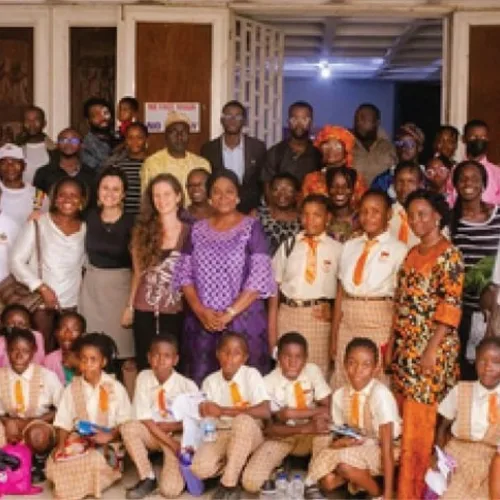
Scholars, students, artists, heritage enthusiasts, and members of the public in Ibadan gathered at the National Museum of Unity for a programme themed: “(Re)imagining Heritage, (Re)using the Museum: Research and Artistic Creation Projects.” This event, organised as part of the Nigerian Alternative Heritage Project and funded by the French Embassy, was implemented by the French Institute for Research in Africa (IFRA-Nigeria) in collaboration with the National Museum of Unity.
The programme began with an immersive guided tour of the museum galleries, introducing participants to creative reimaginings of traditional histories and sacred practices. The main highlight was the public presentation of projects developed by four teams of grant beneficiaries, all centered around the event’s theme. The audience enjoyed a range of creative expressions, including theatrical reenactments, video documentaries, digital animations, art installations, and augmented reality exhibitions, which provided insights into cultural continuity and collective memory. This was followed by a roundtable discussion.
In her opening remarks, Mrs. Oriyomi Pamela Otuka, Curator of the National Museum of Unity, described the event as an important initiative aimed at redefining the perception of museums as static repositories. She emphasized the museum’s role in transcending the mere preservation of artifacts behind glass cases to becoming active cultural spaces that vivify history, culture, and heritage in ways that impact contemporary society.
Dr. Pauline Guinard, Director of IFRA-Nigeria, positioned the programme as a vital initiative encouraging dialogue, creativity, and participation through alternative heritage projects. She underlined that cooperative efforts among researchers, artists, and cultural practitioners are essential methods of knowledge production that merit both scholarly attention and public engagement.
The presented projects included a stage play titled “Voices of the Sacred” by the Museum of Unity, Ibadan team; an animation called “Animating Artefacts” by Abibat Ibrahim and Sorple Sheed; a documentary titled “The Museum as a Performance Piece” by Avodele Olofintuade and Kehinde Awofeso; and a multimodal installation titled “The City Beneath,” which explored the concept of the night market as a metaphorical performance space within the museum, created by Mofeyiseke Bolaji, Neec Nonso, and Dikachi Ugwu.
The project contributors addressed the current disconnect where museum visitors often perceive artifacts as ordinary, silent objects due to a lack of historical context and the ongoing demonization of indigenous practices. They argued that technology and creative collaborations can dismantle these biases and bridge the gap between younger generations and ancestral narratives.
ALSO READ: Atiku unveils new subsidy model
The event featured a roundtable moderated by Dr. Pauline Guinard, involving representatives from each project team. This discussion focused on the development of research questions, data collection methods, project execution processes, the choice of output formats, and the impacts of each project. It transitioned into practical discussions and collaborative reflections, debating whether art can be used to challenge dominant political or historical truths and how to prevent artifacts from being “imprisoned” within static display cases.
An interactive session, moderated by Ms. Rafiat Adejoke Adetoro, followed the discussions, allowing participants to raise questions regarding cultural ownership, presentation and representation, alternative historical perspectives, ancestral identity, artistic truths, and the significance of traditional practices without active religious participation.
Throughout the program, it was emphasized that alternative heritage encompasses both tangible and intangible assets, integrating material culture, digital innovation, artistic interpretation, and academic research. Participants were encouraged to view the museum not just as an inherited building housing old items but as a dynamic cultural platform capable of contributing to contemporary discussions on identity, memory, and society.
Comments
Start the conversation about this story.