





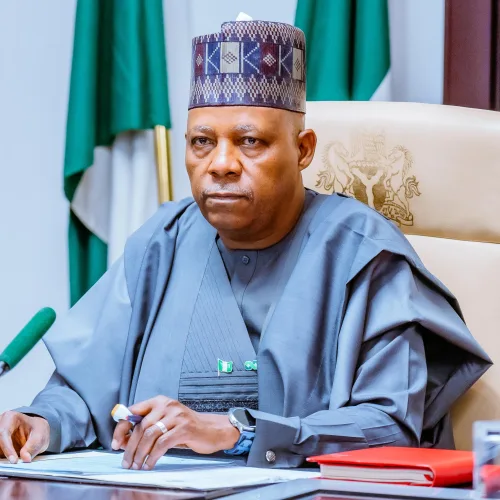
Vice President Kashim Shettima and Zamfara State Governor Dauda Lawal have called for proactive measures and stronger regional cooperation to address the growing humanitarian crisis across Africa.
The duo made the call at the United Town Agency for North-South Cooperation (UTA) International Humanitarian Award and Lecture held in Abuja, stressing the need to move beyond emergency responses towards prevention, recovery and long-term development.
Shettima, who was represented by the Director-General of the National Emergency Management Agency (NEMA), Zubaida Umar, said Nigeria’s humanitarian challenges could not be separated from developments across the Sahel, Lake Chad Basin, West Africa and the wider continent.
He urged African countries to work together to prevent crises before they escalate, noting that the continent must move beyond “condolences, camps, appeals and statistics” and develop systems that turn humanitarian concerns into concrete action.
“Early warning must also produce early action,” Shettima said, stressing the importance of information sharing among local leaders, traditional institutions, women, young people, humanitarian workers and security agencies.
According to him, regional peace remains critical to Nigeria’s national security, while regional prosperity can help tackle the conditions that fuel desperation and instability.
The Vice President also said President Bola Tinubu believes regional partnerships are essential to achieving global peace and shared prosperity.
Lawal, represented by his Chief of Staff, Mukhtar Lugga, disclosed that nearly 20 million people across West and Central Africa were forcibly displaced or stateless as of April 2026, with internally displaced persons accounting for more than 15 million.
He said the figures underscored the urgent need for African governments and humanitarian organisations to rethink how they respond to crises, particularly in the Sahel.
The governor argued that humanitarian action should go beyond providing immediate relief to people affected by conflict and displacement.
He said assistance must protect lives and dignity while providing food, water, shelter, healthcare, education, psychological support and protection for vulnerable groups, particularly women and children.
Lawal stressed that humanitarian intervention must also be linked to development, warning that prolonged dependence on emergency assistance would not adequately address the root causes and consequences of displacement.
He advocated a continuum of intervention involving immediate relief, early recovery, restoration of livelihoods, social protection, reconstruction and development.
Speaking from the experience of Zamfara, the governor said years of banditry and insecurity had resulted in displacement, loss of lives and property, destruction of livelihoods, disruption of education and increased pressure on health services.
Despite the challenges, he commended the people of the state for demonstrating resilience by continuing to farm where possible, educate their children and support one another.
Meanwhile, UTA Nigeria Country President, Abigail Amalaha, appealed for support towards the establishment of a humanitarian centre in Nigeria.
Comments
Start the conversation about this story.