






There is a tendency in Nigeria’s politics to treat awards to public officials as either political patronage or another opportunity for politicians to celebrate themselves. While sometimes, that suspicion is justified, not every award should be dismissed simply because the recipient is a politician.
This is especially so when the administration being celebrated can point to reforms across institutions, infrastructure, education, healthcare, agriculture, water supply, security and human capital development. Visible impact should give us reasons to pause and examine the record before dismissing the recognition.
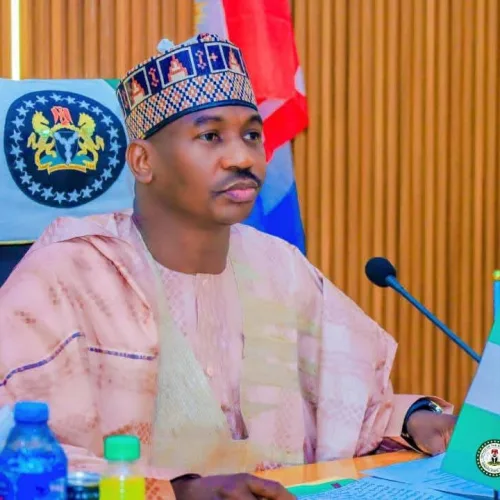
This is why the decision by Blueprint Newspapers to honour Sokoto State Governor, Dr Ahmad Aliyu, with its 2025 Good Governance and Institutional Renewal Award is not only deserved, but also a careful endorsement of the good work that’s going on in Sokoto state under the current administration.
The award recognises an administration that, since assuming office on May 29, 2023, has pursued its development programme through the 9-Point Smart Agenda. More importantly, many of the reforms are beginning to move beyond the usual political language of commissioning projects to actual interventions in systems that determine how government works and how citizens experience government.
As we know, a government can construct roads and still leave its institutions dysfunctional. It can commission hospitals without putting health workers in them. It can distribute agricultural inputs without addressing irrigation and mechanisation. It can recruit workers without improving public-sector productivity.
That’s not the case in Sokoto. The more interesting aspect, the contrast if you like, of the Aliyu administration is therefore not simply the number of projects being executed, but the attempt to combine physical infrastructure with institutional and human-capital interventions and governance.
Take the states civil service for instance. The recruitment of 3,000 personnel to take up positions in Civil Service is significant, particularly in a state where government remains one of the largest employers. But recruitment becomes meaningful only when it translates into better service delivery and that’s the current experience in Sokoto state.
It is still in pursuit of improved efficiency that the Aliyu administration’s push towards digital government and the adoption of Digital Public Infrastructure and the Nigeria Digital Gateway becomes relevant.
Gov. Aliyu understands that government reform should not stop at putting more people on the payroll. It should make government faster, more accessible, more transparent and less dependent on cumbersome paperwork.
The same thinking can be seen in land administration through the digitisation of the Sokoto State Geographic Information System. Modernising land records is not merely an ICT project. It is an institutional reform that can improve planning, reduce disputes, strengthen internally generated revenue and make property transactions more predictable.
While these may be viewed as less glamorous reforms, they are, more often the reforms that determine whether government actually works or not
Perhaps one of the most consequential decisions of the administration is the attempt to strengthen primary healthcare at the ward level. The recruitment of 2,440 Community Health Extension Workers, equivalent to 10 workers for each of the state’s 244 wards, is potentially more important to ordinary citizens than many of the grand projects that make newspaper headlines.
As we know, healthcare begins where people live. A mother in a remote community does not necessarily need another magnificent hospital in the state capital. She needs a functional primary healthcare centre, competent personnel, essential drugs and a system that can respond when her child falls sick or when she needs maternal care.
The administration has also invested in the rehabilitation of health facilities, maternal healthcare and the recruitment of nurses and midwives. The real test, however, will be sustainability: whether these facilities remain functional, adequately staffed and properly equipped beyond the political life of the current administration.
Education is another area where the deliberate reforms have attracted applause. The administration has placed substantial resources behind education, including school rehabilitation, teacher recruitment and training, instructional materials, scholarships and interventions targeted at improving access for girls and vulnerable children. The emphasis on infrastructure is important, but the greater challenge is ensuring that improved buildings translate into improved learning.
A classroom is infrastructure. A child who can read, write, calculate and compete with his peers is the real outcome. And, this is where the recruitment of teachers to man rural schools especially has been particularly praised as one of the most consequential interventions of the Aliyu administration.
Agriculture perhaps provides the clearest example of an administration trying to move beyond seasonal politics. As we know, Sokoto is an agrarian state, therefore, agricultural policy must go beyond distributing fertiliser every planting season. It is with this in mind that the Aliyu administration made the point of combining input support with irrigation, mechanisation and post-harvest interventions.
The 2025 agricultural season, for instance, saw the procurement of more than 105,000 bags of fertiliser and agrochemicals for subsidised distribution. More importantly, the administration has invested in irrigation schemes, including the 450-hectare Kware Irrigation Scheme, while supporting farmers with irrigation pumps, threshers, milling machines and other equipment.
This is the direction agricultural policy should take, and it’s no wonder that reform too has been singled out for praise recognition. It remains that, while fertilisers help farmers grow crops, Irrigation helps them farm beyond the rainy season, even ss mechanisation reduces drudgery, and processing equipment reduces post-harvest losses. In the end, it is access to markets determines whether farming becomes a business or a hubby. Investment in rural roads infrastructure is answering that question and opening up more business corridors.
In June 2026, the state government approved another N1.65 billion for fertiliser, improved seeds and agrochemicals, alongside further investments in healthcare and infrastructure all of which are combining to provide a wholesome government experience for the people of Sokoto state
Water supply is another area where the administration’s interventions have direct implications for citizens. Before the arrival of Gov. Aliyu, the water crisis in Sokoto was so dire that residents sometimes bring water from neighbouring states or must contend with buying gallons of water at insane prices.
Gov. Aliyu quickly set upon arresting the water crisis within the shortest possible time. The completion of major water schemes, including the 40-million-gallon water project, rehabilitation of intake facilities and expansion of distribution networks have helped to address or mitigate a problem that is often discussed in statistics but experienced personally by families every day.
Water is a global economic and social necessity. When water becomes available closer to homes, the benefit is not simply about hydration. It reduces the burden on women and children who spend valuable time searching for water and can improve sanitation and public health.
Every reforms and impact stated above notwithstanding, security remains the elephant in the room. Sokoto, like several North-west states, has had to govern under the shadow of banditry and rural insecurity. The creation of the Sokoto State Community Corps and increased support for conventional security agencies represent attempts to expand the state’s security architecture.
But here again, the ultimate measure is not the number of personnel recruited or vehicles purchased. It is whether farmers can return to their farms, communities can sleep peacefully and economic activity can resume in places previously paralysed by fear.
Do people feel safer today in Sokoto state because of deliberate security reforms brought by Gov. Aliyu? Absolutely. Yet, this is not to say that insecurity has completely abated, and it is also why the Blueprint recognition should not be interpreted as a declaration that everything is perfect in Sokoto.
But, it is an endorsements of the steps that have been taken, of the structures that have been put in place to help people feel safe again. Ultimately, ot is an acknowledgement of direction and measurable interventions.
Governor Aliyu, an accountant and public administrator who previously served as commissioner, deputy governor and pioneer Executive Secretary of the Nigeria Police Trust Fund, came into office with a background that naturally places emphasis on administration, finance and institutional management.
His challenge now is to ensure that the reforms become institutions rather than achievements attached to one administration. One of the clearest way to achieve this is through continuity, in this case, the re-election of Gov. Ahmed in 2027.
A case must also be made for the strengthening of monitoring and evaluation, publishing clearer performance indicators, improving transparency around project costs and completion, and ensuring that recruitment is driven by actual manpower needs rather than political considerations. It also means maintaining the discipline to complete projects before announcing new ones.
Awards are useful when they encourage governments to do more. They become dangerous when they become substitutes for accountability. For Governor Aliyu, therefore, the Blueprint award should not be the end of the conversation. It should increase the burden of expectation.
The people of Sokoto should demand more roads, but also better roads. More schools, but better learning. More hospitals, but better healthcare. More farmers’ support, but greater agricultural productivity. More civil servants, but a more efficient civil service. More security personnel, but safer communities. That is the real meaning of good governance.
And if Governor Aliyu can sustain the reforms, institutionalise the gains and convert today’s projects into tomorrow’s functioning systems, then the awards will eventually matter less than the legacy they were meant to recognise. For now, everyone agrees the recognition is deserved.
But the bigger prize remains a Sokoto where government works better, citizens live better and development continues even after the governor has left office. That is the standard by which every award-winning government should ultimately be judged.
…Kabiru writes from Sokoto
Comments
Start the conversation about this story.