





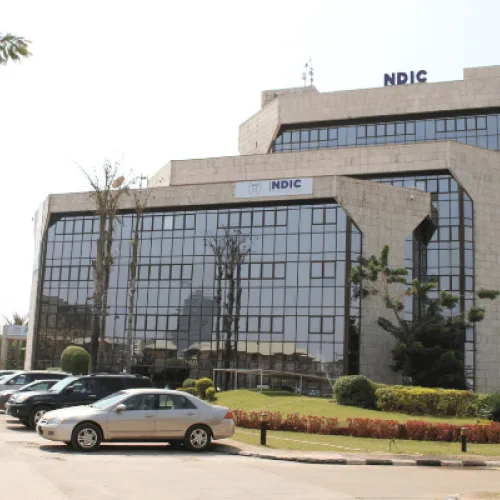
Stronger capital buffers following Nigeria’s banking sector recapitalisation exercise will not by themselves guarantee the stability of financial institutions without effective risk management, regulatory compliance and sound corporate governance, the Nigeria Deposit Insurance Corporation (NDIC) has said.
Thompson Oludare Sunday, managing director and chief executive officer of the NDIC, said the recapitalisation exercise, which concluded on March 31, 2026, was a positive development for the financial sector, but stressed that raising capital was only the first step towards ensuring the safety and soundness of banks.
He spoke at the capacity development programme for Management and Senior Staff in partnership with the Bureau of Public Procurement (BPP), held in Lagos, where he stressed the need for banks to complement stronger capital buffers with effective risk management, regulatory compliance and sound corporate governance.
According to Sunday, regulators must ensure that the additional capital raised by banks is deployed safely and prudently, with strong attention to risk management, compliance and corporate governance.
“The recapitalisation exercise, which concluded on March 31, 2026, is a positive development for the financial sector. Strong capital buffers are essential, but raising capital is only the first step,” he said.
“As regulators, our primary concern remains risk management, regulatory compliance, and sound corporate governance to ensure these funds are deployed safely and prudently.”
The NDIC’s position comes after the conclusion of the banking sector recapitalisation exercise, which was aimed at strengthening banks’ capital positions and enhancing their capacity to withstand financial and economic shocks.
Sunday said the NDIC’s supervisory role remained focused not only on the capital position of financial institutions but also on ensuring that banks operate within regulatory requirements and maintain appropriate governance and risk-management frameworks.
The NDIC chief also disclosed that the corporation had commenced payouts to depositors of the 46 microfinance banks whose licences were revoked by the Central Bank of Nigeria (CBN) on July 1, 2026.
He said guaranteed deposits were being paid seamlessly, with the NDIC collaborating with the Nigeria Inter-Bank Settlement System (NIBSS) and using Bank Verification Numbers (BVNs) to identify depositors and transfer funds directly into alternative bank accounts.
The process, he said, eliminates the need for affected depositors to visit NDIC offices for physical verification.
Sunday explained that licence revocation was considered a last resort after other resolution options had been explored.
He said the NDIC considers mechanisms including Purchase and Assumption agreements, bridge banks, liquidity support and management restructuring before revoking a financial institution’s licence.
“License revocation is strictly a last resort. The affected MFBs breached core terms of their operating licences, leaving revocation as the most viable measure to protect system integrity,” he said.
On failed banks, the NDIC chief said the corporation continued to pay depositors indefinitely, unlike jurisdictions where strict deadlines are imposed for claims.
He urged former customers of Heritage Bank, including former National Youth Service Corps members with small residual balances, to verify and collect their funds.
For Heritage Bank, whose licence was revoked on June 3, 2024, the NDIC said it had declared two liquidation dividends totalling 14.40 kobo per naira, representing a 14.4 percent recovery yield on uninsured deposits to date.
The corporation is continuing efforts to recover assets, including physical properties and collateral, as well as non-performing loans and other investments, while litigation and encumbrances affecting some assets are being resolved.
Sunday said recovered funds would be used to declare further liquidation dividends and pay uninsured depositors.
He said the long-term objective of the NDIC was to deepen public confidence in deposit insurance and ensure that depositors remained protected even when financial institutions failed.
“While institutional failures can occur, the NDIC exists to ensure that depositor funds remain fully protected whenever they do,” he said.


Hope Moses-Ashike is an Associate Editor, Banking and Finance, with more than a decade of experience reporting on Nigeria’s financial system and broader economy. She closely tracks market movements, monetary policy decisions, company disclosures, regulatory actions, economic indicators, and global developments, and interprets what they mean for businesses, investors, policymakers, and households. Her reporting helps readers understand complex issues such as inflation trends, foreign exchange market dynamics, interest rate decisions, bank performance, and investment risks. She also covers major international events and periodically travels to Washington, D.C., to report on the World Bank/IMF Spring and Annual Meetings. Her dedication to financial journalism has earned her multiple recognitions and invitations to high-level professional development programmes. She is an alumna of the International Visitors Leadership Programme (IVLP) in the United States and holds an Advanced Financial Journalism Certificate from the Press Association Training in London, UK. Her other notable achievements include completing the Lagos Business School CMC Programme, the Bloomberg Media Africa Initiative Programme, and a Master Class in Journalism at Rhodes University in South Africa.
Comments
Start the conversation about this story.