





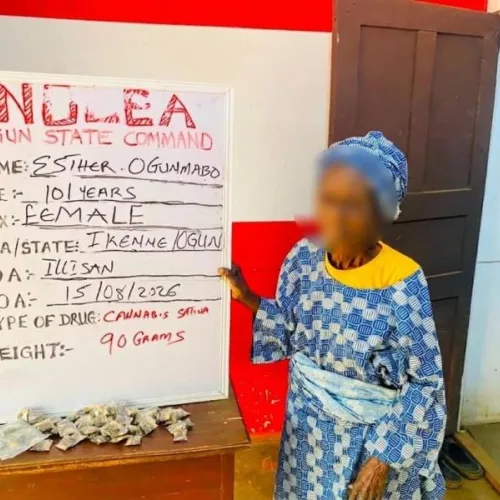
The arrest of a 101-year-old great-grandmother allegedly selling cannabis in Ogun State has exposed one of the more unusual faces of Nigeria’s illicit drug trade, but the case is only a small part of a much larger trafficking network being uncovered by the National Drug Law Enforcement Agency (NDLEA).
Across Nigeria, recent operations have revealed a drug supply chain stretching from forests and residential neighbourhoods to seaports and international maritime routes, with traffickers using everyday commodities and legitimate transport channels to conceal narcotics.
The NDLEA said its latest operations resulted in the seizure of thousands of kilogrammes of cannabis and other illicit substances worth billions of naira.
The 101-Year-Old Cannabis Seller
The agency said Esther Ogunmabo, 101, was arrested at Ilisan, Ogun State, on Saturday, August 15, after officers found 90 grammes of cannabis, known as skunk, packaged in retail sachets.
According to NDLEA spokesman Femi Babafemi, Ogunmabo admitted selling the drug to residents after her provisions shop was destroyed by fire.
She reportedly told investigators that a daughter living in Lagos supplied her with cannabis every four days, which she sold in small quantities.
The case points to a potentially wider question: whether vulnerable individuals are increasingly being used as low-level links in organised drug distribution networks.
The NDLEA said its chairman, Brig. Gen. Mohamed Buba Marwa (rtd.), ordered that the centenarian be granted bail and counselled because of her age. Her daughter was arrested in connection with the case.
Cocaine Hidden in Fufu
In Akwa Ibom, investigators uncovered another example of how traffickers are adapting concealment methods.
On Friday, August 21, operatives intercepted a wooden boat on the high seas allegedly transporting narcotics towards fishing settlements in Cameroon.
Three suspects were arrested. Among them was 27-year-old Kingsley Effiong John, who allegedly concealed 20 grammes of cocaine inside a large wrap of edible cassava flour, popularly known as fufu.
He was also found with 435 grammes of cannabis.
The total quantity of narcotics recovered from the three suspects was 42.622kg.
READ ALSO; NDLEA opposes bail for 10 suspects in ₦480bn Ogun forest meth lab case
The incident suggests that traffickers are exploiting informal maritime routes and legitimate food items to move drugs across borders, potentially complicating conventional detection methods.
Thailand-Nigeria Route Emerges
The most significant development, however, occurred at the Apapa and Lekki ports in Lagos, where the NDLEA intercepted two containers carrying cannabis indica, popularly known as Thai Loud.
The combined seizure weighed 1,490.5kg and was valued at more than N4.4 billion.
The agency described the seizure as its first interception of illicit drugs shipped from Thailand through the maritime corridor.
At Apapa Port, a container declared to contain dry fish, rice, vehicle spare parts, turmeric soap and inverter batteries was subjected to a joint examination by the NDLEA, Nigeria Customs Service and other agencies.
Investigators discovered 1,090.5kg of Thai Loud packed in 54 cartons containing 2,181 sachets.
At the Lekki Deep Sea Port, another container placed on the NDLEA watchlist was intercepted following monitoring by the agency’s Marine Special Operations Unit.
Four pallets contained 400kg of Thai Loud, concealed alongside 798 rims of A4 paper.
The two seizures raise questions about how international trafficking organisations are penetrating Nigeria’s increasingly busy maritime supply chains and whether existing cargo profiling systems are sufficient to identify sophisticated concealment methods.
In the Federal Capital Territory, NDLEA officers intercepted three waybill packages containing 24,410 tramadol capsules inside a Hummer bus travelling from Enugu to Zuba. A follow-up operation in Niger State led to the arrest of the alleged owner, 28-year-old Sunday Eze.
In Ondo State, the agency destroyed 10,000kg of cannabis cultivated across four hectares in Ijare forest, Ifedore Local Government Area.
Another operation at Ita-Ogbolu in Akure North recovered 210kg of cannabis and a Toyota Camry allegedly belonging to Sylvester Dibiagu Anthony, who remains at large.
In Kwara State, officers intercepted 1.325kg of methamphetamine and cannabis in a Toyota Starlet along the Ogbomosho-Ilorin Expressway, arresting 22-year-old Muhammadu Usman
What the Seizures Reveal
Taken together, the operations reveal a drug market operating at multiple levels—from elderly street-level sellers and family-linked distributors to organised maritime trafficking syndicates and large-scale cannabis cultivation.
The emergence of Thai Loud through Nigerian seaports is particularly significant because it suggests that international traffickers may be diversifying supply routes and exploiting legitimate cargo movements.
The use of fufu to conceal cocaine and paper products to mask cannabis also demonstrates the continuing evolution of concealment techniques.
READ ALSO; NDLEA arrests 49 suspects, seizes over 2.5 tonnes of illicit drugs in Edo
While seizures disrupt individual consignments, the larger challenge for law enforcement is identifying the financiers, importers, logistics operators and networks behind the shipments.
Marwa commended officers involved in the operations and urged the agency to maintain its approach combining enforcement with prevention, sensitisation and counselling.
The latest seizures therefore present both a success for Nigeria’s drug-control architecture and a warning: the country is confronting an increasingly sophisticated market in which narcotics can move through forests, families, highways, fishing boats and major international ports.
Comments
Start the conversation about this story.